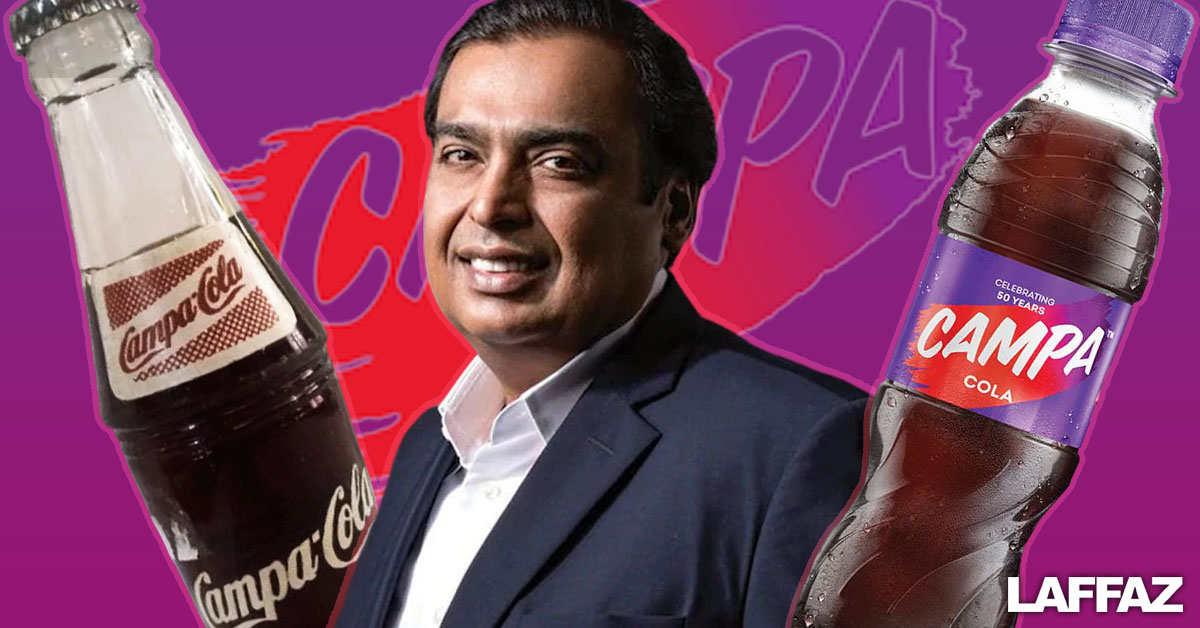
Campa Cola belongs to Reliance Industries Limited today. The conglomerate bought it from Pure Drinks Group in August 2022 for ₹22 crore — a relatively small bet for a company of Reliance’s scale, but one that Mukesh Ambani has since turned into a full-scale assault on Coca-Cola and PepsiCo‘s dominance in India’s soft drink market.
Campa Cola — Quick Facts
| Founded | 1977 |
| Original Founder | Charanjit Singh, Pure Drinks Group |
| Current Owner | Reliance Industries Limited (RIL) |
| Acquired By | Reliance Industries, August 2022 |
| Acquisition Price | ₹22 crore (approx. $2.6 million) |
| Relaunched | March 2023 |
| Headquarters | New Delhi, India |
| Category | Carbonated soft drinks (cola, lemon, orange) |
| Key Competitors | Coca-Cola, PepsiCo, Thums Up |
Campa Cola’s Original Owner and History
The brand’s origins go back to a political decision that reshaped India’s soft drink market overnight. In 1977, the Morarji Desai government expelled Coca-Cola from India after the company refused to share its secret formula with the government. At the time, Coca-Cola was manufactured in India by the Pure Drinks Group, owned by Charanjit Singh. The expulsion put more than 2,800 jobs at risk.
Singh’s response was to create something new. He launched Campa Cola that same year, filling the vacuum Coca-Cola had left behind. For roughly a decade and a half, the brand dominated — most Indian households in the 1970s and 1980s knew no other cola. Campa Orange was especially popular, and the brand held its own in most regions of the country without any foreign competition to contend with.
That changed in 1991. The Manmohan Singh government’s economic liberalisation opened Indian markets to foreign investment, and Coca-Cola came back. Pepsi arrived around the same time. Campa Cola, without the capital or distribution muscle to compete, steadily lost ground. By the 2000s, it had become a regional footnote — still available in parts of Haryana, but largely forgotten everywhere else.
Reliance’s Acquisition: How and Why
Reliance picked up the Campa brand in August 2022 for ₹22 crore. The deal went through Reliance Consumer Products Ltd (RCPL), a subsidiary of Reliance Retail Ventures. Seven months later, on March 9, 2023, Reliance officially relaunched three variants — cola, orange, and lemon — initially through its Reliance Mart stores.
Reliance has since expanded Campa’s presence beyond India — launching Campa Cola in the UAE and securing IPL sponsorship, and more recently partnering with racing driver Ajith Kumar for its Campa Energy brand.
Why Campa, specifically? A brand that had sat dormant for decades gave Reliance something it could not easily buy elsewhere: recognition. Among Indian consumers aged 35 and above, Campa Cola carries genuine nostalgia. Reliance did not need to build awareness from scratch — it just needed to resurrect it. Pair that with Reliance’s existing retail footprint, cold chain infrastructure, and manufacturing scale, and the low acquisition cost starts to look like a calculated undervaluation rather than a bargain.
There was also a tailwind from an unexpected direction. The Israel-Palestine conflict of 2023–24 renewed consumer-led boycotts of American brands across India. Campa, positioned as a homegrown alternative, benefited from a wave of sentiment that no amount of marketing spend could have manufactured.
Pricing Strategy: How Campa Is Taking On Coca-Cola and PepsiCo
Reliance priced Campa Cola’s 200ml bottle at ₹10. A comparable 250ml PET bottle from Coca-Cola or PepsiCo costs ₹20. That ₹10 gap does not sound dramatic in isolation, but at the volume India’s beverage market operates — billions of units annually, concentrated in price-sensitive rural and semi-urban markets — it translates into serious pressure on both American companies.
On the ground, the impact was visible fastest in West Bengal. A Coca-Cola distributor in the Eastern region put the market share shift bluntly:
“The price points of Campa are making an impact on the ground. Coca-Cola and Pepsi have lost some market share in West Bengal. Our estimates suggest that Campa has gained a 2% market share in the non-alcoholic beverage segment in the region.”— says a Coca-Cola distributor from Eastern India
Coca-Cola’s first response was not to cut prices — it was to protect shelf presence by increasing retailer margins in select markets. In Kerala, ahead of Onam, the company moved aggressively on trade terms. A distributor in the state described what that looked like in practice:
“Retailers will only promote those brands for which they get good margins. Usually, Coca-Cola used to offer 2.5-litre bottles (MRP is INR 100) to retailers at INR 75. But this time, before Onam, they reduced it to INR 65. This seems to be due to the entry of Campa in the market.”— said a Coca-Cola distributor from Kerala
PepsiCo, through its India bottling partner Varun Beverages, took a different line. During an earnings call, the company indicated it was weighing a range of lower-priced packs aimed squarely at the markets where Campa was gaining traction. Neither Coca-Cola nor Reliance commented officially when approached; PepsiCo also declined.
The Jio Playbook, Applied to Beverages
Anyone who watched what Reliance did to India’s telecom market between 2016 and 2019 will find the Campa strategy familiar. Jio entered with free calls and data at a price point no existing operator could match without gutting their margins. Within three years, it had roughly 40% of the market. Vodafone and Idea merged out of necessity. Others exited.
Distributors in South and East India have not missed the parallel. One was direct about what Reliance is doing on the ground:
“Reliance is carrying out vigorous promotional activities on the ground for Campa and aggressively trying to get distributors. They want to do the same thing they did with Jio.”— adds the Coca-Cola distributor from Eastern India
Beverages are not telecom. The margin dynamics are different, cold chain logistics are harder, and brand loyalty in soft drinks tends to run deeper than in data plans. Some distributors questioned openly whether Campa’s pricing could hold long-term without sustained cross-subsidisation from Reliance’s other businesses. Whether it can or not, the disruption is already underway.
Campa Cola: Owner, Founder & Company — Frequently Asked Questions
Who owns Campa Cola?
Campa Cola is currently owned by Reliance Industries Limited, headed by Mukesh Ambani. Reliance acquired the brand in August 2022 for ₹22 crore from the Pure Drinks Group.
Who founded Campa Cola originally?
Campa Cola was founded by Charanjit Singh of the Pure Drinks Group in 1977, after the Morarji Desai government expelled Coca-Cola from India for refusing to share its secret formula.
Who is the current owner of Campa Cola?
The current owner is Reliance Industries Limited (RIL). Reliance relaunched the brand in March 2023 through its consumer products subsidiary, RCPL, targeting the Indian beverages market.
What is Campa Cola’s price compared to Coca-Cola and Pepsi?
Campa Cola’s 200ml bottle is priced at ₹10. A 250ml PET bottle from Coca-Cola or PepsiCo costs ₹20 — Campa undercuts both by ₹10–20 across most pack sizes.
When did Reliance acquire Campa Cola?
Reliance Industries wrapped up the deal in August 2022, shelling out ₹22 crore to the Pure Drinks Group. Pure Drinks had held the brand since its inception back in 1977.
What happened to the original Campa Cola owner?
Pure Drinks Group, established by the Singh family, watched as Campa Cola’s fortunes plummeted when Coca-Cola and PepsiCo returned to India after the 1991 liberalization. When Reliance acquired the brand in 2022, its reach had shrunk considerably, with only a limited presence outside of Haryana.