For more than a century, The Washington Post stood as one of America’s most influential newspapers — a publication synonymous with investigative reporting, political accountability, and the defining journalism moments that shaped modern U.S. democracy.
The $250 Million Rescue That Looked Like Salvation
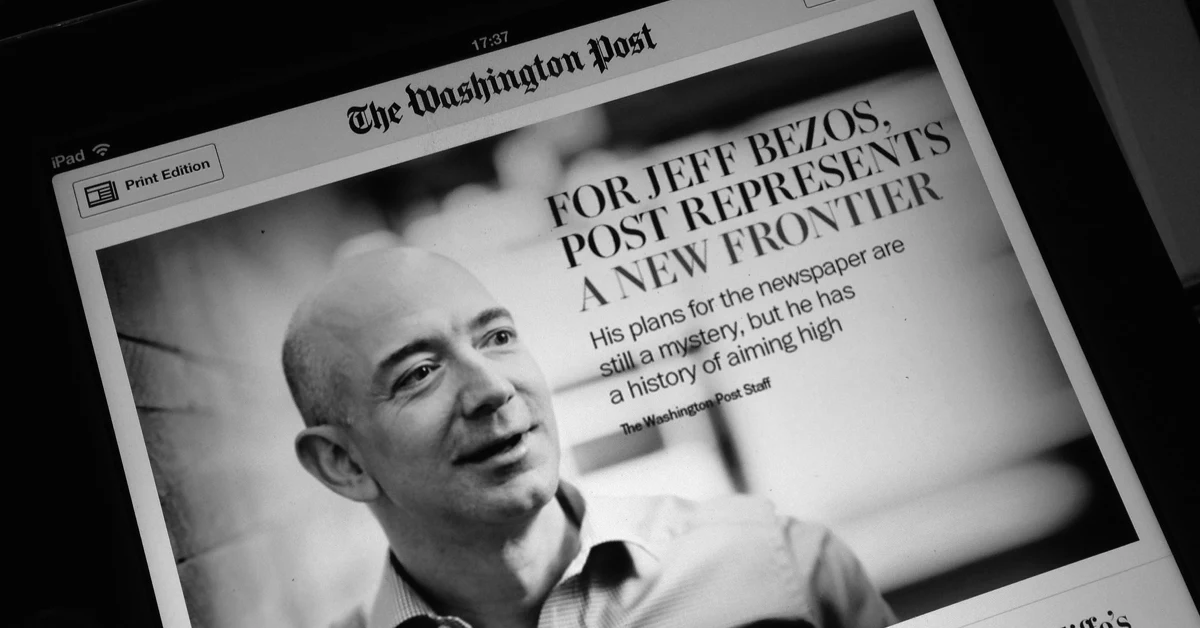
When Jeff Bezos purchased The Washington Post in 2013, the deal was widely framed as a rescue mission. The historic newspaper had been struggling with collapsing print advertising revenue, declining circulation, and an uncertain digital future. Many analysts believed the paper needed a deep-pocketed owner willing to invest long term rather than demand immediate profit.
Bezos appeared to be exactly that owner.

Unlike traditional media buyers, he arrived with a reputation for patient growth, technological experimentation, and a willingness to absorb losses while building future infrastructure. Early signals suggested the strategy was working. The Post expanded its newsroom, hired aggressively, strengthened investigative reporting teams, and invested heavily in engineering-led digital publishing tools.
Internally, the transformation was framed not as cost-cutting but as reinvention.
The Digital Growth Machine
Under Bezos, The Post pivoted from a regional political newspaper into a national digital subscription powerhouse.
The company built a modern publishing platform, optimized headlines and distribution for online audiences, and embraced audience analytics in editorial planning. The newsroom scaled its national politics, technology, and investigative coverage to attract readers far beyond Washington.
The strategy paid off.
Between 2016 and 2020, digital subscriptions surged dramatically as political polarization and nonstop news cycles drove audience engagement. The paper became one of the fastest-growing subscription news organizations in the United States, often cited as proof that legacy journalism could survive the internet era.
For a time, Bezos was widely credited not just with saving The Post — but with building the blueprint for modern digital newspapers.
The End Of The “Trump Bump”
But the growth curve did not last.
After the 2020 election cycle, audience urgency around daily political coverage began to soften. Across the industry, subscription growth slowed. News fatigue increased. Consumers increasingly shifted toward independent newsletters, creator-driven commentary, podcasts, and video platforms.
The Washington Post was not immune.
Reports began surfacing of missed subscriber targets, internal revenue pressure, and the need to rethink cost structures. Newsroom buyouts and staffing reductions followed after years of expansion. Leadership restructuring created further uncertainty inside the organization.
What had once looked like unstoppable digital momentum suddenly resembled the same structural challenges facing nearly every major news publisher.
When A Newspaper Becomes A Tech Product
One of the most consequential shifts of the Bezos era was philosophical rather than financial.
Historically, major American newspapers operated primarily as civic institutions supported by advertising and subscription income. Under Bezos, The Post increasingly resembled a technology-driven subscription platform where growth metrics, engagement data, and retention strategies became central to business planning.
Editorial independence remained formally intact. Yet the operational mindset changed.
Audience dashboards, experimentation with story formats, and aggressive national scaling reflected a Silicon Valley-style growth philosophy. Journalism was still the core product — but it was now managed inside a system built for measurable digital performance.
Supporters argue this modernization was necessary for survival.
Critics counter that it subtly transformed newsroom culture, shifting attention toward scale, traffic strategy, and subscriber conversion priorities.
The Billionaire Ownership Question
Bezos’ ownership also placed The Washington Post at the center of a broader global debate: can ultra-wealthy technology founders credibly own major accountability-driven news organizations?
As the founder of one of the world’s most powerful corporations, Bezos himself frequently appeared in national political discussions involving antitrust scrutiny, labor conditions, taxation policy, and corporate regulation.
Even without evidence of editorial interference, the optics alone created ongoing public debate about perceived conflicts of interest.
In modern media, trust is shaped not only by reporting accuracy but by institutional perception. Ownership structures increasingly influence how audiences interpret newsroom independence.
For some readers, billionaire ownership represented financial stability.
For others, it represented structural vulnerability.
Identity Drift Inside A Changing Industry
Another subtle but important transformation involved the newspaper’s institutional identity.
For decades, The Washington Post’s authority stemmed from its deep integration with Washington’s political ecosystem and its reputation for investigative reporting tied closely to the capital’s power structure.
During the Bezos era, the paper expanded aggressively into broader national coverage, lifestyle verticals, global analysis, and subscription-driven general interest reporting.
The expansion increased reach but also pushed the organization into direct competition with other national subscription giants rather than maintaining a uniquely Washington-centered positioning.
Some media analysts argue this widened audience strategy strengthened business resilience.
Others believe it diluted the paper’s historic editorial personality.
The Reality Facing All Newsrooms
It would be simplistic to attribute every challenge at The Washington Post to its owner.
The entire journalism industry faces profound structural disruption. Print advertising has collapsed globally. Social media platforms dominate distribution economics. Younger audiences increasingly consume news through video creators and personalized feeds rather than traditional newspaper brands.
Even highly respected digital-native publications have faced layoffs, closures, or stalled growth.
From this perspective, Bezos may have delayed a far steeper decline by injecting capital, technical expertise, and strategic patience at a critical moment in the paper’s history.
Without that intervention, the organization’s trajectory in the mid-2010s could have been far worse.
So Did Bezos “End” The Washington Post?
The answer depends entirely on what one believes The Washington Post was supposed to be.
If the ideal version was a family-owned civic newspaper rooted primarily in Washington politics and insulated from technology-sector ownership, then that version effectively ended the day the acquisition closed.
If the goal was institutional survival in a collapsing print economy, then Bezos arguably preserved the organization by transforming it into a scalable digital-first media company.
The Post still breaks major investigative stories. It still shapes national political coverage. It still commands millions of readers.
But culturally, operationally, and strategically, it is no longer the same institution that existed before 2013.
Jeff Bezos did not shut down The Washington Post.
He rebuilt it for a different media era.
Whether that counts as saving it — or ending the version people once trusted — remains one of the defining journalism debates of the 21st century.