Have you ever noticed how two organisations can run similar projects but achieve very different results simply because they follow different project approaches? Many teams face this decision at the planning stage. They must choose a PRINCE2® Certification that keeps work organised and progress clear. This is where the debate around PRINCE2 vs Waterfall often begins.
Many professionals explore structured frameworks while building their knowledge through PRINCE2® Certification, which introduces a controlled and stage based way of managing projects. Others rely on traditional methods, such as the Waterfall model, that follow a fixed sequence of activities. Both approaches aim to bring order to project delivery, but the way they guide teams can lead to very different outcomes.
In this blog, we explore what happens when organisations choose between these two approaches.
Choosing the Right Project Approach for Organisational Success
Organisations rarely select a project approach randomly. The complexity of the project and the degree of control required frequently determine whether to use Waterfall or PRINCE2.
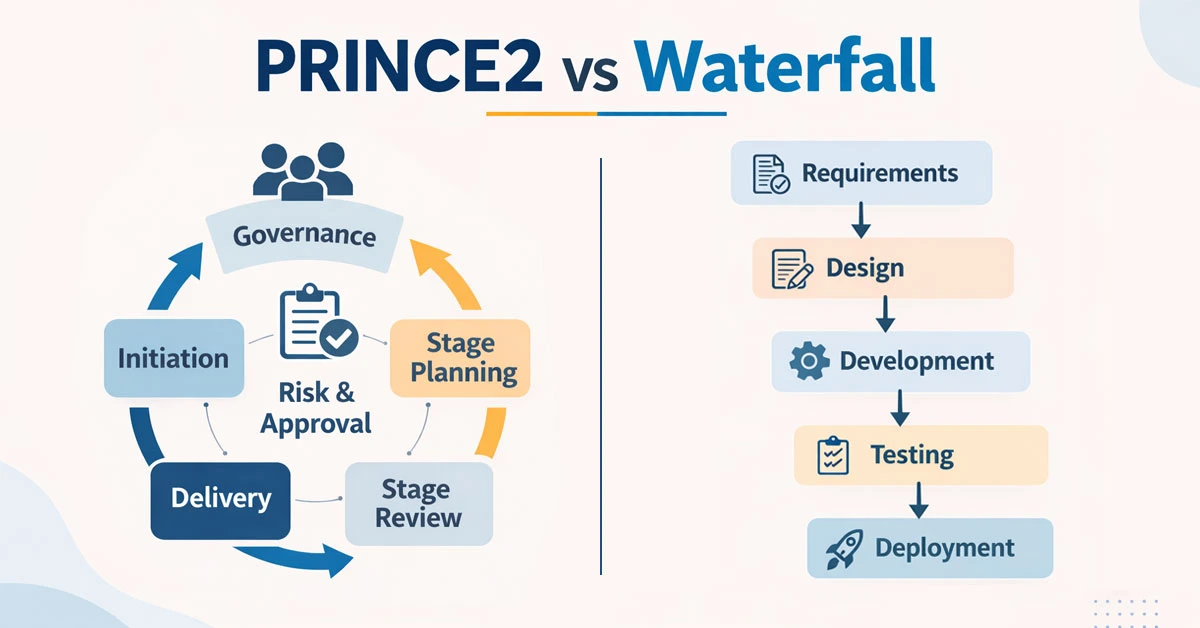
The structure of the Waterfall is linear. Every level doesn’t start until the preceding one is complete. A clear roadmap is produced as a result. Teams are aware of what has to be provided and when. When project needs are consistent and unlikely to change, it performs well.
PRINCE2 adopts a slightly different approach. It emphasises tight governance and regulated stages. Before proceeding, teams assess their progress at each stage. This enables leaders to reevaluate risks and make necessary adjustments to decisions.
Organisations frequently have greater visibility into project performance as a result of this arrangement. Decision-makers can act quickly if issues arise because they remain informed.
Organisations can improve their capacity to manage complicated projects by using PRINCE2® Certification expertise among their teams. Teams acquire skills in role organisation, risk management, and project alignment with corporate objectives.
How PRINCE2 and Waterfall Shape Project Delivery
The choice between Waterfall and PRINCE2 affects more than just planning. It influences how groups interact and uphold accountability throughout the project. Below are the key ways PRINCE2 vs Waterfall influence how organisations plan and deliver projects:
Project Control and Governance
Waterfall emphasises sticking to the original idea. Changes are frequently challenging to implement once the project has started. For infrastructure or building projects where requirements do not change, this can be effective.
PRINCE2 places a strong emphasis on supervision and governance. Reviews and permissions are part of every step. Organisations are able to keep strict control while still making necessary adjustments because of this structure.
Managing Risks and Uncertainty
Seldom do projects turn out exactly as planned. Because Waterfall relies so largely on early preparation, it may struggle when new risks arise.
PRINCE2 uses frequent stage reviews to address risk management. At every level, teams assess commercial value, risks, and progress. This guarantees that initiatives will continue to provide value over the course of their existence.
Clarity in Roles and Responsibilities
Waterfall frequently prioritises duties over governance responsibilities. Teams adhere to a methodical procedure that dictates the sequence of tasks.
Project managers and members of the project board are examples of specified roles introduced by PRINCE2. This framework guarantees that decisions are taken at the appropriate level and enhances responsibility.
Flexibility in Complex Projects
Complex projects frequently change over time. Because the framework is predicated on the idea that needs will not change, the Waterfall model can struggle in these kinds of situations.
At the conclusion of each step, PRINCE2 enables businesses to reevaluate their priorities. Teams can adapt to shifting business requirements while still keeping tight control because of this flexibility.
Long Term Organisational Impact
The decision between Waterfall and PRINCE2 might affect an organisation’s level of project management maturity.
For projects that are predictable, the Waterfall model may facilitate simple delivery. On the other hand, companies that implement PRINCE2 frequently see improvements in project and strategy alignment and clearer reporting.
This methodical approach eventually aids businesses in creating a culture where projects are handled consistently and responsibly.
Conclusion
Selecting between PRINCE2 vs Waterfall is not simply a technical decision. It reflects how organisations want to manage projects and strategic outcomes. Waterfall provides simplicity when requirements remain fixed. PRINCE2 introduces stronger governance and stage based oversight.
Professionals who understand these approaches can guide organisations toward better project outcomes. Building deeper knowledge through PRINCE2 Training can help teams strengthen planning and leadership across complex projects.