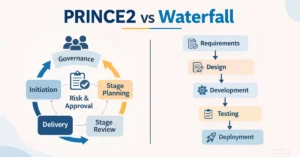
Have you noticed how some projects feel calm and predictable while others feel rushed and unclear? PRINCE2® Courses often introduce professionals to a way of working that brings order to project activity from day one. When teams understand the Benefits of PRINCE2, they begin to see why organisations rely on it for structured delivery. It is not about complexity. It is about clarity. This approach gives projects a steady rhythm and visible progress that stakeholders can trust at every stage.
In this blog, you will explore why organisations prefer PRINCE2 for structured project delivery and how it delivers consistent project outcomes.
Reasons Organisations Choose PRINCE2 for Structured Project Management
Below are the key reasons organisations choose PRINCE2 for structured project management:
Structured Framework from Start to Finish
Teams are guided by a structure with distinct phases and roles from the start of the project to its completion. Everyone knows what has to happen and when it should happen.
This arrangement avoids misunderstanding and prevents duplicated effort. Teams do not guess their next step. They adhere to a predetermined course that maintains control and consistency throughout the project lifespan.
Improved Control and Governance Through Clear Decision Points
Planned review points facilitate governance. PRINCE2 introduces stage limits and tolerances that allow managers to track progress without constant meddling.
This strategy is known as management by exception. Leaders step in only when limitations are breached. This keeps oversight robust while enabling teams to deliver work confidently within defined parameters.
Proactive Risk Management That Protects Project Outcomes
Risk is not regarded as an afterthought. It is detected, assessed, and controlled from the beginning. Teams are urged to look ahead and prepare responses before difficulties grow.
Because of this early emphasis, issues are reduced before they impede delivery. This proactive attitude towards risk is something organisations value the most.
Enhanced Communication Through Defined Roles and Responsibilities
Poor communication is a common reason why projects fail. PRINCE2 fixes this by making roles clear. Everyone knows who is in charge of making decisions and reporting on progress.
This clarity makes it easier for stakeholders to get involved. There is more meaning in meetings. Things go smoothly because everyone knows what their job is and there is no overlap.
Scalability and Flexibility for Any Project Environment
Not all projects are the same. Some are little and simple. Others are vast and complex. Without sacrificing its framework, PRINCE2 can be modified to accommodate both.
It also works well alongside Agile and other delivery methodologies. This flexibility allows businesses to adjust the method to their environment while still deriving substantial value from it.
Standardisation That Creates a Common Project Language
When teams share the same terminology and structure, collaboration becomes easier. PRINCE2 creates a shared knowledge across departments and even across enterprises.
This uniformity reduces misunderstandings. New team members rapidly understand how the project functions because the methodology is familiar and consistent.
Proven Success with Higher Project Delivery Confidence
Because PRINCE2 operates in real-world settings, it is widely acknowledged. Businesses that use it frequently report having more control over deadlines and scope.
This proven success increases confidence among stakeholders. Teams feel supported by a process that has generated outcomes across sectors and project kinds.
Quality Checks That Keep Deliverables Reliable
Teams are encouraged under PRINCE2 to establish quality standards prior to starting work. Everyone can better comprehend what is good for each deliverable when there are clear acceptance criteria.
Errors are kept from progressing to later levels by conducting regular quality assessments. This keeps standards high and lowers the need for rework near project completion.
Learning from Experience to Improve Future Projects
Every project delivers lessons. PRINCE2 guarantees that these lessons are documented and examined for future reference. Teams do not repeat the same mistakes again.
This learning habit leads to ongoing progress. Organisations become better at delivery because expertise is carried forward from one project to the next.
Conclusion
Structured delivery is not an accident. It occurs when groups employ a strategy that gives their work regularity and clarity. Organisations may accomplish this without needless complication thanks to PRINCE2. For professionals aiming to understand this approach in practical depth. Learning with The Knowledge Academy, a trusted global training provider, can build the confidence needed to apply PRINCE2 effectively in real project environments.