When Aman Gupta announced OffBeat Studios’ ₹100 crore seed round this week, the name that caught most people’s attention wasn’t his. It was Bessemer Venture Partners — the American VC firm that led the round before OffBeat has a product, a business model, or even a disclosed team.
For those tracking India’s startup ecosystem closely, the move wasn’t surprising. It was very on-brand for Bessemer. The firm has spent nearly two decades writing early cheques to Indian founders that most of the market wasn’t ready to take seriously yet — and then watching those bets become the names everyone knows.
But Bessemer’s India story is one of the least-written chapters in Indian startup journalism. The firm doesn’t shout. It doesn’t dominate headlines the way Sequoia (now Peak XV) or Accel do. And yet, the portfolio it has quietly assembled — Swiggy, BigBasket, Urban Company, Perfios, Livspace, Medi Assist — is a roll call of companies that redefined how India shops, eats, finds help at home, and manages its health.
So who exactly is Bessemer in India, who runs the money, and why does a firm with this kind of track record bet on conviction over proof?
Nearly two decades in Bangalore, before it was obvious
Bessemer Venture Partners is one of the oldest venture capital firms in the world. Its roots go back to 1911, when Henry Phipps Jr. — a co-founder of Carnegie Steel — set up Bessemer Trust to manage his family’s wealth. What eventually emerged from that was a venture firm with more than $18 billion in assets under management, over 145 IPOs in its global portfolio, and names like Shopify, LinkedIn, Canva, and Anthropic on its cap table.
Bessemer opened its India office in Bangalore in 2006. For the next fifteen years, it backed Indian startups out of its global fund — not a dedicated India vehicle — and kept its local team intentionally small. That was a deliberate choice, not an oversight. While peers like Sequoia and Accel were deploying aggressively through India’s startup boom years of 2012 to 2021, Bessemer held back, invested selectively, and moved patiently.
The strategy had a real cost — Bessemer missed some big wins during those boom years. But it also meant that when the money came back, it came back faster. Compared to Peak XV, which has raised $10.5 billion and returned $7 billion, and Accel, which has raised $3 billion and returned $1 billion, Bessemer’s proportional cash returns to LPs have been faster than both — a rare achievement in a market where investors routinely complain about slow exits.
That slow-build approach changed in 2021, when Bessemer raised its first dedicated India fund of $220 million. Then, just last month — in March 2025 — it closed its second India fund at $350 million, which was reportedly oversubscribed before they capped it.
The two partners running the India bet
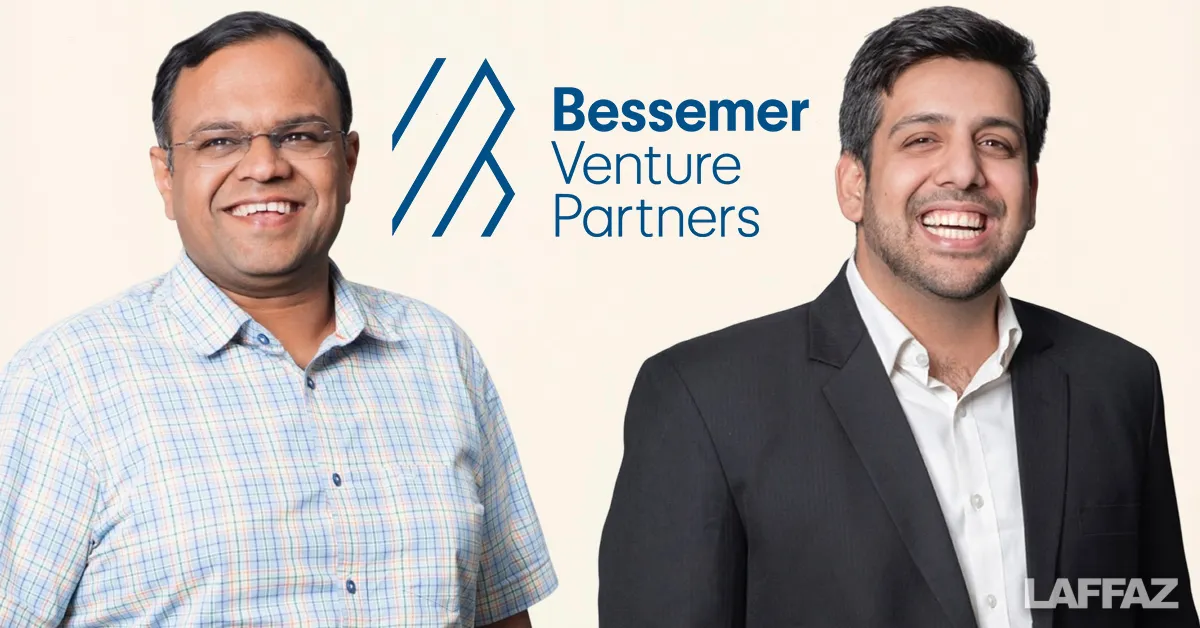
Understanding Bessemer’s India strategy really means understanding two people: Vishal Gupta and Anant Vidur Puri. They are the partners who run the Bangalore office, sit on the boards of Bessemer’s India companies, and have been the human infrastructure behind almost every major India deal the firm has done.
Vishal Gupta has been with Bessemer since 2006 — the same year the India office opened. Before that, he worked in the treasury department at the Reliance Group. He holds an MBA from IIM Calcutta, is a chartered accountant, and is, somewhat improbably, also a member of Mensa and a former nationally-ranked table tennis player. His investment record in India reads like a greatest hits of the country’s consumer internet era: Swiggy, BigBasket, Urban Company, Livspace, Medi Assist, NephroPlus, Perfios, and PharmEasy, among others.
Anant Vidur Puri joined Bessemer as an analyst in 2014, left for Harvard Business School, and came back in 2018 as a full-time investor. He is an IIT Delhi electrical engineering graduate who worked at Boston Consulting Group before turning to venture capital. He was promoted to Partner after leading two of Bessemer’s biggest India wins — Swiggy and Urban Company. His Swiggy origin story has since become something of a VC folklore piece in Indian startup circles.
“Anant has played an instrumental role in sourcing breakout successes including consumer internet leaders, Swiggy and Urban Company, two portfolio companies which are now worth $6 billion and $2.1 billion, respectively.” — Vishal Gupta, Partner, Bessemer Venture Partners, on Anant Vidur Puri’s promotion as a Partner
The Swiggy story itself is worth telling. Anant’s flatmate mentioned a new food delivery company. The founder showed up at their doorstep with the food himself and started asking questions about the service. Anant was intrigued enough to accompany Swiggy riders on actual deliveries to understand the product. He saw signs of unusual customer love — and invested at Series B, when Swiggy was the 60th company trying to crack food delivery in India. The rest is now listed on the NSE.
What Bessemer’s India portfolio actually looks like
Across nearly two decades, Bessemer has backed over 80 startups in India. The portfolio spans consumer internet, fintech, healthtech, SaaS, and direct-to-consumer brands. Nine of those companies have gone public — a strong exit record by any measure.
The marquee names from the broader portfolio include Swiggy (NSE: SWIGGY, listed November 2024), Urban Company (NSE: URBANCO, listed September 2025), BigBasket, Livspace, Perfios, Medi Assist (NSE: MEDIASSIST, listed January 2024), NephroPlus (NSE: NEPHROPLUS, listed December 2025), Bharat Matrimony, and PharmEasy. From its first dedicated India fund, Bessemer backed Boldfit, MoveInSync, Pepper Content, Shopdeck, Vetic, and Zopper.
The second fund — $350 million closed in March 2025 — is focused on AI-enabled services, SaaS, fintech, digital health, direct-to-consumer brands, and cybersecurity. Investment sizes range from $5 million to $40 million per company, with early-stage bets being the clear priority. More than 80% of Bessemer’s India investments over the past five years have been at the seed or Series A stage.
The “roadmap” approach — and why it explains the OffBeat bet
The most distinctive thing about how Bessemer operates is something they call a “roadmap-driven” investment approach. Rather than reacting to deal flow, the partners build detailed internal theses about where entire industries are heading — and then look for founders building in that direction, often before the market agrees with them.
Anant Vidur Puri has articulated this publicly more than once. The firm’s past India roadmaps correctly anticipated the mobile internet wave (Swiggy, Urban Company), the formalisation of India’s financial infrastructure (Perfios, Medi Assist, IEX), and the healthtech opportunity (NephroPlus, MediBuddy). The new fund’s roadmap is oriented around AI as the next infrastructure layer — and consumer brands as one of the primary categories being disrupted by it.
“India is at the forefront of the AI-driven transformation, with founders building domestic as well as globally-competitive businesses across enterprise software, fintech, and consumer technology. As AI adoption accelerates, we see immense opportunities for innovation, and this fund allows us to back entrepreneurs shaping the next phase of India’s digital economy.” — Anant Vidur Puri, Partner, Bessemer Venture Partners
Read that against Aman Gupta’s own words when he announced the OffBeat Studios raise, and the fit becomes obvious. Gupta said he was looking for partners who could help him “leverage technology and AI, because that’s where the future lies.” Bessemer’s current India roadmap is essentially built around that exact intersection — AI meets consumer behaviour, at scale, in India.
This is also why the absence of a product at OffBeat Studios is not a red flag from Bessemer’s perspective. They have been in this position before. Their Swiggy bet was placed when food delivery was a graveyard of failed startups. Their Urban Company bet was placed when gig-economy home services were considered unscalable. The roadmap told them the opportunity was real. The founder told them who could execute it. The cheque followed.
“We back founders who see around corners. Aman saw how a new India would come to think about aspiration, identity, and quality, and built boAt as proof. He is now applying that same instinct to a market being reshaped by AI and by a generation with entirely new expectations. That is exactly the intersection Bessemer exists to back.” — Anant Vidur Puri, Partner, Bessemer Venture Partners
What this means for Indian founders
For most Indian founders, Bessemer has historically been harder to access than Sequoia or Accel simply because it is less visible. The firm doesn’t run high-profile founder communities or dominate panel stages at startup conferences. Its partners are respected but not omnipresent. The Bangalore office is lean by design.
But the $350 million second fund changes the calculus. Bessemer has more capital to deploy in India than at any point in its history, it is deploying it faster than before, and its stated focus — AI, consumer brands, fintech, digital health — maps almost exactly to where the most interesting early-stage companies are being built right now.
Vishal Gupta put it plainly when the second fund was announced:
“This fund deepens our commitment to India’s startup ecosystem as we continue backing the next generation of entrepreneurs building technology-led businesses. We remain focused on identifying and investing in founders who are driving innovation, solving complex challenges, and building market-defining companies.” — Vishal Gupta, Partner & Managing Director, Bessemer Venture Partners India
The OffBeat Studios deal is the first public signal of how that second fund will be deployed. It is a seed cheque, written to a founder with no product yet, on the basis of track record, instinct, and a shared thesis about where Indian consumer behaviour is heading. For Bessemer, that is not a departure from form. It is exactly how they have always operated — quietly, patiently, and usually right.