Something extraordinary is happening in cryptocurrency.
The loudest warnings about its future are no longer coming from regulators, banks, or critics.
They’re coming from inside the industry itself, and they point to a contradiction:
The technology built to remove intermediaries is becoming too complex for anyone to fully understand.
And that’s only part of the story.
There’s another, even more dramatic layer: quantum computing could one day break the cryptography protecting millions of dormant Bitcoin wallets, including coins tied to Satoshi Nakamoto.
Complexity is Already a Threat to Decentralization
Vitalik Buterin, co‑founder of Ethereum Foundation, has repeatedly stressed that comprehensibility is central to trustlessness:
“An important and underrated form of trustlessness is increasing the number of people who can actually understand the whole protocol from top to bottom.”
He warned that excessive engineering risks concentrating power:
“Ethereum needs to get better at this by making the protocol simpler.”
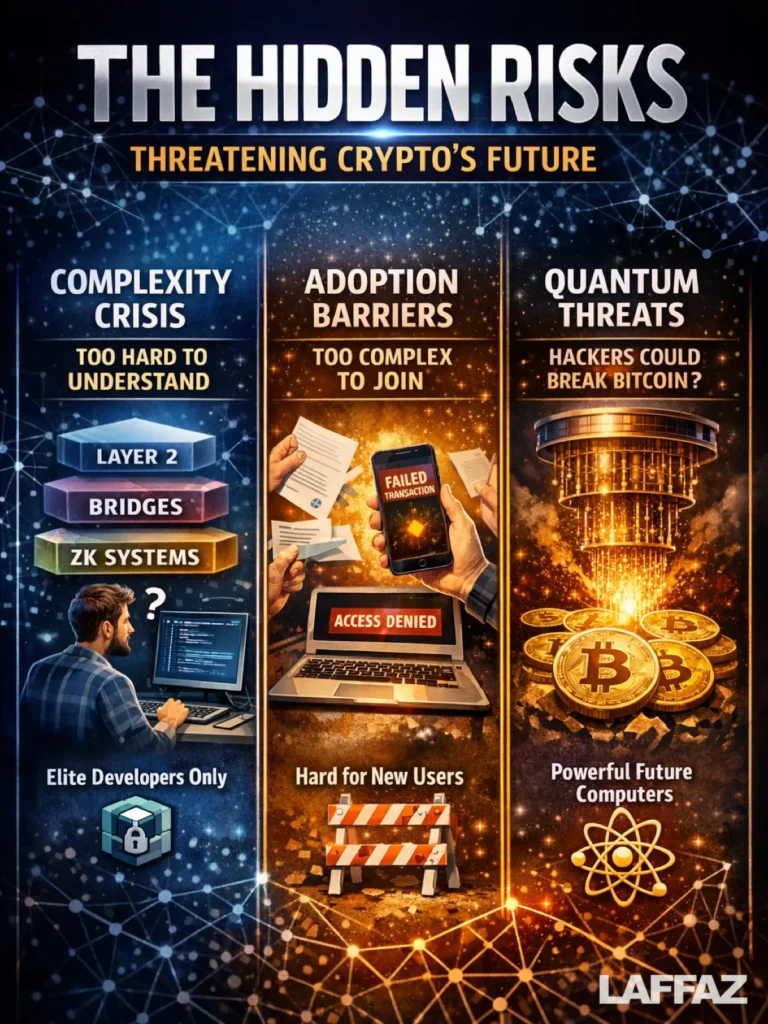
In practice, complex protocols, layered stacks, and advanced security measures make it difficult for ordinary developers, and almost impossible for average users, to audit or fully comprehend networks.
“Every additional system layer introduces new failure points,” notes security technologist Bruce Schneier
The Adoption Paradox
Crypto promises democratization of finance, but technical complexity often centralizes control instead.
Only advanced teams can audit protocols.
Only specialists can safely run complex infrastructure.
Only elite developers fully understand cross-chain risks.
In startup terms: complexity quietly becomes centralization, limiting mass adoption despite decentralized intentions.
Quantum Computing: A Future Risk Layer
Technical complexity isn’t just a human problem. It may make crypto fragile in the face of future technology.
Some of Bitcoin’s earliest wallets, especially those belonging to Satoshi Nakamoto – expose public keys on-chain, a relic of early cryptographic design.
Experts warn that sufficiently powerful quantum computers could derive private keys from these public keys, potentially giving attackers access to dormant BTC holdings, estimated around $440 billion, including ~1 million BTC attributed to Satoshi.
As Jameson Lopp, Bitcoin engineer, explains:
“This proposal is radically different … just as the threat posed by quantum computing is radically different from any other threat in Bitcoin’s history.”
Some developers suggest preemptively freezing or migrating legacy addresses to quantum-resistant formats. Others argue such interventions violate Bitcoin’s principle of immutability.
“They’ll stay cautious, they’ll stay disciplined, and they’ll wait for clarity,” notes investor Kevin O’Leary on institutional sentiment.
The Dual Complexity Paradox
Crypto now faces a double-edged risk:
- Human complexity: usability barriers, layered protocols, and hard-to-audit systems threaten decentralization and adoption.
- Technological complexity: quantum computing could compromise dormant wallets and network security in the future.
Together, these risks highlight the delicate balance between innovation, usability, and security in decentralized finance.
Where This Leaves Crypto Today
For founders, developers, and investors, this isn’t academic.
Modern blockchain stacks are layered, modular, and cryptographically sophisticated, but these very advantages also introduce vulnerability:
- Technical opacity centralizes control.
- Quantum risk threatens high-value dormant holdings.
- Mainstream adoption stalls when systems are too complex for users or auditors.
In decentralized finance, confidence – both human and cryptographic — is the foundation of trust.
Ignoring complexity now may not just slow adoption. It could undermine the very principles crypto was built on.