On 26 March 2026, Moving Tech Innovations (MTI) — the Bengaluru company behind Namma Yatri — announced the acquisition of Automicle Holding BV, a Netherlands-based digital mobility startup. The deal, undisclosed in value, made MTI the latest Indian startup to plant its flag in Europe. It will not be the last.
For much of the past decade, the UAE was the default first stop for Indian startups heading abroad. Low taxes, free zones requiring no local partner, a large NRI base ready to adopt familiar Indian brands, and proximity to home made it almost frictionless. Dozens of Indian startups —from Zomato and Lenskart to Razorpay and Zeta — built their international confidence in the Gulf. But that corridor is maturing. Competition is thicker, differentiation harder, and the addressable market — roughly 10 million people — has its limits.
Europe is a different proposition. At 450 million consumers, it is the world’s second-largest single market. It is also more complex: 27 countries, multiple languages, strict data protection laws, and regulatory frameworks that have tripped up even American tech giants. And yet, Indian startups are charging into Europe — increasingly with models, products, and pricing structures designed precisely for what the continent needs.
The Biggest Tailwind: A Historic Trade Deal
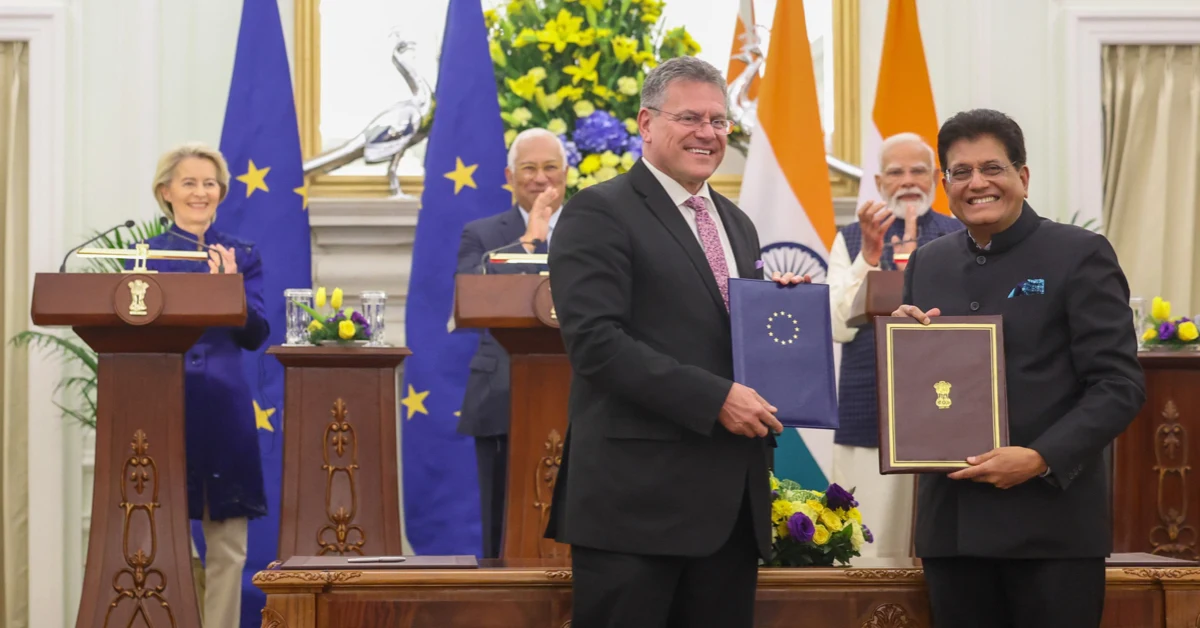
The structural shift accelerating all of this arrived on 27 January 2026, when India and the European Union concluded their landmark India-EU Free Trade Agreement at the 16th India-EU Summit in New Delhi — the largest such deal ever concluded by either side. The agreement, hailed by Prime Minister Narendra Modi as the “mother of all trade deals,” covers goods, services, digital trade, and regulatory cooperation. India will abolish or gradually reduce tariffs on over 90% of European goods it imports, and the EU will provide clearer pathways for Indian services companies to enter its markets.
For startups specifically, the summit produced something more immediate: both sides announced the launch of an EU-India Startup Partnership, involving the European Innovation Council, Start-Up India, and a network of EU-India Innovation Hubs. It is the first formal institutional framework that connects Indian and European startups at scale.
The geopolitical logic matters too. Both Brussels and New Delhi are actively seeking alternatives to Chinese and, to a growing extent, American technology platforms in critical sectors — urban infrastructure, enterprise software, AI, and digital public goods. Indian startups, with their cost-efficiency, technical depth, and now GDPR-conscious product design, fit that brief well.
“The agreement brings together India’s skills, services and scale, with Europe’s technology, capital and innovation.”
— Ursula von der Leyen, European Commission President, at the India-EU Summit, January 2026
The Companies Making the Move
The expansion wave is already well underway — and it spans mobility, enterprise software, conversational AI, and deep tech. Here are the Indian startups building a real presence across Europe.
1. Moving Tech Innovations / Namma Yatri — Netherlands
Moving Tech Innovations (MTI), the Bengaluru company behind Namma Yatri, acquired Netherlands-based Automicle Holding BV in March 2026 as its first international move — and the choice of entry model is deliberate. Uber, Bolt, Lyft-owned Free Now, and BlaBlaCar dominate Europe’s ride-hailing market, charging drivers commissions of 10% to 50% depending on the country. Namma Yatri spotted the same gap in India and disrupted it with a zero-commission model that has delivered over ₹2,500 crore in driver earnings across 150 million trips without taking a cut. Automicle brings city-authority relationships and European digital mobility infrastructure; MTI brings the open-network, community-led platform. MTI co-founders Magizhan and Shan MS cited growing India-EU alignment on digital public infrastructure as the context for the deal.
2. Uniphore — UK & Spain
Founded at IIT Madras in 2008 by Umesh Sachdev and Ravi Saraogi, Uniphore has raised nearly $1 billion to date — including a $260 million Series F in October 2025 led by NVIDIA, AMD, Snowflake, and Databricks. In June 2025, Uniphore formally expanded to Europe, opening a dedicated office in London and a second in Valencia, Spain, alongside active enterprise deployments across EMEA. The pitch is precise: with generative AI spending in Europe expected to exceed $133 billion by 2028, Uniphore positioned its Business AI Cloud as the sovereign, GDPR-compliant alternative to US hyperscaler platforms — built to satisfy the EU AI Act’s requirements out of the box rather than by retrofit. New customers, including Hearst UK and an expanded deployment with global BPO Konecta, mark its early European footing.
3. Darwinbox — UK & Europe
Hyderabad-based Darwinbox raised $140 million in March 2025 in a round co-led by Swiss private markets firm Partners Group and KKR, explicitly to accelerate international expansion. Founded in 2015 by Jayant Paleti, Chaitanya Peddi, and Rohit Chennamaneni, Darwinbox is an AI-powered human capital management platform with over 1,000 enterprise users worldwide—including Starbucks, Nivea, AXA, Cigna, and T-Systems. In 2024, it became the youngest and only Asian company named a Challenger in the Gartner Magic Quadrant for Cloud HCM Suites. Over 60% of new revenue now comes from international markets, with the UK as its primary European beachhead. The company’s 9× revenue growth in MENA over three years is the template it is replicating across European markets.
4. Zoho Corporation — UK, Netherlands, Germany, France & Spain
Zoho is the most systematically embedded Indian startup in Europe and the clearest proof that the continent can be a durable, long-term market — not just an opportunistic one. The Chennai-founded, bootstrapped SaaS giant operates offices in five European countries: the UK (its third-largest market globally), the Netherlands, Germany, France, and Spain, backed by two EU data centres in Amsterdam and Dublin. In the two years to late 2025, Zoho reported 43% UK growth and tripled UK staff, moving its Milton Keynes office to accommodate further hiring. With 100 million global users and 55+ enterprise software products, Zoho’s Europe expansion runs on what its Managing Director for Europe, Sridhar Iyengar, calls “transnational localism” — deep in-country hiring, local-language product builds, and GDPR compliance baked in from the start. It even launched a dedicated zoho.eu website, priced in Euros, with all EU customer data stored within European borders.
5. Freshworks — UK, Germany, France & Netherlands
Chennai-founded Freshworks, listed on Nasdaq in 2021, has built one of the most commercially substantial Indian startup footprints in Europe. The company runs offices in London, Berlin, Paris, and Utrecht, and 38% of its $720 million in 2024 revenue came from the EMEA region. In Q2 2025, it reported 18% year-over-year revenue growth to $204.7 million. Its Freddy Agentic AI Platform, launched in Europe at Refresh Europe 2025 in London, has crossed $20 million in annual recurring revenue. Recent European customer additions include Manchester Metropolitan University and Reed. Freshworks’ core positioning — affordable, fast-to-deploy, AI-native customer and employee service software — is a direct counter to the complexity and cost of legacy platforms like SAP and Salesforce, a message that resonates sharply with European mid-market buyers.
6. CoRover / BharatGPT — France
Bengaluru’s CoRover, a conversational AI company with 25,000+ clients and over one billion users globally, made its European commercial debut at VivaTech 2025 in Paris in June 2025. The company launched BharatGPT Mini, a 534-million parameter small language model that runs entirely offline, on low-end devices, across 14 Indian languages and major international languages — a direct response to rising cloud costs and data privacy anxiety in Europe. Within days of the VivaTech launch, École des Ponts Business School in Paris signed a commercial deployment for student services, marking the first European adoption of Indian-built AI in a live institutional context. CoRover was also selected for the Station F-HEC International LaunchPad, backed by India’s Ministry of Electronics and IT. Founder and CEO Ankush Sabharwal frames the product around “AI sovereignty” — nations and institutions running powerful AI on their own terms, without cloud dependency or data leaving their borders.
7. IndiaAI Cohort — France (HEC Paris & STATION F)
Beyond individual companies, India is now moving startups into Europe as a coordinated national push. Ten Indian deep tech and AI startups joined HEC Paris in 2025 through the IndiaAI program — a joint initiative between the IndiaAI Mission, India’s Ministry of Electronics and IT, HEC Paris Innovation & Entrepreneurship Institute, and STATION F, Europe’s largest startup campus. The cohort spans satellite imagery analytics for agriculture and infrastructure (SatSure), AI-powered video content generation (Storyvord), drone-based AI inspections for industrial environments (Volar Alta), and adaptive edtech (Smartail). India’s Ambassador to France was present at the launch. The signal is unambiguous: European expansion for Indian startups is no longer a founder’s individual bet — it is national policy.
Why Europe, and Why Now
Five forces are converging to make Europe the most compelling international market for Indian startups at this moment.
- India–EU Free Trade Agreement is changing the game for companies looking to expand to Europe. Previously, Indian businesses faced a tangle of individual country rules and regulations, which made expanding across borders a slow and complex process. Now, with the FTA in effect, along with the EU–India Startup Partnership and the forthcoming Innovation Hubs, those obstacles are starting to disappear. This translates to easier access to European markets, improved funding prospects, and stronger partnerships between research and industry for startups and growing companies.
- GDPR compliance is a moat, not a burden. Indian startups that have spent years handling India’s complex data landscape and have deliberately built GDPR-compliant architectures are arriving in Europe with a genuine advantage over US platforms, which often treat GDPR as an afterthought. Uniphore’s “sovereign, composable, secure” AI framing and CoRover’s offline-first, data-stays-on-device design are both explicit responses to European regulatory culture. Indian startups are increasingly aligning with GDPR at the product level — and this alignment, built into the architecture rather than bolted on, signals maturity to European enterprise buyers.
- European markets have legacy cost structures ready to be disrupted. Commission-heavy ride-hailing, expensive HR software, overpriced CRM and customer service tools — these are the sectors where Indian startups with leaner cost structures and cloud-native architectures are winning European mid-market buyers. Freshworks’ entire European pitch is built on this: faster to deploy, cheaper to run, and AI-native from day one compared to incumbent platforms like Salesforce and ServiceNow.
- Brain circulation is deepening the talent pipeline. Both Brussels and New Delhi are actively managing a growing movement of Indian technology workers between Europe and India. This is not just labour migration — it is the seeding of local teams, local knowledge, and local relationships that make sustained expansion possible. Zoho’s transnational localism model — hiring deeply local in each European country — has proven this at scale.
- Geopolitical positioning aligns with Indian startup strengths. Europe’s push for technology sovereignty — reducing dependence on US hyperscalers and avoiding Chinese platforms in critical infrastructure — creates openings for Indian AI and enterprise software companies offering sovereign, GDPR-ready, cost-competitive alternatives. This alignment is less a coincidence than a structural convergence.
The Ola Warning — and Why This Time Is Different
The cautionary tale is Ola. The Indian ride-hailing giant entered Australia in 2018, New Zealand shortly after, and the UK in March 2019 — with ambition and money, but with a conventional commission-based model identical to what Uber was already doing. After six consecutive years of losses, Ola shut down all three markets in April 2024. The lesson founders are drawing from that episode is not that Europe is too hard — it is that entering Europe with a commoditised product and no structural differentiation is a guaranteed failure. The Indian startups moving into Europe in 2025–2026 understand this. Namma Yatri is going in with a zero-commission model that directly challenges European platforms’ core pricing. CoRover is going in with offline-ready AI in a market overwhelmed by cloud-cost anxiety. Freshworks is going in with simplicity in a market exhausted by the complexity of legacy enterprise software.
“When we built Namma Yatri, we put cities and their people first. With Automicle, we are taking those learnings beyond India. These are not local solutions, they are universal principles. Cities everywhere are seeking a mobility model that is open and community-led,”
— Magizhan & Shan MS, Co-founders, Moving Tech Innovations
What Europe Means for Indian Startups
Europe is not the easiest international market for Indian startups — the UAE still holds that distinction. But it may be the most important one. A company that can scale across the EU’s regulatory complexity, linguistic diversity, and high consumer expectations has demonstrated something that US investors, institutional buyers, and global acquirers take seriously: that the underlying product and business model are genuinely world-class, not just India-class.
India is already the world’s third-largest technology startup hub, having surpassed Germany and France in the first nine months of 2025. The irony is sharp — Indian startups are now expanding into the very countries they outpaced at home. And with the India-EU FTA creating formal institutional plumbing for the first time, with European regulators actively seeking non-US, non-Chinese technology alternatives, and with Indian founders arriving with differentiated models rather than copycat products, the conditions for durable success are better than they have ever been.
The UAE was where Indian startups learned to go global. Europe is where they will prove they can stay.