For years, artificial intelligence companies have walked a delicate line between innovation and responsibility. That balance is now under strain.
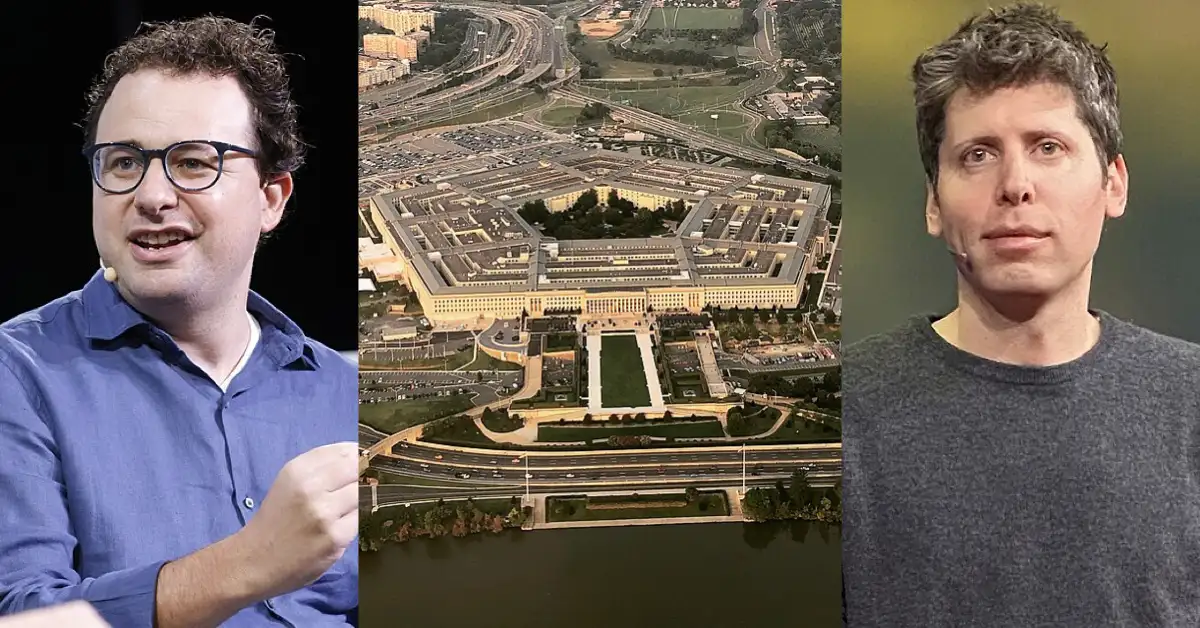
In a dramatic sequence of events, Anthropic was barred from U.S. government contracts after refusing to remove certain safety restrictions from its AI systems. Within hours, OpenAI announced a deal with the Pentagon to deploy its models on classified military networks — under what it described as strict safeguards.
The headlines focused on the ban and the contract. But the deeper story is about leverage, precedent, and the future of AI governance.

This isn’t just a corporate rivalry. It’s a signal moment in the evolving relationship between Silicon Valley and the military establishment.
The Flashpoint: Safety Red Lines
Anthropic’s position centered on two key boundaries: it would not allow its AI to be used for mass domestic surveillance or fully autonomous weapons systems. In a public statement, the company framed those restrictions as both ethical and technically necessary.
The Pentagon, however, reportedly insisted that AI systems supplied to the government must be available for “all lawful purposes.” That phrase — broad, flexible, and open to interpretation — became the fault line.
The result: Anthropic was labeled a supply chain risk and excluded from federal deals.
Then came the twist.
OpenAI signed an agreement with the Department of Defense that, according to its public disclosures, includes guardrails against mass surveillance and autonomous weapons — the very boundaries at the heart of the dispute.
The optics were immediate and powerful: one company blocked, another embraced.
But the second-order implications run deeper.
A New AI Power Equation
The first signal is clear: AI companies are no longer just vendors. They are strategic infrastructure.
When a leading AI lab is designated a risk by its own government, it sets a precedent. Historically, such designations have targeted foreign adversaries. Applying that label to a domestic frontier AI company signals that national security policy has entered a new era — one where model access and deployment terms are geopolitical assets.
At the same time, OpenAI’s successful negotiation demonstrates that companies with scale and strategic positioning can influence the boundaries of military AI deployment.
In other words, this is no longer about which model performs best.
It’s about who gets to set the rules.
Corporate Leverage vs. Government Authority
For founders and tech leaders, the lesson is sobering.
Governments have unmatched authority. They control procurement, regulation, and national security framing. But frontier AI companies control something equally powerful: the underlying technology shaping economic and military advantage.
This creates a fragile equilibrium.
If the government pushes too hard, it risks driving innovation away or fracturing trust with domestic AI leaders. If companies push too far, they risk being cut out of strategic ecosystems.
The Anthropic-OpenAI split reveals how narrow that corridor has become.
It also exposes a new competitive dynamic: AI labs are not only competing for market share — they are competing for geopolitical alignment.
The Civil Liberties Question
Beneath the corporate chessboard lies a deeper tension: civil liberties.
Advanced AI systems can analyze vast data streams, identify patterns, predict behavior, and automate complex decisions at scale. Used responsibly, they can strengthen defense logistics, cybersecurity, and crisis response. Used recklessly, they can enable unprecedented levels of surveillance and automated force.
The disagreement over “all lawful purposes” highlights how existing legal frameworks may not be sufficient guardrails for emerging capabilities.
What is lawful today may not account for what AI makes possible tomorrow.
And that uncertainty is precisely what makes this moment consequential.
The Industry Ripple Effect
The shockwaves extend beyond two companies.
Recently, more than a thousand tech workers, AI researchers, and industry professionals signed a public letter urging the Pentagon and Congress to withdraw the decision to label Anthropic as a “supply chain risk.” Supporters argue that applying such a designation to a domestic AI company could chill future safety advocacy and erode trust between government institutions and the technology sector. The backlash has since expanded into a broader policy debate in Washington, as detailed in our newsroom coverage of the tech worker response to the Pentagon’s designation.
Other AI labs are now watching closely. If safety conditions become a competitive disadvantage, firms may feel pressure to soften red lines. Conversely, if OpenAI’s publicly stated safeguards become normalized across defense contracts, a de facto industry standard could emerge.
The risk is fragmentation.
A divided industry weakens collective bargaining power on ethical standards. A unified stance strengthens it — but only if companies agree on where those red lines should be.
The Pentagon, meanwhile, gains leverage from competition. If one firm resists, another may step in.
This dynamic could define the next phase of AI commercialization.
Global Implications
The U.S. is not alone in integrating AI into national defense strategies. China, the European Union, and other major powers are accelerating their own AI-military frameworks.
How America navigates this moment will shape global norms.
If U.S. AI firms maintain visible ethical boundaries while still partnering with defense institutions, that model could influence allies. If boundaries erode under pressure, it may accelerate an AI arms race defined by capability over caution.
Either way, the precedent has been set: AI companies are now central actors in geopolitical power structures.
What This Means for the Future of AI Governance
Three long-term outcomes are possible.
1. Formalized Guardrails
Public controversy could push lawmakers to codify limits on AI use in surveillance and autonomous weapons. That would shift red lines from corporate policy to statutory law.
2. Quiet Normalization
Defense AI deployments may expand under negotiated safeguards, gradually becoming standard practice with limited public debate.
3. Escalating Tension
Future disagreements could lead to stricter crackdowns or retaliatory positioning between government agencies and AI labs.
The path chosen will influence not only military strategy, but also public trust in artificial intelligence.
Because once AI becomes embedded in defense infrastructure, reversing course becomes exponentially harder.
Beyond the Headlines
At surface level, this was a story about a ban and a contract.
At a deeper level, it is about sovereignty over intelligence — not human intelligence, but machine intelligence.
Who controls it?
Who defines its limits?
Who decides when ethical hesitation becomes strategic weakness?
The answers will not come from press releases alone. They will emerge through negotiations, policy battles, and competitive maneuvering over the next several years.
For now, one thing is certain: the relationship between Anthropic, OpenAI and the Pentagon marks a turning point.
Artificial intelligence is no longer just a tool of innovation.
It is a lever of power.
And power, once contested, rarely returns to equilibrium unchanged.