The increasing frequency of extreme heat events has transformed urban cooling from a matter of convenience into an essential element of city planning. Modern cities are challenged by rising temperatures, dense construction, limited vegetation, and extensive paved surfaces that absorb solar energy throughout the day and slowly release it after sunset. These conditions create uncomfortable environments for residents and visitors, reducing outdoor activity and increasing health risks during the hottest months of the year. To address these challenges, municipalities are investing in sustainable cooling technologies that combine environmental responsibility with practical performance. Decorative fountains and high-pressure water mist systems have become two of the most effective solutions for improving thermal comfort in public spaces without significantly increasing energy consumption.
Urban Heat Is Built Into the Streets
Heat in cities is not just weather; it is built into the streets. A study of the Tokyo metropolitan area found that the urban heat island effect accounted for roughly 30% of heat-related deaths in urban municipalities between 2010 and 2019. That means about 2,200 deaths were tied to how the city is built, not to the regional climate. The pattern extends well beyond Japan. The WHO’s Europe office says heat has caused over 200,000 deaths on the continent in four years, nearly all of them preventable. Its updated guidance lists cooling centres, shade and greening among the responses cities should adopt.
How Fountains and Mist Systems Cool Public Spaces
Unlike conventional cooling equipment that depends on enclosed spaces and mechanical refrigeration, water-based cooling relies on the natural process of evaporation. As water changes from liquid to vapor, it absorbs heat from the surrounding air, lowering the perceived temperature in the immediate area. Decorative fountains continuously circulate water through jets, cascades, and dynamic displays, creating refreshing microclimates that attract people during hot weather. Beyond their cooling effect, fountains contribute to urban identity by enhancing architectural landscapes, supporting tourism, and encouraging social interaction in parks, plazas, and pedestrian zones.
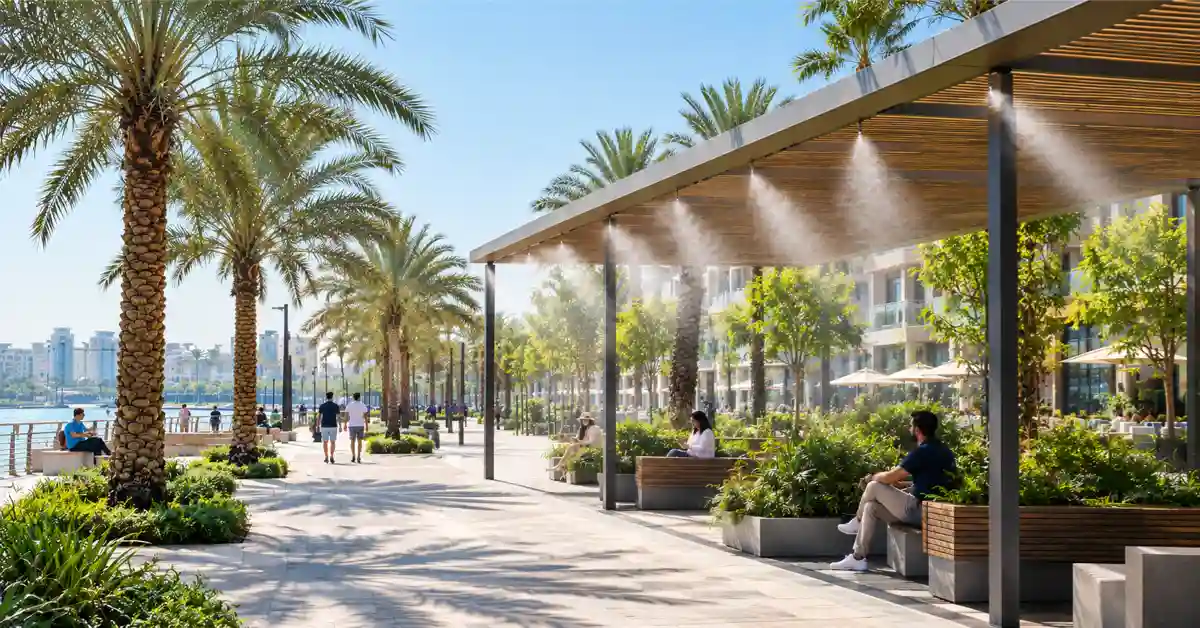
Water mist technology offers an even more efficient method of evaporative cooling. High-pressure pumps force water through precision-engineered nozzles that generate microscopic droplets, allowing almost instantaneous evaporation before the water reaches the ground. This process cools the surrounding air while keeping pedestrians comfortable and dry. Mist systems are increasingly installed in transportation terminals, outdoor cafés, sports facilities, playgrounds, shopping districts, entertainment venues, botanical gardens, and public event areas where maintaining comfortable conditions is essential for visitor satisfaction. Their modular design allows them to be integrated into both new developments and existing infrastructure with minimal visual impact.
How Much Cooling Can Mist Systems Deliver?
Mist cooling works, but the gains depend heavily on conditions. In a heat chamber starting at 40°C and 15% humidity, an Arizona State University study found low-pressure misting cut air temperature by 2 to 4°C. It also found that ventilation strongly affected performance. A review of field trials reports a 1.5°C average drop from a misting fan system in Singapore. Overhead sprayers in a shaded waiting area cut the air temperature by up to 3°C, according to the same review. Humid climates are the weak spot, because evaporative cooling cannot push air below its wet-bulb temperature. Italian researchers who monitored a spray system in an open urban space report local reductions of nearly 10°C in extreme dry heat, so results range widely. The article should say plainly that results vary with climate and airflow.
Water Quality Is Part of the Cooling System
The success of these cooling systems depends not only on mechanical design but also on the quality of the circulating water. Water used in fountains and mist installations must be properly disinfected to prevent the development of bacteria, algae, fungi, and biofilms that naturally thrive in warm recirculating systems. Effective disinfection protects public health, preserves equipment performance, and minimizes maintenance requirements. Equally important is ensuring that the water remains completely free of unpleasant odors. Fresh, clean, odorless water significantly improves the visitor experience and reflects the overall quality of system operation. Advanced treatment technologies such as ultraviolet disinfection, ozone, chlorine dioxide, and automated dosing systems help maintain consistently high water quality throughout the operating season.
Maintaining these high standards requires more than individual treatment components. Successful operation depends on a carefully engineered combination of filtration, hydraulic design, water chemistry control, and continuous monitoring. Each installation has unique operating conditions determined by climate, water source, visitor numbers, and system configuration. Engineering solutions for water treatment are available from AQUAANALYTIC, where specialists design integrated systems for filtration, disinfection, water quality monitoring, and process automation. By selecting the appropriate treatment technologies for each project, specialist engineers can ensure that cooling installations operate safely, efficiently, and reliably while meeting the demanding hygiene standards expected for public infrastructure.
Managing Water as Carefully as Heat
Cities that keep growing and keep heating up will lean harder on water to make outdoor spaces bearable. Fountains and mist systems show that cooling can be sustainable and still look good in a public square, though the water itself is the catch. Dubai Municipality’s technical guidelines for Legionella control include a dedicated section and checklist for fountains and water features, which shows how seriously Gulf regulators treat them. Europe’s disease-control agency raised the issue in 2016, when it investigated a rise in Legionnaires’ cases among travellers returning from Dubai and named misting devices and fountains among possible sources of exposure. Monitoring and disinfection are a basic operating requirement, not an optional extra. A fountain or mister that is properly treated and checked regularly will serve a neighbourhood for years, while a neglected one can make people ill. Climate-resilient cities will need to cool their streets and manage the water that does the cooling, from the first season to the last.