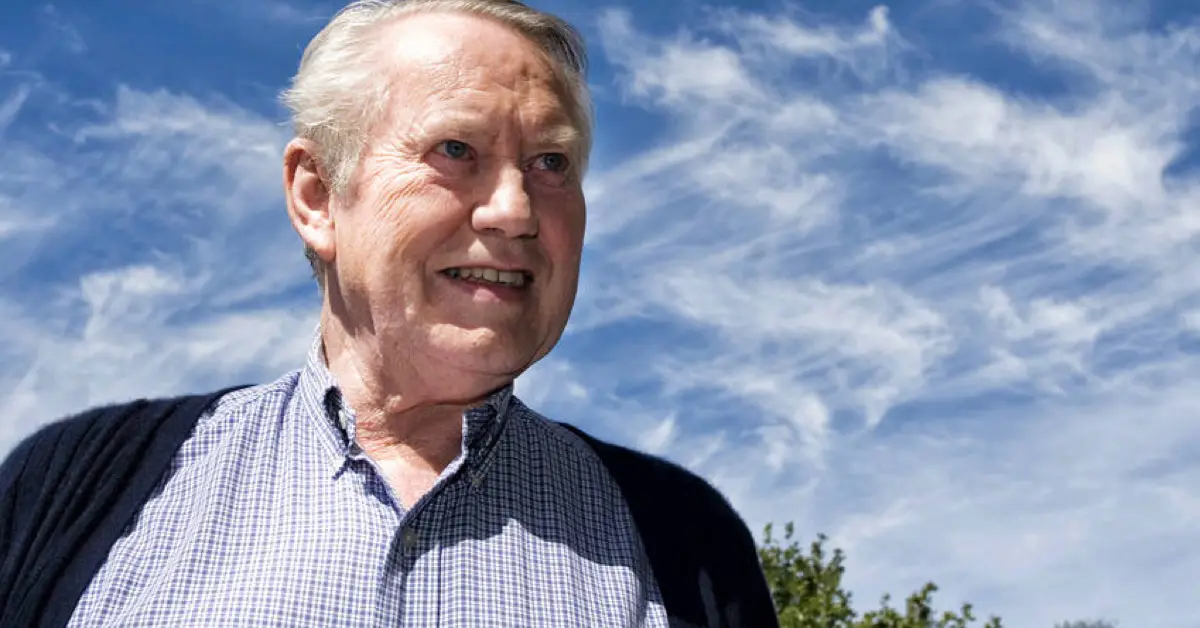
When Charles “Chuck” Feeney died in October 2023, obituaries leaned almost entirely on one story: a duty-free retail billionaire who secretly gave away his entire fortune and died with almost nothing left. Fewer mentioned that the vehicle he used to multiply that fortune before giving it away, General Atlantic, is today a $118-billion growth-equity firm with an active, decades-long footprint in Indian technology, retail, and healthcare.
From bologna sandwiches to duty-free billions
Feeney’s own money story is well documented. Born in 1931 in Elizabeth, New Jersey, to an Irish-American family, he attended Cornell University on the GI Bill after serving in the U.S. Air Force during the Korean War, and by his own account earned his keep on campus selling sandwiches to classmates. One of those classmates was Robert Warren Miller, with whom he founded Duty Free Shoppers in 1960, selling tax-free goods to travellers first in Hong Kong and Honolulu, then to a wave of outbound Japanese tourists once Tokyo eased travel restrictions in the mid-1960s. DFS grew into the world’s largest travel-retail chain, and Feeney’s stake was worth billions by the time he sold it to LVMH in 1996.
What set Feeney apart wasn’t the fortune; it was what he did with it 13 years before anyone found out. In 1984, he transferred his entire DFS stake into a foundation, The Atlantic Philanthropies, virtually, and kept it secret until a 1997 lawsuit from Miller forced disclosure. The foundation went on to give away more than $8 billion across health, education, human rights and peace-building work, including a role in the Northern Ireland peace process, before deliberately spending itself down and closing in 2020. Feeney called the approach “Giving While Living”, and it became the direct template for the Giving Pledge that Bill Gates and Warren Buffett launched years later.
The firm nobody remembers is a philanthropist’s family office
Less discussed is what Feeney built to fund all that giving. In 1980, four years before he moved his DFS stake into Atlantic Philanthropies, Feeney set up a small investment team as his personal family office, with a simple brief: find growing companies, back them, and use the returns to magnify his philanthropy. That team is General Atlantic, and Feeney remained its sole investor for more than a decade before the firm began raising capital from outside institutions, families, and endowments. Today, the firm manages roughly $118 billion in assets and employs more than 900 people across 29 offices, operating as a private partnership owned by its own active partners rather than any outside parent company.
General Atlantic’s long, quiet bet on India
For a firm with such an unusual origin story, General Atlantic’s footprint in India has been anything but quiet. Its first major India technology bet came in 2018, when it invested $100 million in Byju’s for a 5% stake at a $2 billion valuation, marking the firm’s first entry into education technology anywhere in the world. Two years later, in the middle of the pandemic, General Atlantic put ₹6,598.38 crore into Jio Platforms, part of a broader wave of global capital, including Facebook and Silver Lake, that valued Reliance Industries’ digital arm at nearly ₹5 lakh crore. The firm also holds a stake in Reliance Retail, India’s largest retailer.
By early 2023, with Indian startup valuations resetting hard after the 2021 funding peak, General Atlantic signalled it was ready to lean back in. Sandeep Naik, the firm’s head of India and Southeast Asia business, said the firm was in early-stage talks with roughly 15 companies across technology, financial services and consumer sectors, part of a plan to commit close to $2 billion to the region.
“The realism is setting in. We were waiting for the value creation to happen,” Naik said, on the shift underway in India’s startup valuations.
The firm backed that intent with people on the ground: in 2024, it appointed Anand Agarwal, formerly the CFO of Amazon’s India consumer business, as an Operating Partner focused on India and Southeast Asia, based in Mumbai.
The current deal on the table
General Atlantic has teamed up with Hyderabad-based Renova Hospitals to bid for American Oncology Institute, the Indian oncology hospital network that Siemens Healthineers is selling as it exits non-core hospital operations to focus on diagnostics and therapeutics. The consortium is competing against Cancer Centers of America, led by Indian-American entrepreneur Raj Mantena, with the deal expected to value AOI at around ₹1,500 crore and close by mid-August 2026. For Renova, the tie-up is a fast route into markets it doesn’t currently serve, with General Atlantic providing the financial backing behind the expansion.
Why this matters beyond the deal sheet
None of this makes General Atlantic unusual among global growth-equity firms operating in India, several of which trace back to a single wealthy founder or family office. What makes it worth noting is the specific lineage: capital that Chuck Feeney built explicitly to be recycled into philanthropy has, over four decades, become one of the more durable sources of growth capital for Indian founders navigating a slower, more selective funding market than the one they raised in during 2021.
The firm’s own framing of itself, as a “growth equity” pioneer backing entrepreneurs with patient capital rather than leverage-driven buyouts, is easy to read as standard private-equity marketing. But it does line up with a four-decade pattern: an edtech startup taking its first institutional cheque in 2018, a telecom-and-retail conglomerate’s digital arm raising pandemic-era capital in 2020, and an oncology hospital chain changing hands in 2026 have little in common except that the same firm, and indirectly the same original idea about what money is for, keeps showing up on the cap table.
FAQs
Did Chuck Feeney personally invest in Indian startups?
Not directly. Feeney stepped back from day-to-day involvement in General Atlantic’s investment decisions as the firm grew beyond his personal capital; its India investments, including Byju’s and Jio Platforms, were made by the firm’s professional investment team long after Feeney’s active role had faded.
Is General Atlantic still connected to Atlantic Philanthropies?
The two entities share a founder and history but have been operationally separate for decades. Atlantic Philanthropies formally closed in 2020 after spending down its endowment, while General Atlantic continues to operate as an independent growth-equity firm.
What is General Atlantic’s current India strategy?
The firm has said it aims to commit close to $2 billion across India and Southeast Asia, spanning technology, financial services, retail, and consumer sectors, alongside opportunistic bets in adjacent areas like healthcare, as seen in its current bid for American Oncology Institute.