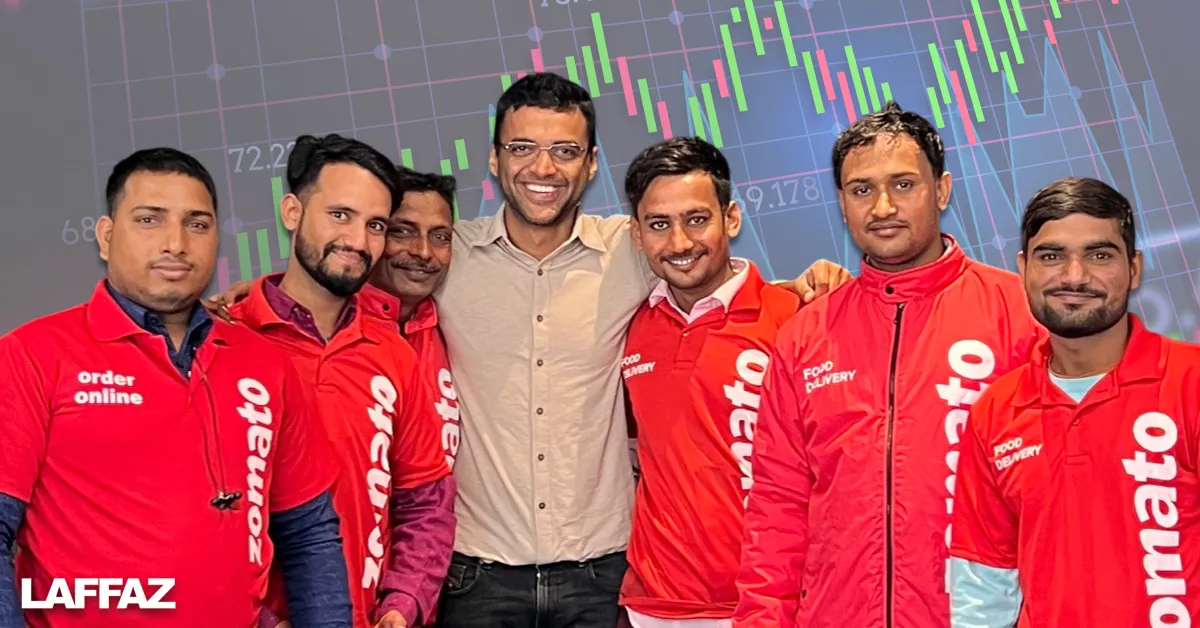
When public markets are closely observed, share price movements often reveal more than short-term valuation changes; they signal how an entire industry is perceived by investors. In the food delivery sector, these movements are closely tracked as early indicators of shifts in confidence, capital flows, and growth expectations.
One example is Zomato Limited, now known as Eternal Limited, which is frequently referenced to understand sentiment across listed food delivery platforms. Zomato’s share price is often analysed to interpret how investors are reacting to changes in demand patterns, profitability outlook, and competitive pressure within the sector. Even subtle movements can reflect larger shifts in how the industry is valued.
This blog explores key ways these share price trends influence funding cycles across the food delivery sector and what they signal for market participants.
5 Ways Share Price Fluctuations Align with Funding Cycles in the Food Delivery Sector
Here is a closer look at how market behaviour shows that share price trends influence funding decisions across the food delivery ecosystem:
1. Funding benchmarks for market valuations
Share price movements often act as an early indicator of funding sentiment in the food delivery sector. Rising prices signal stronger investor confidence in future earnings and growth potential, supported by improving demand visibility, better margins, or stronger operational efficiency. In such conditions, risk appetite increases, leading to more active capital deployment and faster deal momentum.
Movements in Zomato’s share price are widely tracked as a reference benchmark for valuation expectations in the sector. This influences how funding rounds are priced and how growth prospects are assessed.
Conversely, declining share prices signal caution around growth or profitability due to rising costs, slower demand, or margin pressure. This weakens investor confidence, making capital allocation more selective and slowing funding activity.
2. Public market valuations set private funding benchmarks
Public market valuations serve as key reference points for private funding benchmarks, with metrics such as Zomato’s share price guiding investor expectations. Listed companies help calibrate valuation multiples, especially for late-stage startups nearing liquidity events.
While private market developments may influence sentiment, public markets remain the primary driver, shaping pricing discipline, capital allocation, and overall sector valuation trends.
3. Profitability becomes a priority in weak markets
When share prices weaken, investor sentiment typically shifts from growth expectations to profitability and capital efficiency. They place greater weight on sustainable margins, cash-flow visibility, cost discipline, and the resilience of business models under slower-demand conditions.
Evaluation frameworks are becoming more conservative, with a greater focus on unit economics, customer retention, delivery efficiency, and long-term earnings stability. This often results in stricter valuation discipline and more selective capital allocation.
For this reason, Zomato’s share price is frequently interpreted by investors as a signal to reassess risk exposure and recalibrate valuation benchmarks across the sector. As sentiment moderates, funding expectations are reset lower, and deal pricing reflects heightened emphasis on profitability and sustainable cash generation. This eventually leads to tighter capital deployment cycles.
5. Sector-wide sentiment moves in sync with listed stocks
Listed companies serve as primary sentiment anchors for sectoral positioning, with market performance of players such as Zomato offering real-time signals on industry health, demand visibility, and profitability expectations.
Investors rely on these indicators to shape risk appetite and capital allocation across both public and private markets.
While periods of elevated funding activity may coincide with stronger sentiment, they largely reflect underlying optimism rather than independently driving listed valuations. This remains anchored to fundamentals and macro conditions.
5. Market corrections reset growth expectations
Sharp corrections prompt investors to reassess earlier growth assumptions and re-evaluate risk-adjusted returns with a stronger focus on downside protection.
Over-optimistic projections are replaced with more conservative and realistic targets, leading to stricter scrutiny of business models, cash flows, and long-term sustainability. This shift results in a downward revision of valuation expectations and disciplined capital allocation, with funding decisions based on visibility into profitability and operational resilience.
Corrections in Zomato’s share price often reset broader investor expectations across the food delivery sector in the online share market. This reinforces tighter valuation benchmarks and more cautious funding cycles.
Track market signals to make smarter funding decisions
Understanding funding cycles in the food delivery sector depends heavily on reading public market signals that reflect investor behaviour. These signals often change before private funding activity adjusts, making them an important early indicator.
Zomato’s share price serves as a clear example of how shifts in sentiment influence funding expansion or contraction across startups. Rising trends usually indicate stronger capital flow and higher valuations, while declines point to cautious investor behaviour and slower deal activity.
Online trading and investment platforms like Ventura help investors and startups track these movements more effectively by providing access to market data and insights. Start monitoring these signals to improve investment timing, valuation decisions, and alignment with the real funding cycle, leading to better long-term outcomes.