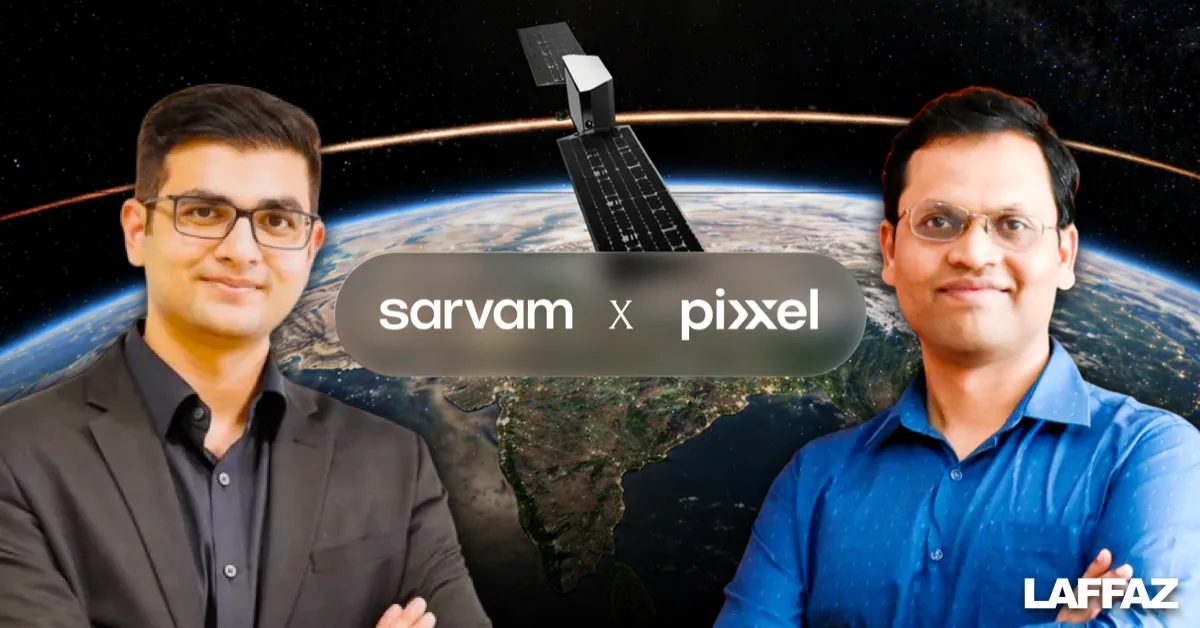
Pixxel and Sarvam AI have announced a partnership to develop India’s first orbital data centre satellite, named Pathfinder — a 200 kg spacecraft carrying datacenter-class GPUs into low Earth orbit, with an AI inference stack running entirely in space. The satellite is scheduled to reach orbit as early as Q4 2026.
Under the partnership, Pixxel will design, build, launch, and operate the satellite. Sarvam will provide the AI backbone — handling both model training and inference directly in orbit, with no dependence on foreign cloud or ground infrastructure. It is the first time India-built AI models will run aboard an India-built satellite.
“Ground-based data centres are facing increasing constraints around energy, land, regulation, and scale, and the current model is becoming harder to sustain environmentally. Orbital data centres open up a new frontier, where compute can be powered by abundant solar energy, operate closer to space-based data, and move beyond some of the limits faced on Earth.”
— Awais Ahmed, CEO, Pixxel
The operational logic is a direct challenge to how Earth observation has worked for decades. Most satellites collect raw imagery, beam it to ground stations, and wait for terrestrial systems to process it — a pipeline that introduces hours of latency between capture and insight. Pathfinder collapses that gap. When the satellite passes over a location, it can detect a wildfire, identify a crop disease, or flag a pipeline leak in the same orbital pass — without a round trip to Earth.
Pathfinder will also carry Pixxel’s hyperspectral imaging camera, capable of capturing high-fidelity spectral data across hundreds of wavelength bands. That imagery will be analysed in-orbit by Sarvam’s foundation models, delivering processed intelligence rather than raw files.
“AI infrastructure is not just a software question — it is a sovereignty question. Sarvam has been building India’s full-stack AI platform from the ground up, and partnering with Pixxel allows us to extend that sovereign stack into space.”
— Pratyush Kumar, CEO, Sarvam AI, via Pixxel
The mission is also a hardware stress test. Running datacenter-class GPUs in orbit requires managing extreme thermal swings, radiation exposure, and power constraints that ground-based systems never face. Pathfinder will validate whether frontier compute can survive and perform in the harsh space environment at scale.
Pathfinder will be built at Gigapixxel, Pixxel’s upcoming satellite production facility designed to produce up to 100 units. The company was founded by Awais Ahmed and Kshitij Khandelwal and is backed by investors including Google, Lightspeed, and Accenture. It has previously launched a constellation of hyperspectral satellites and positioned itself as a planetary intelligence company rather than a conventional Earth observation provider.
Pixxel has earned its credibility the hard way. In September 2024, Pixxel became the first Indian space startup to win a NASA contract — joining the agency’s $476 million commercial smallsat data acquisition programme to supply hyperspectral Earth observation data to NASA, the US government, and academic partners.
Sarvam, co-founded by Vivek Raghavan and Pratyush Kumar, has been building India’s sovereign large language model stack since 2023, with backing from Peak XV Partners and Lightspeed India. The orbital partnership marks a significant expansion of that mandate — from language to space-based intelligence infrastructure.
Pixxel has been making the broader case publicly too. In a thread on X on 15 May, the company argued that the scale of the problem demands a structural rethink — not just incremental infrastructure expansion.
“Every second, the world generates more data than its infrastructure was built to handle. And the gap is widening.” Pixxel posted on X
The broader backdrop matters. As AI demand strains terrestrial power grids and water resources, orbital compute is emerging as a structural alternative — solar-powered, jurisdiction-flexible, and physically closer to space-based data sources. Pixxel and Sarvam are not alone in this race. Neevcloud and launch startup Agnikul Cosmos are targeting a launch for Project Orion — a planned orbital data centre constellation — by the end of 2026 as well. The orbital compute race in India is no longer a single bet; it is becoming a sector.