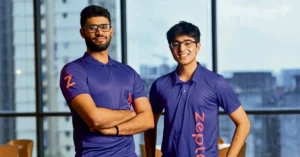
When Zomato founder Deepinder Goyal builds something new, it rarely stays confined to business pages.
His latest venture, Temple, has reportedly raised $54 million at a $190 million valuation, signaling strong early investor confidence in the performance-focused startup. But the fundraise did not dominate the conversation alone. A reported hiring preference – selecting men with less than 16% body fat, has triggered online backlash and raised uncomfortable questions about workplace norms, inclusivity, and founder-driven culture design.
We're recruiting at @temple.
— Deepinder Goyal (@deepigoyal) February 27, 2026
At Temple, we are building the ultimate wearable for elite performance athletes. A device that measures what no other wearable in the world measures, with a level of precision that doesn't exist yet.
To build it, we need people who are obsessive… pic.twitter.com/iCHaMUwdEw
At first glance, these seem like separate developments: one financial, one cultural.
They are not.
Temple’s fundraise and hiring controversy reflect a broader shift in India’s startup ecosystem, where founder identity, cultural positioning, and capital are increasingly intertwined.
This isn’t just about valuation or outrage. It’s about how repeat founders are redefining what’s acceptable, aspirational, and investable in India’s evolving startup culture.
Capital Meets Controversy
Start with the numbers.
A $190 million valuation at an early stage signals belief — not only in a business concept, but in leadership credibility. In a funding climate that has remained measured since the post-2022 correction, a $54 million raise stands out. It reflects conviction.
Then came the hiring debate.
Social media discussions questioned whether physical metrics should influence recruitment decisions. Critics called it exclusionary. Supporters framed it as intensity signaling aligned with a performance-driven brand.
Regardless of intent, the moment transformed a funding headline into a cultural flashpoint.
This is not a small experiment.
The Rise of Founder-Led Identity Startups
India’s first unicorn wave was operational.
Food delivery. Fintech. Logistics. Marketplaces. The dominant narrative was scale, efficiency, and capital intensity.
The emerging wave feels different.
Today, repeat founders are increasingly building around identity — intensity, discipline, personal ethos, even ideology. Startups are no longer just solving problems; they are signaling values.
Temple appears positioned around physical performance, wellness discipline, and high personal standards. That framing, intentional or not, makes culture part of the product itself.
When a proven founder launches a new venture, investors are not underwriting only the business model. They are underwriting pattern recognition, resilience, and execution history.
This creates what venture circles often call a “founder premium.”
Founder premium compresses skepticism. It accelerates funding. And it magnifies scrutiny.
Why Investors Still Bet Big
In 2026, repeat founders enjoy structural advantages that first-time founders do not.
They bring:
- Crisis navigation experience
- Media literacy
- Hiring networks
- Operational scar tissue
- Brand equity
Even controversy can become, in some cases, a managed variable rather than an existential threat.
Investors backing Temple are likely betting less on a hiring filter and more on execution probability. In early-stage venture, conviction in the founder often precedes full validation of the concept.
That tells us something important: India’s capital markets are increasingly comfortable pricing reputational volatility — at least when attached to proven builders.
The Hiring Filter: Outrage or Cultural Positioning?
Through a conventional HR lens, the reported body-fat preference appears exclusionary. Modern talent markets emphasize skills, output, diversity, and fairness over physical attributes.
Through a branding lens, however, it can be interpreted differently.
Some high-performance organizations globally frame their identity around endurance, discipline, or elite standards. The narrative of “we hire the obsessed” is not new.
What is new is visibility.
In the social media era, internal filters quickly become public narratives — and public narratives shape employer brand instantly.
Imagine being a 28-year-old engineer reading that hiring criterion. Do you apply? Do you hesitate? Or do you decide the culture isn’t meant for you?
That moment of self-selection is powerful. It narrows the funnel before the interview even begins.
Temple’s case demonstrates that hiring philosophy is no longer internal policy. It is external positioning.
The scrutiny, however, has not been limited to hiring. In a separate development, an ex-AIIMS doctor publicly questioned the scientific credibility of the Temple device, arguing that it lacks robust evidence and cautioning against treating it as medically validated performance technology. The criticism added another layer to the debate — shifting it from workplace norms to product legitimacy.
What This Means for Startup Hiring in India
The implications extend far beyond one company.
1. Employer Brand Is Now Volatile
India’s startup workforce — especially Gen Z and millennial professionals — evaluates alignment as much as compensation.
Talent increasingly considers:
- Cultural values
- Inclusivity signals
- Leadership personality
- Public perception
Controversial criteria can shrink candidate pools. But they can also intensify loyalty among those who resonate with the projected identity.
Polarization repels some. It attracts others.
That tension is becoming part of modern employer branding.
2. Performance Culture Is Re-Emerging
After the funding winter recalibrated growth-at-all-costs strategies, many startups shifted toward leaner operations and disciplined scaling.
Now, a sharper narrative is gaining ground: smaller teams, higher accountability, stronger alignment.
Performance is increasingly framed not just through KPIs but through personal discipline and founder-driven ethos.
India’s first startup boom was about logistics scale. This one may be about cultural scale.
If more founders adopt intensity-first frameworks, hiring norms could shift meaningfully over the next few years.
3. Capital Now Absorbs Cultural Risk
One of the clearest signals in this episode is investor response.
The funding proceeded. The valuation held. There has been no visible capital retreat.
This suggests that venture capital in India may now be more tolerant of cultural friction when attached to proven founders.
But tolerance has limits.
If controversy begins to affect talent acquisition, partnerships, regulatory scrutiny, or long-term brand perception, investor patience could shift.
The central question becomes durability: can strong positioning coexist with scalable hiring?
Founder as Brand: A Double-Edged Sword
Repeat founders carry gravitational pull.
Their statements travel faster. Their decisions are scrutinized harder. Their experiments are amplified wider.
That visibility accelerates both growth and backlash.
Temple illustrates the tradeoff clearly:
- Founder brand accelerates funding.
- Founder brand magnifies controversy.
Reputation compounds — in both directions.
Is Polarization the New Differentiation?
In a crowded ecosystem, neutrality rarely trends.
Bold positioning creates conversation. Conversation creates visibility. Visibility attracts capital, talent, and customers — even if not universally.
The risk lies in calibration.
If differentiation becomes exclusionary to the point of operational friction, growth slows.
If differentiation is balanced carefully, it can create strong alignment and deep loyalty.
Temple’s trajectory will test where that line sits in India’s evolving startup landscape.
The Bigger Ecosystem Shift
What makes this moment significant is not the hiring rule alone.
It is the convergence of three forces:
- Founder premium capital
- Cultural identity branding
- Hyper-reactive public discourse
India’s startup ecosystem is no longer in its adolescence. It is mature enough to debate hiring philosophy openly. Mature enough for founders to experiment with strong identity positioning. Mature enough for investors to factor reputational volatility into valuation models.
Temple stands at that intersection.
Final Take: A Test Case for 2026
Temple could scale into a serious wellness-performance brand. It could refine its hiring language. Or it could become a case study in how far founder-led positioning can stretch before it meets resistance.
Either way, this is not just another startup funding headline.
It is a signal.
A signal that capital, culture, and founder personality are becoming inseparable forces in India’s startup ecosystem.
For founders, investors, and operators watching closely, that shift matters far more than a single hiring filter.