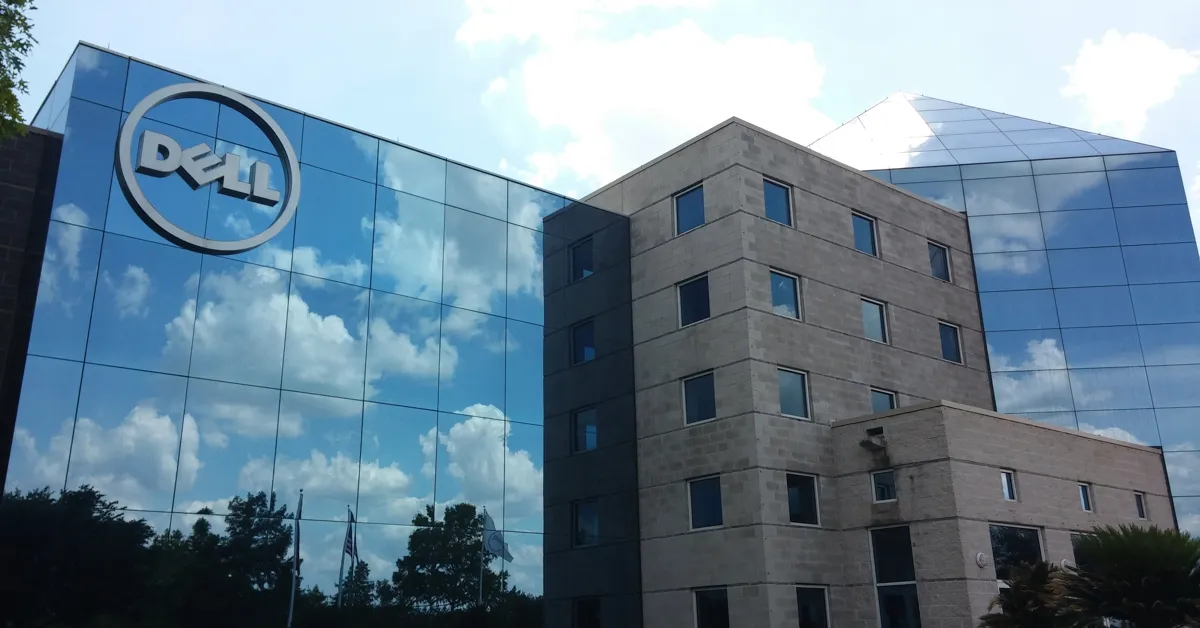
While Dell Technologies was cutting roughly 11,000 jobs in fiscal 2026, it was also increasing its focus on artificial intelligence and enterprise infrastructure. The layoffs, which account for nearly 10% of its workforce, were not announced through a major press release or headline-grabbing statement. Instead, they were disclosed quietly in the company’s annual 10-K filing.
This contrast — shrinking workforce alongside rising AI investment — is no longer unique to Dell. It is quickly becoming the defining playbook across Big Tech.
Dell’s silent restructuring is years in the making
Dell’s workforce reduction is not a one-off event. It is part of a multi-year downsizing trend that has steadily reduced its employee base from around 133,000 in 2023 to approximately 97,000 in 2026. That’s a decline of nearly 36,000 jobs, or about 27% of its total workforce in just three years.
In its filing, Dell described the layoffs as part of “disciplined cost management,” citing employee reorganisations, limited external hiring, and broader efforts to align resources with strategic priorities.
The company also spent $569 million on severance during fiscal 2026, signalling that these cuts were not abrupt, but planned and executed over time.
The language is deliberate. Rather than framing these moves as layoffs, companies increasingly describe them as optimisation, restructuring, or efficiency measures — even when thousands of roles are eliminated.
A pattern repeating across Big Tech
Dell is far from alone. Across the technology sector, several major companies are cutting jobs while simultaneously investing heavily in AI-driven transformation.
Oracle is reportedly cutting around 30,000 roles as part of its ongoing restructuring. Atlassian has announced plans to lay off approximately 1,600 employees, or about 10% of its workforce, as it shifts focus toward AI-integrated products and services.
Block is undergoing one of the most aggressive restructurings, with reports suggesting cuts of nearly 4,000 employees — roughly 40% of its workforce — in a move aimed at improving efficiency and accelerating AI adoption.
Meanwhile, Meta is expected to implement further layoffs that could impact a significant portion of its workforce, continuing a trend that began in earlier restructuring cycles.
Individually, these layoffs may appear as company-specific decisions. But collectively, they point to a broader transformation in how tech companies operate.
The real shift: from headcount growth to output efficiency
For years, growth in the tech sector was closely tied to hiring. More engineers, more product teams, and larger operations were seen as indicators of expansion and innovation.
That equation is now changing.
Artificial intelligence is enabling companies to produce more output with fewer people. Tasks that once required entire teams — from customer support and data processing to elements of software development — are increasingly being automated or augmented by AI systems.
As a result, companies are rethinking workforce structures. Instead of scaling headcount alongside revenue, they are prioritising efficiency, automation, and capital allocation toward AI infrastructure.
This shift is not just about cutting costs. It is about redefining how work gets done.
The language of layoffs is changing
One of the most notable aspects of this transition is how companies communicate it.
Terms like “disciplined cost management,” “operational efficiency,” and “strategic realignment” are becoming standard in corporate filings and executive statements. These phrases often obscure the human impact of layoffs while emphasising long-term business goals.
Dell’s own wording reflects this shift in how companies frame workforce cuts.
“We are always assessing our business to remain competitive and ensure we are set up to deliver the best innovation, value, and service to our customers and partners.” the company said in a statement to Business Insider
In its federal filing, Dell further noted its commitment to “cost management in coordination with our ongoing business modernization initiatives,” adding that it reduced costs through measures including “employee reorganizations, limitation of external hiring, and other actions to align our investments with our announced strategic and customer priorities.”
This change in language matters. It signals a move away from the era of high-visibility layoffs — where companies openly announced large job cuts — to a more gradual and less visible form of workforce reduction.
Dell’s gradual reduction — spanning multiple years rather than a single announcement — is a clear example of this strategy in action.
Also Read: AI Isn’t Killing Jobs — Corporate Overhiring Is: Inside the Real Reason Behind 2026’s Layoff Wave
Quiet layoffs may become the new normal
Unlike the mass layoffs seen during economic downturns, today’s job cuts are increasingly distributed over time. Companies are reducing hiring, restructuring teams, and eliminating roles in smaller waves that attract less public attention.
This approach allows organisations to manage costs without triggering the same level of scrutiny or negative sentiment that often accompanies large, headline-making layoffs.
Dell’s gradual reduction — spanning multiple years rather than a single announcement — is a clear example of this strategy in action.
What this means for the future of work
The implications of this shift are significant.
If AI continues to improve productivity at scale, the link between company growth and job creation could weaken further. Businesses may generate higher revenues without proportionally increasing their workforce.
For employees, this introduces a new reality: job stability may depend less on company performance and more on how roles evolve alongside AI capabilities.
For the industry, it raises broader questions about how companies balance technological advancement with workforce impact.
The emerging Big Tech playbook
Taken together, the moves by Dell, Oracle, Atlassian, Block, and Meta suggest a clear pattern:
- Invest aggressively in AI and automation
- Optimise costs through workforce reductions
- Communicate changes using efficiency-driven language
- Execute layoffs gradually rather than in large, visible waves
This is the new playbook — one that prioritises long-term efficiency over short-term headcount growth.
The bottom line
Dell’s decision to cut 11,000 jobs while increasing AI investment is not an isolated development. It is a signal of where the tech industry is headed.
The real story is not just that jobs are being cut — but that they are being cut quietly, systematically, and in parallel with one of the largest technological shifts in decades.
As artificial intelligence becomes central to business strategy, the question is no longer whether layoffs will happen.
It is how many will happen — and how quietly they will unfold.
Also Read: Sam Altman’s Tweet Sparks Layoff Fears — Here’s How People Are Reacting