Across India, thousands of small farmers are struggling with labour shortages, a growing challenge that is now pushing local startups to build real-world automation solutions.
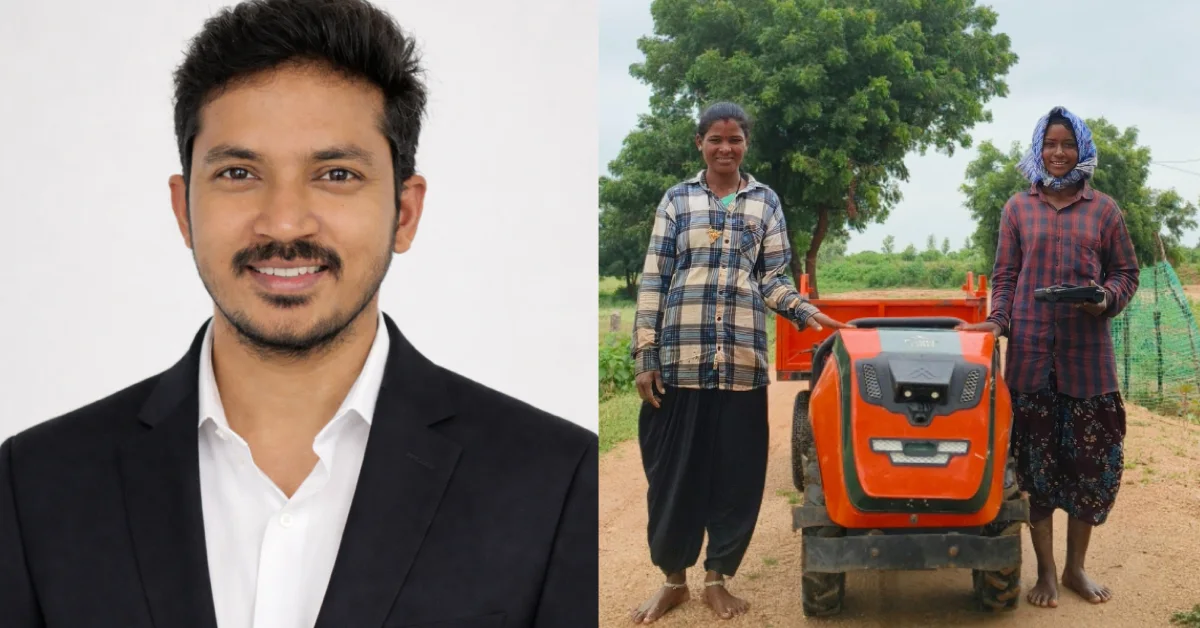
For agricultural engineer Sreekanth Reddy Vajrala, this wasn’t an abstract policy problem, it was a real operational gap that farmers repeatedly faced on the ground.
Instead of building another software platform or advisory app, he chose a harder path: build a physical robot that farmers could actually afford and operate.
That decision led to the creation of FarmRobo Technologies Pvt Ltd, a Hyderabad, India-based agritech startup focused on practical automation for small and mid-scale farms.
And its flagship machine, the FarmRobo iMog – has now earned global recognition after winning the Ag Robot of the Year 2025 award, along with the public-favourite vote at the international FIRA robotics event.
Building automation for farms that actually need it
While much of global agri-robotics targets large industrial farms, Vajrala’s focus remained firmly on smaller operations.
The core idea behind iMog was straightforward:
Make farm automation modular, electric, and remotely operable, without requiring large capital investment or specialised technical staff.
The robot is designed as a multi-purpose autonomous platform capable of handling several farm activities through interchangeable attachments.
Depending on configuration, the machine can support:
- Spraying operations
- Mechanical weeding
- Transport tasks
- Field logistics
- Precision crop operations
Unlike heavy diesel tractors, the system runs fully electric, reducing both fuel dependency and operational cost over time.
For many farmers facing seasonal labour shortages, the value proposition isn’t futuristic autonomy, it’s reliability during peak workload windows.
Designed for labour-scarce rural realities
In many farming regions, labour availability has become unpredictable due to urban migration and rising wage pressure.
This creates operational bottlenecks during:
- Sowing windows
- Weed-control cycles
- Crop protection periods
- Harvest preparation stages
Missing even a few days in these windows can significantly reduce yields.
Similar efforts to improve farmer productivity are emerging across India, including initiatives like the AgriFeeder farmer platform that help growers access stronger supply networks and market connections.
The iMog platform attempts to address this structural risk by allowing:
- Remote-controlled operation when needed
- Semi-autonomous programmed movement
- Continuous repetitive task execution
This allows one operator to manage work that traditionally required multiple workers in the field.
Global recognition validates the approach
The robot’s recent international award marks a major milestone not just for the startup but also for India’s emerging agritech hardware ecosystem.
Judges at the global robotics competition highlighted:
- Real-world deployability
- Affordability focus
- Multipurpose design
- Readiness for small-farm environments
Winning both the jury selection and public vote signals that the product’s positioning resonates beyond domestic markets.
For a bootstrapped startup, such recognition significantly strengthens credibility with potential partners, distributors, and institutional buyers.
Why practical robotics may define the next agritech wave
Over the past decade, agritech investment globally has heavily favoured:
- farm analytics platforms
- satellite monitoring tools
- AI advisory systems
But physical automation, especially accessible robotics, is increasingly seen as the next major frontier.
The reason is simple:
Software can advise farmers. Robots can replace missing labour.
As rural workforce patterns continue shifting worldwide, machines capable of handling repetitive agricultural work may become less of an innovation and more of a necessity.
Startups like FarmRobo are positioning themselves at precisely this intersection: combining electric mobility, remote operation, and modular attachments into deployable field machines rather than experimental prototypes.
From engineering problem to farm-level solution
For Vajrala, the journey reflects a growing trend among Indian deep-tech founders: solving infrastructure-level operational problems rather than building purely digital products.
Instead of chasing scale through software downloads, the company’s approach is rooted in field deployment, one robot, one farm, one workflow at a time.
If labour shortages remain one of agriculture’s defining structural challenges, machines like iMog may increasingly shift from niche innovation to everyday farm equipment.
And that shift could redefine what “mechanisation” means for small farmers in the decade ahead.