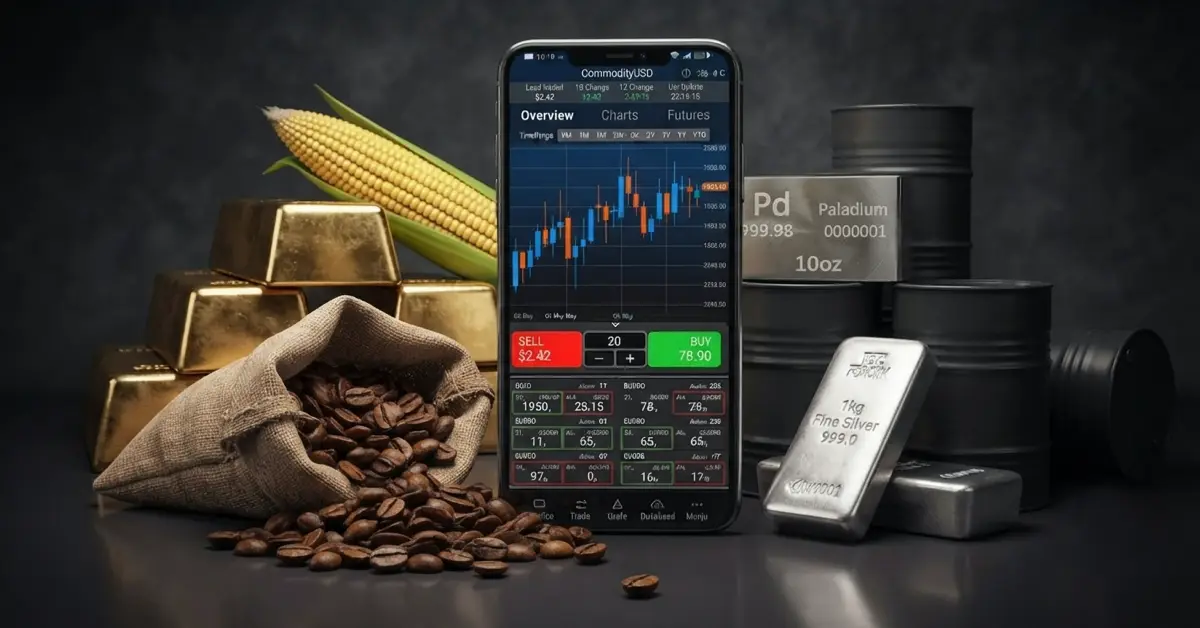
Global commodities markets connect economies, industries, producers, and traders through assets such as energy, metals, and agricultural products. Their prices can respond to changing economic conditions, supply patterns, geopolitical developments, and market sentiment.
The past year shows how differently commodity groups can behave at the same time. The World Bank’s April 2026 outlook projects energy prices up about 24% in 2026 and precious metals up about 42% to record highs, while agricultural prices are expected to fall around 6%. Monthly prices in March 2026 reached their highest level since 2022, driven largely by supply fears linked to the Middle East. A trader who treats ‘commodities’ as one category would miss most of that spread.
Understanding these influences is important for anyone exploring commodity market trading as part of a broader market strategy. Rather than focusing only on short-term price movements, traders can benefit from studying market fundamentals, volatility, timing, risk exposure, and the factors influencing individual commodities. A structured approach supports more informed decisions while helping traders understand the opportunities and risks of leveraged commodity products.
Market Fundamentals Shaping Commodity Trading Decisions
Understanding supply, demand, economic conditions, and market sentiment provides a stronger foundation for evaluating commodity price movements.
1. Understanding Supply And Demand Dynamics
Commodity prices are strongly influenced by changes in supply and demand. Production disruptions, weather conditions, transportation challenges, consumption patterns, and industrial requirements can affect market availability and pricing. Traders should therefore examine the fundamental factors behind an asset rather than relying solely on recent price movements. Understanding these dynamics provides useful context for evaluating potential market scenarios and deciding whether a commodity aligns with an individual’s trading strategy, experience, and risk tolerance.
2. Following Energy Market Developments
Energy commodities such as oil and natural gas are closely connected with global economic activity. Changes in production, inventories, transportation, geopolitical developments, and consumption can influence prices. Traders in these markets should watch relevant economic announcements and industry developments. Energy markets can also be highly volatile, making risk management especially important. Understanding the factors behind price movements can help traders interpret market changes more carefully rather than reacting impulsively to sudden fluctuations.
3. Evaluating Precious Metals Markets
Gold, silver, platinum, and other precious metals can respond to changing economic expectations, currency movements, interest-rate conditions, and investor sentiment. These markets often attract attention during periods of uncertainty, although prices can move in either direction. Traders should consider broader economic conditions alongside technical price information when evaluating opportunities. Examining historical volatility and understanding each metal’s characteristics can help you form a more balanced perspective before entering a leveraged position.
4. Tracking Agricultural Commodity Factors
Agricultural commodities can be influenced by seasonal production, weather patterns, crop conditions, transportation, global consumption, and inventory changes. Coffee, cocoa, sugar, and other agricultural products may therefore move on factors that differ from those affecting metals or energy. Traders interested in these markets should understand the underlying supply chain and monitor relevant developments. This broader perspective can help distinguish temporary price movements from changes driven by more significant market fundamentals.
Practical Strategies For More Informed Commodity Trading
Successful market participation requires more than identifying an asset with attractive price potential; it also involves planning, research, and disciplined risk management.
Traders exploring commodity market trading can compare markets by volatility, liquidity, trading hours, underlying factors, and personal experience. Some commodities may see sharper price movements than others, while certain events can suddenly shift market conditions. Establishing entry and exit criteria before placing a position can help reduce emotional decisions. Traders should also understand leverage and position sizing because leveraged products can magnify both potential gains and losses. A disciplined approach focuses on managing exposure rather than attempting to predict every market movement.
Risk Management Supporting Sustainable Trading Practices
Risk management is essential to approaching commodity markets responsibly, especially when trading leveraged products.
1. Setting Clear Risk Parameters
Before entering a trade, traders can establish how much capital they are prepared to risk and where they would exit if the market moves against them. Predefined parameters can help prevent emotional decisions during periods of volatility. Position sizing should reflect the trader’s experience, available capital, and tolerance for potential losses. Clear planning does not eliminate market risk, but it can create greater discipline when conditions change unexpectedly.
2. Understanding The Impact Of Leverage
Leverage allows traders to control a larger market position with a smaller amount of capital, but it can also magnify losses. This makes understanding leverage particularly important for commodity CFD trading. Traders should carefully evaluate how price movements could affect their account before opening a position. Using appropriate position sizes and understanding margin requirements can help traders maintain better control over their exposure while avoiding unnecessarily large commitments.
The evidence on leveraged products is sobering. When ESMA agreed its CFD restrictions in 2018, analyses by national regulators across the EU found that 74% to 89% of retail accounts typically lost money, with average losses of €1,600 to €29,000 per client. The response was leverage limits, negative balance protection, and standardised risk warnings. Those figures are several years old, but the mechanism is unchanged: leverage magnifies small price moves in both directions, so position size matters as much as the market view.
3. Using Stop-Loss And Take-Profit Tools
Risk-management tools can help traders establish predetermined levels for closing positions. A stop-loss may limit potential losses when prices move unfavorably, while a take-profit order can automatically close a position when it reaches a selected target. These tools can support disciplined execution and reduce the need to make decisions during sudden market movements. However, they do not guarantee a specific execution price under every market condition.
4. Reviewing Trading Decisions Regularly
Keeping a record of trades can help traders identify recurring strengths and weaknesses in their decision-making. Reviewing entry reasons, exit decisions, market conditions, and risk levels can reveal patterns that may otherwise remain unnoticed. Regular evaluation encourages traders to refine their strategies based on experience rather than short-term outcomes. This process can also help distinguish well-planned decisions from trades driven primarily by emotion or sudden market reactions.
Digital Tools Improving Access To Commodity Markets
Technology has changed how traders monitor markets, analyze price movements, and manage positions across different devices.
Modern trading platforms can provide access to charts, market information, price alerts, order-management tools, and other features that support decision-making. Digital access also allows traders to monitor commodities without being physically connected to a traditional trading environment. However, convenient technology does not remove the need for market knowledge. Traders still need to understand the instruments they are using, review associated costs, monitor volatility, and recognize that market conditions can change quickly.
Making More Informed Commodity Market Choices
Global commodity markets offer exposure to diverse areas including energy, precious metals, and agriculture. A more informed approach requires understanding market drivers, evaluating volatility, managing leverage, and setting clear risk parameters. Traders can strengthen their decision-making by combining research with disciplined planning rather than focusing solely on potential returns.
Forecasts themselves can change quickly. In October 2025, the World Bank expected commodity prices to fall about 7% in 2026. After the war in the Middle East began, its April outlook projected a 16% rise instead, with risks tilted toward higher prices. If institutions with full research teams revise their view that sharply, a trader using leverage is better off treating any single forecast as one scenario, not a plan.