Studying no longer has physical weight — it lives on screens, in tabs, and in constant notifications. That shift has made student life faster and more flexible, but also harder to switch off.
There was a time when studying had a certain physical weight to it. Heavy textbooks, printed lecture notes, library cards, folders full of half-understood material. A student could almost measure the semester by the mess on the desk. Now, much of that weight has disappeared into screens. It sounds convenient, and often it is, but something more complicated has happened too. Student life has not simply become easier. It has become faster, more exposed, more flexible, and, in some ways, harder to escape.
Technology in student life is not only about laptops and online classes. It is about the way students think, plan, panic, communicate, compare themselves, and recover from failure. A missed lecture can be watched later. A difficult concept can be searched in seconds. A group project can be completed without anyone sitting in the same room. At the same time, attention is constantly under attack. The same device that opens a Stanford lecture also opens TikTok, messages, games, and a dozen unfinished tabs. That pull is measurable: a 2025 HEPI–Kortext survey of UK undergraduates found 92% now use AI tools in their studies, up from 66% the year before — a sign of how fast digital habits are moving through campus life.
For many students, especially at college and university level, digital tools now shape the entire academic routine. A student may start the day checking Google Calendar, download readings from Moodle or Canvas, join a Zoom seminar, use Grammarly to polish an essay, ask ChatGPT for brainstorming help, and finish with a YouTube explanation of a topic the professor made sound impossible.
The academic writing support online for students is for those who need structured academic writing help during intense study periods, especially when deadlines, part-time work, and coursework begin to collide. That does not mean technology replaces learning. The real question is how technology affects students when digital support becomes part of almost every decision around learning.
The student’s day has become less linear
Before digital learning became normal, studying usually followed a clearer pattern: attend class, take notes, read, write, submit. Now a student’s day is fragmented. A person may study in short bursts between work shifts, public transport, family responsibilities, and social media interruptions. This is one of the biggest changes in educational technology for students: learning has become portable.
That portability is powerful. A student working part-time can listen to a recorded lecture at night. Someone who feels shy in class can ask questions in a discussion forum. International students can translate unfamiliar words instantly. Students with disabilities can use screen readers, captions, speech-to-text tools, and digital planners.
A digital essay writing service can also become part of this wider support system when students need help understanding structure, academic tone, citation logic, or the expectations behind a difficult assignment. Used responsibly, that kind of support works best as guidance rather than a substitute for thinking.
Still, flexibility has a hidden cost. When studying can happen anywhere, it can also feel as if it should happen everywhere. Rest becomes suspicious. Free time starts to feel inefficient. A student may close the laptop and still feel followed by unread notifications from university platforms.
Digital tools changed how students solve problems
The biggest shift is not access to information. It is access to immediate help. Twenty years ago, confusion lasted longer. A student who did not understand a concept had to wait for office hours, ask a classmate, or search through books. Now confusion often lasts thirty seconds.
Common digital tools for students include:
| Tool | How students use it |
|---|---|
| Google Scholar | Finding academic sources |
| Notion | Organizing notes and deadlines |
| Grammarly | Editing grammar and clarity |
| Quizlet | Memorizing terms |
| ChatGPT | Brainstorming, explanations, outlines |
| Coursera / Khan Academy | Extra lessons beyond class |
This changes confidence. Students are less dependent on one teacher or one textbook. A weak lecture does not automatically mean weak understanding. If a professor explains statistics badly, a student can find another explanation from Khan Academy, MIT OpenCourseWare, or a random educator on YouTube who somehow makes regression analysis sound normal.
But there is a strange side effect. When help is always available, patience becomes thinner. Some students become uncomfortable sitting with difficulty. They expect every problem to have a quick explanation, a template, or a shortcut. Real learning often requires slowness, and technology is not naturally slow.
Online learning made education more democratic, but not equal
The impact of technology on education is often described in bright language: access, innovation, personalization. Some of that is true. During the COVID-19 pandemic, universities across the world moved online almost overnight. Harvard, Oxford, the University of California system, and thousands of smaller institutions had to rethink teaching quickly. At its peak, UNESCO recorded more than 1.6 billion learners in over 190 countries out of school — the largest disruption to education in history. It was messy, but it proved something important: education could continue outside the classroom.
For students in remote areas, online education can be life-changing. For working students, it can be the difference between staying enrolled and dropping out. For students who learn better at their own pace, recorded lectures are not a luxury. They are a survival tool.
Yet technology did not remove inequality. It exposed it. UNESCO found that half the world’s students lacked a household computer during the pandemic, and 43% had no internet access at home. Not every student has a quiet room, fast internet, a good laptop, or parents who understand why silence matters during an exam. A student attending class from a crowded kitchen is not experiencing the same digital education as someone with a private study room and a MacBook.
So, how technology affects students depends heavily on their environment. The tool may be the same. The experience is not.
Communication became easier, and sometimes colder
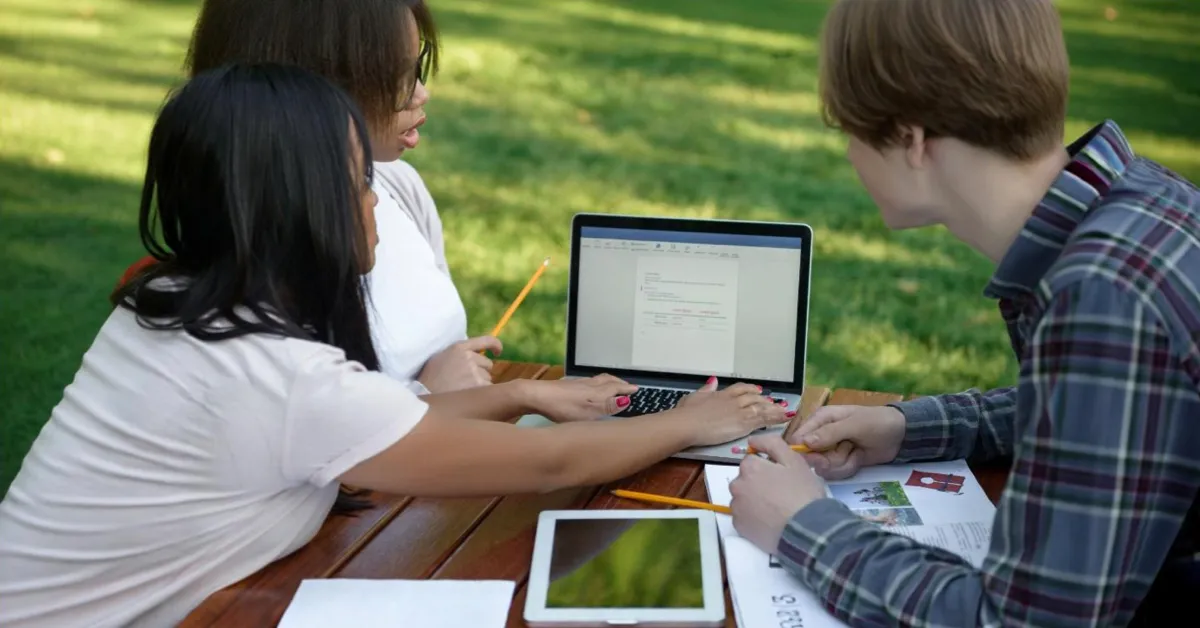
Technology has made communication faster. Students can message professors, collaborate through Google Docs, join Discord study groups, and receive feedback without waiting for the next class. Group projects no longer require everyone to meet in a library at 5 p.m.
But faster communication is not always better communication. Students may receive too many messages from too many platforms — email, Slack, WhatsApp, university portals, group chats. Important information gets buried. A deadline may be announced in one place, changed in another, and discussed in a third.
There is also the emotional distance. A student can disappear from an online course more quietly than from a physical classroom. No one sees the tired face, the confusion, the embarrassment. Digital education can be efficient while still feeling lonely.
Technology changed academic pressure
One uncomfortable truth: students are now surrounded by comparison. LinkedIn shows classmates getting internships. Instagram shows beautiful study desks and color-coded notes. Productivity apps turn studying into performance. Even learning can become aesthetic.
This pressure is subtle. A student may not only ask, “Am I studying enough?” but also, “Am I studying in the right way? Using the right apps? Building the right profile?” Technology creates opportunities, but it also creates the feeling that everyone else is moving faster.
At the same time, academic dishonesty has become more complicated. AI tools can generate essays, solve equations, summarize books, and imitate academic tone. That shift is already showing up in how students themselves feel about it: RAND’s American Youth Panel found AI use for homework rose from 48% to 62% between May and December 2025, even as 67% of students said the habit was eroding their critical thinking. Universities now face a difficult task: they must teach students how to use these tools responsibly instead of pretending they do not exist. Banning everything is lazy. Allowing everything is careless. The answer is somewhere in the uncomfortable middle.
The future student will need judgment, not just access
The student of the future will not be the one who knows the most facts. Facts are already everywhere. The stronger student will be the one who can judge quality, ask better questions, notice weak arguments, manage attention, and use technology without becoming passive.
Educational technology for students should not only make tasks faster. It should make thinking deeper. A calculator did not destroy mathematics. Google did not destroy research. AI will not automatically destroy writing. But each tool changes what effort means.
A good student now needs a different kind of discipline. Not just “study harder,” but choose carefully. Which tool helps? Which one distracts? Which shortcut teaches something, and which one quietly removes the learning?
What students may need to understand next?
Technology has changed student life in obvious ways: online classes, digital textbooks, AI tools, instant research, flexible schedules. But the bigger change is emotional. Students live with more possibility and more noise. They can learn almost anything, but they must fight harder to focus on one thing.
Maybe that is the real story. Technology did not make student life simple. It made it wider — more open, more demanding, more personal. A student today carries a university, a library, a tutor, a planner, and a distraction machine in one pocket. What happens next depends less on the device itself and more on whether students are taught how to use it with intention.