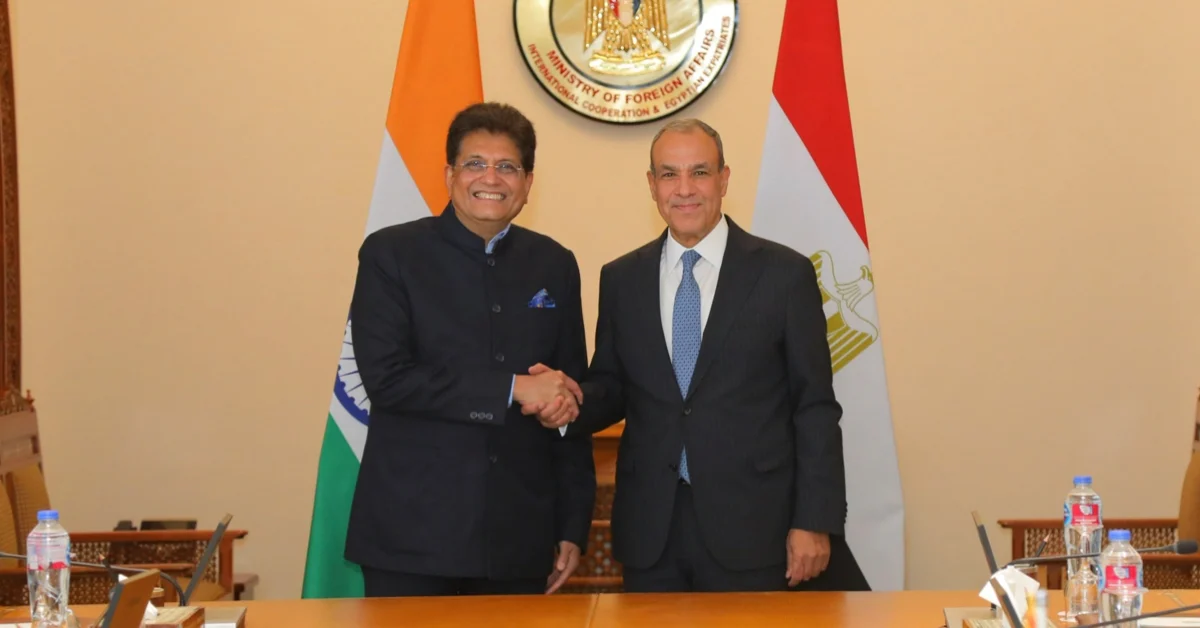
India and Egypt have agreed to explore a trade agreement, setting up a working group to draft the terms of reference for a preferential trade agreement, free trade agreement, or comprehensive economic partnership. The decision came at the close of Commerce and Industry Minister Piyush Goyal’s two-day visit to Cairo on 15–16 November, according to a release from the Press Information Bureau (PIB).
The group’s remit is narrow for now. It will work out how a deal could be structured across goods, services and investment, and will first weigh what each side stands to gain.
Both governments also agreed to work toward lifting bilateral trade to $12 billion. PIB gave no deadline. The base is growing fast: merchandise trade between April and September 2026 reached $5.04 billion, 64 per cent higher than the same period a year earlier, PIB said, citing DGCIS data. In FY 2025-26, India shipped $3.87 billion of goods to Egypt and imported $2.60 billion.
Goyal co-chaired the 7th India–Egypt Joint Trade Committee with Egypt’s Minister of Investment and Foreign Trade, Mohamed Farid Saleh, on 15 November. The committee was elevated to ministerial level, and both ministers signed its agreed minutes.
Payments got attention too. The two sides discussed linking India’s UPI with Egypt’s Instapay, settling trade in local currencies, and using India’s digital public infrastructure to speed up Egypt’s digital transformation. The release gave no timeline for any of these.
On investment, roughly 70 Indian companies operate in Egypt with about $5 billion invested, PIB said. Egypt invited more Indian capital into automotive and auto components, pharmaceuticals, chemicals, textiles, food processing, engineering, renewable energy and logistics, with the Suez Canal Economic Zone a focal point. Goyal called on Prime Minister Mostafa Madbouly and met Foreign Minister Badr Abdelatty, Industry Minister Khaled Hashem, Planning and Economic Development Minister Ahmed Rostom and Transport Minister Kamel Wazir. The transport talks touched on port modernisation, shipbuilding, airport development, and affordable metro rail.
The Indian business delegation also met officials of Afreximbank, the African Export-Import Bank, to discuss project finance, export development and the Africa Trade Gateway. PIB said the talks explored ways to help Indian businesses engage with African markets.
On 16 November, nearly 50 Indian and Egyptian startups presented at the India–Egypt Startups Forum, which Goyal attended with Rostom. Indian founders asked for distribution partners, pilot projects, certification support and local manufacturing options. Goyal said in a post on X that more than 140 Indian companies and startups travelled with the delegation, and that he was confident the engagement “will take India-Egypt business collaboration to the next level.”
After meeting Mohamed Ismail Mansour, chairman of Infinity Energy, Goyal pitched India to Egyptian business leaders in another X post as “a golden opportunity for businesses in Egypt to partner in India’s growth story.”
Not everything was settled. The two sides raised GOEIC (General Organization for Export and Import Control) registration for Indian ceramic tile companies, outstanding commercial payments, trade remedies, and Indian firms’ participation in Egyptian public procurement tenders. PIB did not report a resolution on any of them.
The visit was Goyal’s first bilateral trip to an African country. The next Joint Trade Committee meeting is due in New Delhi in 2028, or earlier if both sides agree. He also invited Egyptian businesses to the Vibrant Gujarat Summit 2027 and to Bharat Mobility 2027, scheduled for 4–9 February 2027 in New Delhi.