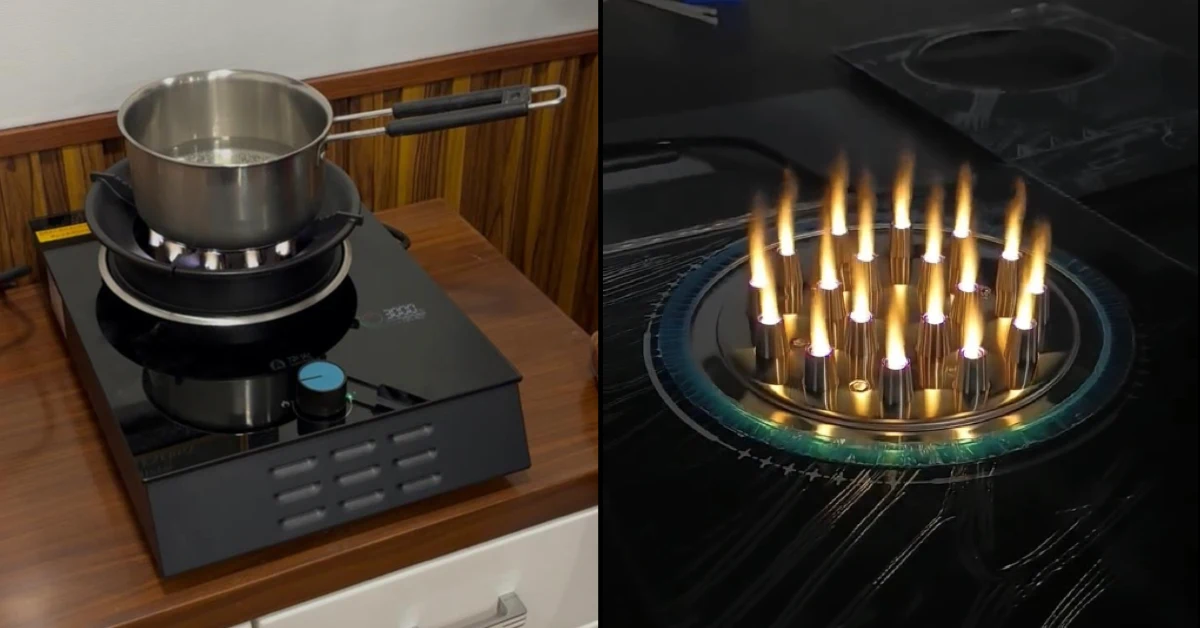
Timing matters in product launches. And few moments could be better timed than a gas-free cooking appliance arriving just as LPG prices surge, cylinders run short in several cities, and geopolitical disruption rattles fuel supply chains. That is exactly the moment the APAPL Electric Flame Plasma Stove found itself in — boosted by a social media post from Union Minister Pralhad Joshi and amplified by a wave of coverage from major Indian publications.
Yesterday, an Indian company demonstrated an imported stove that uses electricity to generate flame-like burners, similar to LPG, for cooking. I was truly impressed by this innovative technology and would like to see Indian manufacturers adopt and scale it domestically.
— Pralhad Joshi (@JoshiPralhad) April 10, 2026
When… pic.twitter.com/AQaNePu9N4
The excitement is understandable. The questions are worth asking anyway.
What the technology actually is
Plasma is the fourth state of matter — a gas that has been energised so intensely that electrons separate from their atoms, creating an ionised, highly energetic state. This is not exotic science fiction. Plasma exists in lightning, in neon signs, and in industrial cutting equipment used across manufacturing sectors.
A plasma stove applies this phenomenon to cooking. An electric current inside the device creates a plasma arc — a concentrated, directed stream of extreme heat that produces a visible, flame-like output. Unlike an induction cooktop, which heats cookware indirectly through a magnetic field and only works with specific utensils, a plasma stove generates direct radiant heat. The result, in theory, is a cooking experience that feels far closer to a gas burner — visible flame, all-utensil compatibility, instant response — but powered entirely by electricity and producing no combustion emissions.
On those technical fundamentals, plasma cooking is a real and established concept. The question is whether it has made the jump from industrial application to a reliable, affordable kitchen appliance.
What we know about APAPL — and what we don’t
ADVNCEPROTEC AUTOMATION PRIVATE LIMITED (APAPL) is a Greater Noida-based company that describes its focus as automation, electronics, safety, and defence solutions. The plasma stove product appears on IndiaMart with a specification sheet listing power options from 2,500W to 6,000W, a stated temperature range, and a price of approximately ₹35,000 for single and double burner variants.
What is not publicly available: independent laboratory testing of those specifications, Bureau of Indian Standards (BIS) certification details, confirmed retail distribution, or any third-party verification of efficiency or safety claims. The demonstrations circulating online — including the clip shared by Minister Joshi — show the product working, but social media clips are not the same as independent performance data.
To be clear, this is not an accusation of fraud. Early-stage products often exist in exactly this space — real technology, genuine intent, limited commercial infrastructure. But readers considering a ₹35,000 purchase deserve to know where on that curve this product sits. Right now, based on publicly available information, it sits closer to the beginning.
Why India has every reason to want this to work
Set aside the product-specific questions for a moment, because the structural case for plasma cooking in India is genuinely compelling.
India has over 300 million households that depend on LPG for daily cooking. Cylinder prices have risen repeatedly over the past two years. Piped gas infrastructure remains concentrated in urban centres. Meanwhile, PM Surya Ghar Yojana is actively pushing rooftop solar adoption — which means a growing number of Indian homes are generating their own electricity. A cooking appliance that runs on electricity and eliminates the cylinder supply chain entirely is not just a convenience upgrade; it is a structural fit with where India’s energy policy is headed.
The commercial kitchen segment makes the near-term case even stronger. Cloud kitchens, food trucks, and hotel kitchens face real logistical friction around LPG storage and refilling. A high-efficiency electric alternative that works with all existing cookware and delivers gas-like performance would have obvious operational appeal — and at ₹35,000, the price point is far less prohibitive for a commercial buyer than a household one.
The honest challenges
Three barriers stand between the plasma stove and mainstream Indian kitchen adoption, and none of them are trivial.
The first is power draw. A 2,500W–6,000W appliance requires a stable, dedicated electrical circuit. Many Indian homes — particularly in Tier-2 cities and rural areas — are not wired to handle sustained loads at that level without tripping breakers or risking damage. This is not an insurmountable problem, but it is a real infrastructure dependency that replaces one supply constraint with another.
The second is price. At ₹35,000, the plasma stove is approximately 10 to 15 times the cost of a standard LPG stove. For household adoption to reach any meaningful scale, manufacturing needs to localise, competition needs to enter the market, and the price needs to fall substantially — likely below ₹10,000–15,000. That is possible with scale, but it has not happened yet.
The third is awareness and after-sales infrastructure. Even if a consumer buys the product today, the support ecosystem — service centres, spare parts, trained technicians — does not yet exist in any meaningful way outside of the manufacturer’s own channels. For a high-value kitchen appliance, that is a significant adoption barrier.
What would change the picture?
The plasma stove story is not over — it may barely have started. But for it to move from viral curiosity to a genuine kitchen alternative, several things would need to happen in sequence.
BIS certification would establish baseline safety and performance standards and give buyers a credible reference point. Independent third-party testing of efficiency and temperature claims would let the product speak for itself without relying on manufacturer specs. Local manufacturing partnerships — potentially under Make in India incentives — would drive down cost. And a distribution network beyond IndiaMart B2B inquiries would make the product accessible to the consumers it is ostensibly targeting.
None of that is impossible. India has seen faster adoption curves for clean energy technology when the policy environment, pricing, and infrastructure aligned. The plasma stove could follow a similar path.
Bottom Line
The plasma electric stove is solving a real problem with real technology. The Indian need — reducing LPG dependence, integrating with solar energy, enabling cleaner household cooking — is genuine and growing. But as a product available today, it is early-stage, commercially unverified, and priced for commercial kitchens rather than household budgets. Watch this space seriously. Just don’t disconnect your gas connection yet.