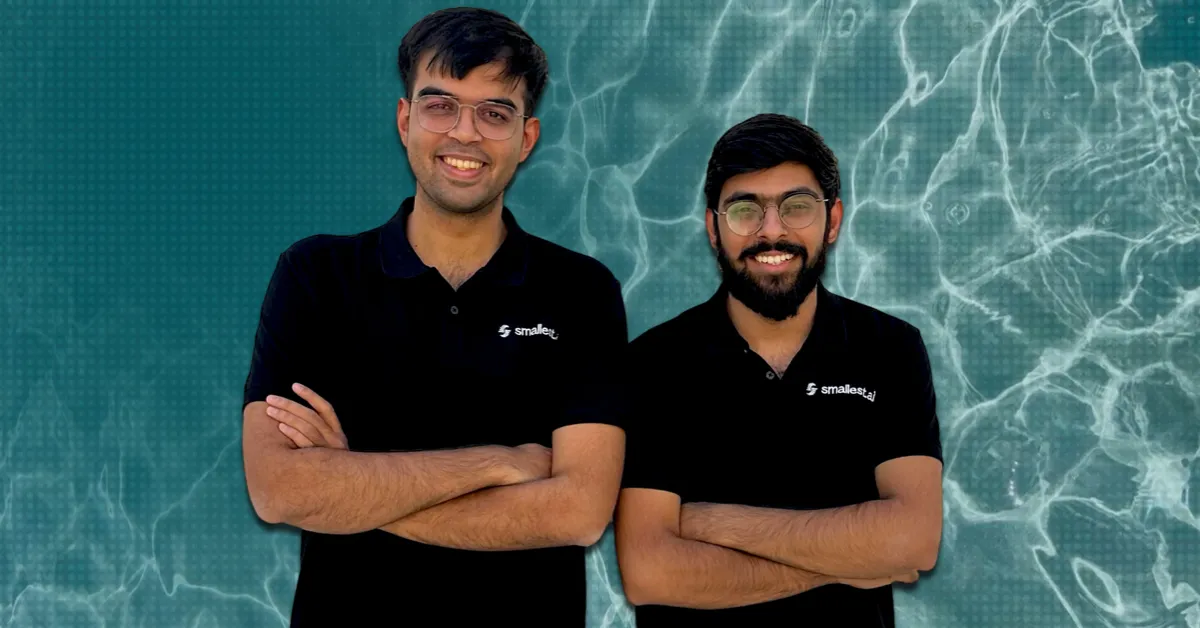
Smallest.ai, the Bengaluru-based voice AI company, has raised $13 million in a Series A round led by Seligman Ventures, with participation from existing backers Sierra Ventures and 3one4 Capital, alongside Better Capital, Upsparks Capital, Schema Ventures, Tiny VC, DeVC and Mission Street Capital. The round takes the company’s total funding past $21 million.
Voice AI is one of the more crowded corners of enterprise AI right now, and Smallest.ai is a minnow next to the category’s better-funded names — rival ElevenLabs raised $500 million in February alone, and Fish Audio recently pulled in $52 million for its open-source speech platform. What Smallest.ai is selling instead is architecture: a real-time speech-to-speech system built to process listening, reasoning and response in parallel rather than waiting for a full audio clip before generating a reply, aimed at cutting the latency that makes AI voice agents sound robotic on calls with financial services, healthcare and contact-centre customers.
Founded by IIT Guwahati graduates Sudarshan Kamath (CEO) and Akshat Mandloi (CTO), Smallest.ai raised an $8 million seed round in October 2025 led by Sierra Ventures to build its low-latency Lightning algorithm and 4-billion-parameter Electron v2 model. A May hardware partnership with Tenstorrent claimed the ability to run 550 simultaneous voice calls for roughly $27,000 on 27 P100 accelerators, versus close to $100,000 on 11 NVIDIA L40S GPUs for comparable throughput — a cost argument the company is leaning on hard as it courts regulated industries where call volumes are high and margins on automation are thin.
Also Read: River Mobility raises $120 Mn Series C led by Elev8, Claypond
“Voice AI has gone through three generations of innovation, but each generation has ultimately hit the same wall. The industry has focused on making models larger when the real challenge is architectural. Humans don’t wait for someone to finish speaking before they begin thinking. We listen, think, and respond simultaneously. Voice AI needs to work the same way. That’s why we built Smallest.ai around a real-time architecture that processes speech as it arrives, enabling faster, more natural conversations without sacrificing intelligence. By rethinking the stack instead of simply scaling models, we’re reducing latency to the point where voice interactions feel genuinely human.” said Sudarshan Kamath, founder and CEO of Smallest.ai
The company, which currently employs close to 60 people, plans to use the fresh capital for product development, hiring and commercial expansion across financial services, healthcare, contact centres and business process outsourcing. With less than 1% of global voice interactions currently AI-powered, against a market industry forecasts expect to grow from $2.4 billion in 2024 to $47.5 billion by 2034, Smallest.ai’s bet is that architecture and cost efficiency can carve out enterprise share even against rivals with far deeper war chests.