There is a particular kind of 2 AM that only parents know. The diaper is finished. The baby is awake. The last pack ran out two days earlier than expected, because it always does. You open Blinkit, find diapers, and place the order. Twelve minutes later, they are at your door. Problem solved — mostly.
But what if the issue is not the diaper? What if it is the feeding bottle your three-month-old has decided she will only accept after the original broke, and the replacement you ordered on FirstCry three days ago has not arrived yet? What if the stroller you need for a trip next week requires a live demo before you spend ₹18,000 on it, but you live in Gurugram and the nearest store is 40 minutes away on a good day?
This is where India’s quick commerce giants quietly run out of road. Blinkit, Zepto, and Swiggy Instamart carry baby care products — diapers, wipes, lotions — but they are grocery platforms that also carry baby products. Their dark stores stock roughly 2,000–3,000 SKUs in the entire baby category. That is fast convenience. It is not baby commerce.
A small but increasingly funded set of startups thinks that gap is a business. And the data behind the parenting market in India suggests they may be right.
What the Horizontals Actually Offer
To be fair to Blinkit and its peers, they were never designed to be baby stores. They built their infrastructure around high-frequency, low-consideration purchases — milk, bread, chips, shampoo. Baby products piggyback on that infrastructure. You can get Pampers, MamyPoko, and Huggies on Blinkit in under 15 minutes, and those three brands alone account for a large chunk of what urban Indian parents buy every week.
But the category ceiling is low. A look at what major platforms actually carry reveals a pattern: diapers, wipes, some feeding essentials, and a handful of baby skincare brands. Swiggy Instamart, one of the more expansive platforms, had a stroller listed in its baby care section at peak availability — a single model. The moment you need a specific feeding bottle, a teething toy from a particular brand, a size 3T jacket, or anything resembling baby gear beyond consumables, you are back on Amazon with a 2–3 day wait.
“Convenience is not just about a 10-minute delivery. It is about finding the right product at the right time from a trusted brand without compromise, all in one place.” said Amit Sah, Founder & CEO, OZi, in a statement
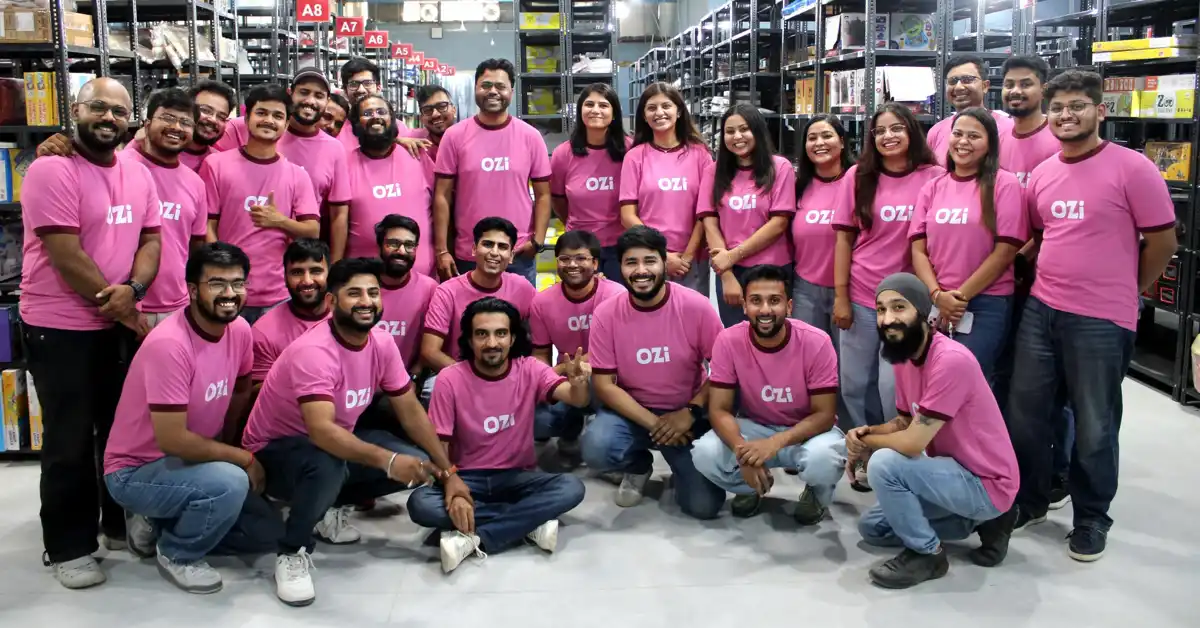
This is the argument OZi is building its entire company around. Founded in 2025 by Amit Sah — a serial entrepreneur who has worked at Ola Auto, led OYO’s international expansion across Mexico, the US, Brazil, and Canada, and joined Pristyn Care early in its unicorn journey — OZi launched in Gurugram with one clear thesis: parents deserve a platform built around them, not a grocery app with a baby aisle.
What OZi Is Actually Building
The product range tells the story plainly. OZi carries over 15,000 products for children aged 0–12 across fashion, toys, nursing and feeding essentials, pharmacy, school supplies, baby gear, consumables, and gifting. That is not a baby aisle. That is a baby store.
But range alone does not explain why investors have written two cheques in five months. OZi’s $3.3 million seed round in October 2025 was followed by a $6.2 million Series A round in March 2026 led by RTP Global, with Blume Ventures, Huddle Ventures, and Zeropearl VC all returning. The angel table includes Kishore Biyani and founders from Unacademy, Mosaic Wellness, Livspace, Vetic, Magicpin, Spinny, Pristyn Care, and Handpicked — people who understand consumer loyalty and repeat-purchase behaviour.
What sets OZi apart operationally is a set of features that a grocery quick-commerce platform would never build:
Try & Buy: apparel and gear can be evaluated at home. Keep what fits, return the rest immediately. No waiting, no driving to a store, no judgment about returning a ₹2,400 onesie that ran small.
Demo Cart: for strollers and other large baby gear, OZi sends multiple options to the parent’s home. Compare them on your own floor. No showroom visit, no sales pressure.
Scheduled delivery: parents can time deliveries around nap schedules and feeding windows. An 11 AM delivery window when the baby is asleep is more valuable than a 10-minute delivery that rings the doorbell at exactly the wrong moment.
In under a year, OZi has gone from a blank sheet to a humming operation with a high-grade team, a robust warehouse backbone, and tightly run on-ground operations.” — said Sajith Pai, Partner, Blume Ventures
The Vertical Quick Commerce Thesis
OZi is not alone in this bet. Peeko, a Bengaluru-based competitor, raised $3.2 million in seed funding in August 2025, positioning itself as a vertical platform for curated baby assortments and fast delivery. The convergence is not coincidental.
Investors who spent the last three years watching Blinkit, Zepto, and Instamart race each other on delivery speed and SKU breadth are now asking a different question: what categories justify a dedicated platform? The answers keep pointing to high-emotion, high-trust, repeat-purchase verticals. Parenting is near the top of that list.
The logic, as we noted in our Q1 2026 funding analysis, is about customer loyalty. Young parents repeat-purchase across a narrow set of trusted brands. They are not particularly price-sensitive on essentials — a ₹50 saving on diapers does not outweigh the risk of using an unfamiliar brand on a newborn. And once trust is established with a platform, switching costs are high. That is a fundamentally different customer profile from the grocery shopper toggling between Blinkit and Zepto based on who has the better offer that week.
How the Platforms Stack Up
| Feature | OZi | Blinkit | Zepto | FirstCry |
|---|---|---|---|---|
| Baby-only platform | Yes | No | No | Yes |
| Delivery speed | Same/next day | 10–20 min | 10 min | Same / next day |
| SKU depth (baby) | 15,000+ | ~500–800 | ~400–600 | 200,000+ |
| Try & Buy for apparel | Yes | No | No | No |
| Stroller demo at home | Yes | No | No | No |
| 24×7 operations | Yes | No | No | No |
| Pharmacy category | Yes | Limited | Limited | Limited |
| Currently available | Gurugram, Noida | 153 cities | 20+ cities | PAN India |
Note: Blinkit and Zepto SKU estimates for baby are approximate, based on publicly visible category listings. FirstCry’s depth advantage is significant, but its delivery speed is not in the quick commerce range. OZi’s current geographic footprint is its most significant limitation.
The Real Question Is Scale
The honest caveat in all of this is geography. OZi operates in Gurugram and Noida. Peeko is in Bengaluru. These are two startups in two cities. Blinkit is in 153 cities. The structural advantage of horizontal platforms — their dark store density, their logistics network, their existing customer base — is not something a Series A cheque dissolves overnight.
Sah is candid about this. In comments around the Series A, he framed OZi’s mission as solving “convenience consistently for young parents,” with scale described as a natural outcome of doing that well — not the primary objective. That is a deliberate sequencing of priorities, and it reflects the kind of operational discipline that Madhur Makkar of RTP Global cited when explaining the investment:
“The discipline and clarity with which he is building OZi, investing early in leadership, systems and capability, are creating a strong foundation for scale. We’re excited to partner with him as he builds a focused platform in a category that requires both deep consumer insight and operational rigour.” said Madhur Makkar — Principal, RTP Global
What RTP is backing is not just delivery speed. It is the idea that category depth, trust, and a curated parent experience can justify a standalone platform — the same logic that let Nykaa build a beauty business in a world that already had Amazon and Flipkart selling lipstick.
So — Can It Do What Blinkit Can’t?
On raw delivery time, no. Blinkit’s 10-minute model is a logistics achievement that a two-city startup cannot replicate in the near term, nor does it need to. The parent ordering diapers at midnight will still open Blinkit.
But the parent choosing a stroller, trying on baby clothes without leaving the house, building a cart of school supplies, pharmacy essentials, and a birthday gift in one session, and having it delivered at a time that actually works for them — that parent is not well served by any horizontal platform today. India’s baby care market is projected to reach $9.5 billion by 2031, and the online channel is the fastest-growing segment within it. The question is not whether there is a market. The question is whether vertical quick commerce can earn enough parent trust, fast enough, to capture a defensible piece of it before the horizontals notice and respond.
Given what Blinkit’s dark store model is optimised for — FMCG throughput, speed, scale — a stroller demo cart seems very far from its roadmap. That gap is exactly where OZi is planting its flag.