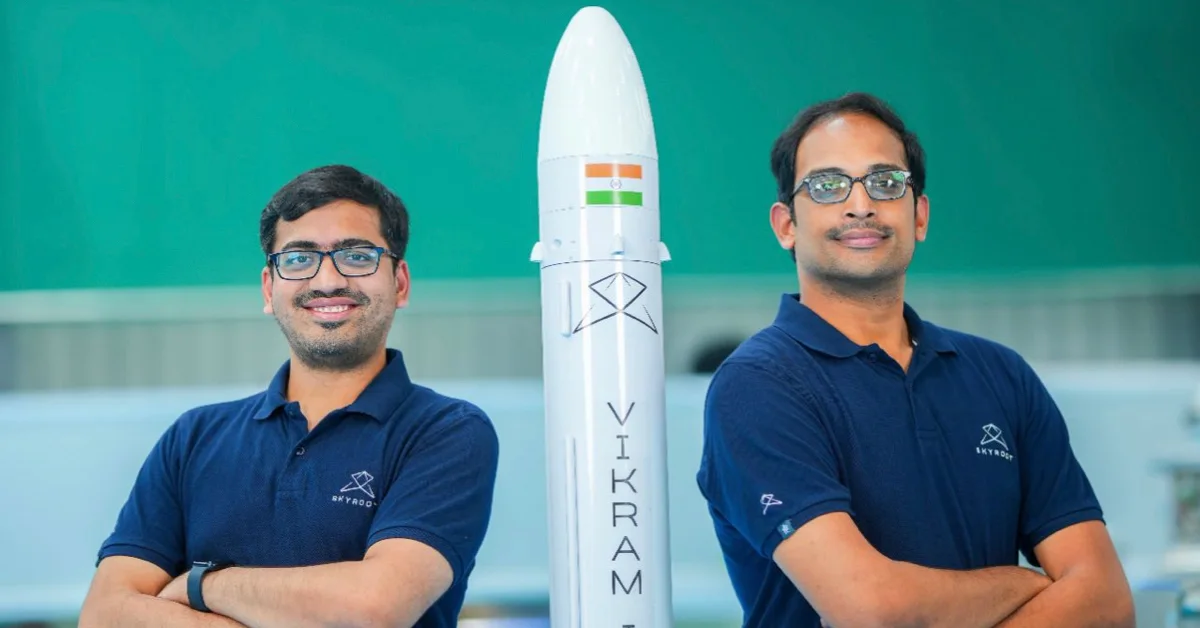
Skyroot Aerospace has raised $60 million (around ₹570 crore) in a round co-led by Sherpalo Ventures and Singapore’s sovereign wealth fund GIC, crossing a $1.1 billion valuation and becoming India’s first spacetech unicorn. The Hyderabad-based launch-vehicle company is already past the fundraising story — its Vikram-1 rocket is on the launchpad at Sriharikota, integration is underway, and the first private orbital launch from Indian soil is now weeks away.
The round also saw participation from BlackRock, Arkam Ventures, Playbook Partners, Shanghvi Family Office, and the founders of Greenko Group. Sherpalo Ventures founder Ram Shriram — an early Google investor and current Alphabet board member — joins Skyroot’s board as part of the deal. Total capital raised since inception stands at $160 million.
The timing of the close is not incidental. Co-founder and CEO Pawan Kumar Chandana told Moneycontrol the rocket is currently mid-integration at the spaceport: “We are right now at the spaceport, the whole rocket is there, it’s undergoing integration operations. In a few weeks, we are expecting the launch.”
Vikram-1 is a 23-metre, three-stage solid-fuelled rocket with a liquid-fuelled kick stage for precise orbital insertion. It is designed to carry up to 480 kg to a 500 km sun-synchronous orbit. Chandana noted the vehicle was developed in roughly four to five years — among the fastest orbital launch vehicle development timelines globally — and that 80 percent of the Vikram tech stack was already validated on the suborbital Vikram-S mission in 2022.
While the upcoming Vikram-1 mission will carry customer payloads, Skyroot is treating it as a development flight focused on validating systems and collecting performance data. Chandana indicated the company could run multiple developmental launches before transitioning to full commercial operations — noting that three development launches are the industry standard before declaring commercial readiness. Manufacturing for future Vikram vehicles is already underway.
“We are more like a cab or an Uber to go to space. Customers requiring unique destinations in space book the full rocket.” — Pawan Kumar Chandana, Co-founder & CEO, Skyroot Aerospace
That positioning is deliberate. Rather than competing with heavy-lift rideshare operators like SpaceX, Skyroot is going after customers who need dedicated launches into specific orbital paths — a segment where global supply remains constrained. Chandana expects 70 to 80 percent of Skyroot’s business to come from overseas markets, including the US, Europe, and Southeast Asia, citing limited orbital launch availability globally as the structural tailwind: “Very few companies in the world have orbital launch capability.”
On domestic competition — Agnikul Cosmos, the Chennai-based rocket startup that has also tested sub-orbital vehicles — Chandana was measured: “The market is good enough to absorb multiple players right now, but the early players will have the advantage because the rocket is proven.”
The unicorn milestone and the imminent launch arrive against a rapidly expanding backdrop. India’s space economy is valued at $8.4 billion today and projected to reach $44 billion by 2033, with nearly 400 spacetech startups now operating under the Indian Space Policy 2023 framework. Proceeds from the latest round will also fund the development of Vikram-2 — a cryogenic-stage vehicle capable of lifting up to 900 kg to LEO, targeted for maiden flight as early as 2027.
Skyroot is the fourth startup to enter the unicorn club in 2026, following Juspay (January), Neysa (February), and KreditBee (April) — and the first from India’s deep-tech hardware space.
“We at Skyroot are excited about the upcoming Vikram-1 launch, India’s first private orbital rocket, marking a significant milestone both for India and the global space sector.” said Pawan Kumar Chandana in a statement