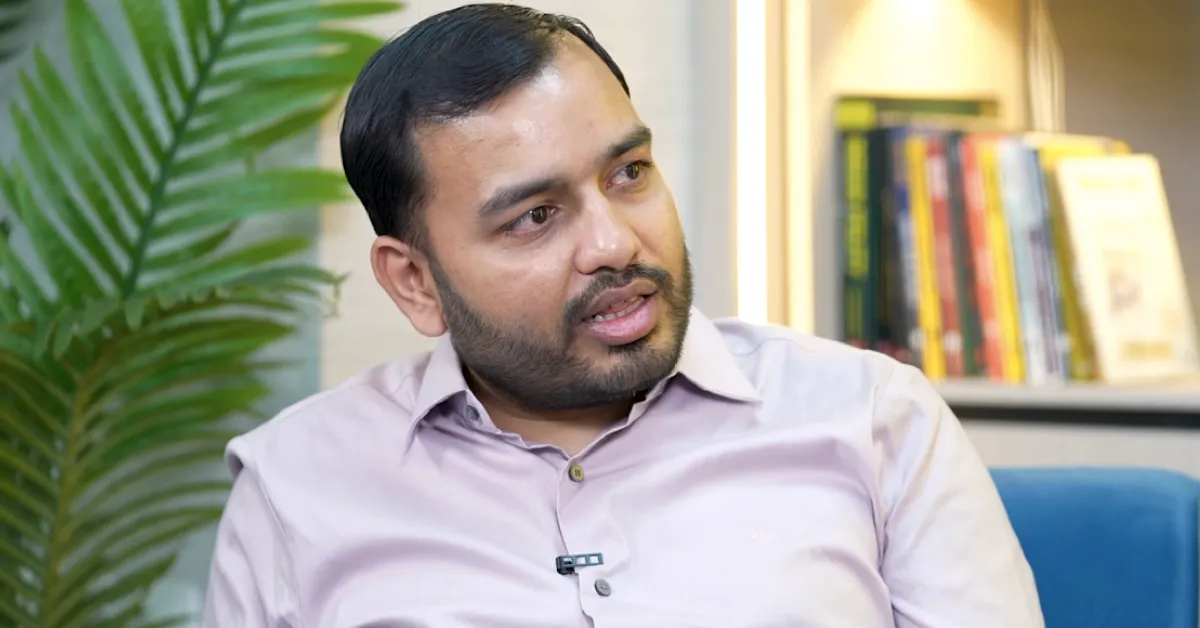
When Alakh Pandey — founder and CEO of Physics Wallah — sat down with News Pinch on May 13 and went on record against the National Testing Agency, he was not speaking as a businessman protecting market share. He was speaking as someone who built an entire company around a belief that the system had already failed millions of students once — and was watching it happen again.
The interview clip spread within hours of going live. Not because of algorithms. Because every line landed like something the country had been thinking for years, but nobody in power had been willing to say out loud.
NEET-UG 2026 was conducted on May 3 across the country. Around 22 lakh students appeared. Within days, the Rajasthan Special Operations Group had already found what it needed: a handwritten “guess paper” circulating on Telegram before exam day, containing around 410 questions — 120 of which matched the actual paper, including roughly 90 Biology questions and 30 Chemistry questions. Those papers were allegedly being sold for up to ₹2 lakh apiece. A preliminary probe also traced a similar set of material to a medical student in Kerala, who investigators believe circulated the content before May 3. The SOG arrested two men — Manish Yadav and Rakesh Mandavriya — as alleged masterminds of the operation.
“Even schools manage exams better than the NTA. Kids are depressed. Their families were heavily invested in this exam for two years.” — said Alakh Pandey in an interview with News Pinch on May 13
On May 12, the NTA announced the full cancellation of NEET-UG 2026 and confirmed that the exam would be reconducted. The Central Bureau of Investigation registered an FIR under provisions of the BNS, the Prevention of Corruption Act, and other applicable laws. NTA Director General Abhishek Singh said at a press conference in New Delhi that all examination fees would be refunded, and no fresh registration would be required — all candidature data and centre preferences from the May cycle would be carried forward.
The minimum the agency could do. Not a defence. A damage-control statement — and India’s medical aspirants know the difference.
The quote from Pandey’s interview that spread most widely painted a picture that the dry language of exam cancellations never reaches.
In a statement to ANI, Pandey described what this exam actually means to ordinary households: a mother selling jewellery to buy textbooks, a father skipping new clothes for three years, an entire family organising its finances and its emotional life around the single ambition of making their child a doctor. The child goes in happy, scores 600, comes home believing the sacrifice worked — and then the paper gets cancelled. That description is not rhetoric. It is the lived reality of NEET aspirants across Uttar Pradesh, Bihar, Rajasthan, and Madhya Pradesh — states where cracking NEET carries the weight of generational mobility. The betrayal, when a leak happens, lands on the whole family.
“There are 1 crore people who are unhappy and sad today. The children have not attended any party in 2–3 years, nor have they had any fun… his mother sold jewellery to buy his books. His father did not buy new clothes. And all of a sudden, the child goes to give the paper, and he is happy and says, ‘I am getting 600 marks’ — and now this,” said pandey to ANI
Pandey went further than grief. He argued that the cancellation itself was aimed at obscuring where the leak originated, and demanded criminal consequences not just for the sellers of leaked papers but for the buyers — the wealthy families who can afford ₹2 lakh per paper while students from ordinary homes prepare on free YouTube lectures. He questioned why those responsible for past leaks had not faced jail time, and in his most striking formulation, told ANI that these individuals should be treated the way the state treats those who pose a national security threat. He alleged that the paper leak was orchestrated by an organised nexus of insiders and influential intermediaries seeking quick money — and that strict action is rarely taken because those who conduct the raids are embedded in the same system that benefits from looking the other way.
This was not Pandey’s first public confrontation with the NTA. In 2024, he filed a Public Interest Litigation in the Supreme Court of India challenging the agency’s controversial grace-mark decisions — a case that led to a Supreme Court intervention. The NEET 2024 controversy had its own anatomy: an unusually high number of perfect scorers, grace marks awarded unevenly across centres, arrests in Patna and Godhra, and CBI investigations that, as educator Khan Sir noted in a PTI report, yielded no structural accountability. More critically, the 2024 paper leak was not detected by any government agency. It was students themselves who first flagged the irregularity to the government. The pattern — leak, detection by outsiders, delay, cancellation, probe, no systemic reform — has now played out twice in consecutive years.
The NTA was created in 2017 precisely to bring professional rigour to national entrance examinations. The argument for a dedicated agency was that ad hoc arrangements produced vulnerability. In the years since its establishment, the frequency and scale of examination-related fraud has moved in the opposite direction. Critics have noted, with some bitterness, that the agency responsible for securing India’s most consequential exam has presided over its two most damaging paper leaks.
Beyond the anger, Pandey put forward a concrete reform agenda. He proposed that the NTA move away from the current single-day, pen-and-paper model and shift to a digital, multi-shift format — similar to the Joint Entrance Examination (JEE) for engineering. The offline model, he argued, creates too many human touchpoints: printing presses, courier logistics, exam centre staff — each a potential entry point for an organised gang. He announced that Physics Wallah would provide free coaching for all students appearing in the reconducted exam, and urged other coaching centres across India to waive fees for the 2026 cycle.
Also Read: PhysicsWallah in talks to acquire stake in government exam prep platform for ₹300–400 crore
The political response arrived swiftly. Leader of Opposition Rahul Gandhi posted on X calling the cancellation not just a failure but a crime against the future of Indian youth.
“The NEET 2026 exam has been canceled. The hard work, sacrifices, and dreams of over 22 lakh students have been crushed by this corrupt BJP regime. Some fathers took loans, some mothers sold their jewelry, lakhs of children stayed up nights studying, and in return, they got paper leaks, governmental negligence, and organized corruption in education,” said Rahul Gandhi on X
Former Chief Minister Ashok Gehlot alleged that the BJP government in Rajasthan had concealed information about the leak for two full weeks.
DMK president M K Stalin called NEET a qualifying exam that has become a scam, and reiterated longstanding demands from southern states — particularly Tamil Nadu — for the right to conduct their own medical entrance examinations independent of the NTA. The 2026 cancellation will sharpen that argument considerably.
“This year too, #NEET paper leak irregularities have come to light, and the exam has been cancelled. Lakhs of students have been subjected to severe mental distress. At every stage of this examination, NEET is filled with fraud. As I have been saying continuously, there is no scam in NEET — NEET itself is a scam,” said M K Stalin on X
“The newly formed government in Tamil Nadu should also announce its firm stand against the NEET exam. I request that the new government take forward our Dravidian Model Government’s legal efforts seeking exemption for Tamil Nadu from NEET and ensure our efforts succeed.” Stalin added
What the situation requires is not just Physics Wallah stepping up with free coaching. It requires a structural overhaul of how question paper logistics are handled — who holds paper materials before exam day, how printing contracts are audited, what happens to individuals at every point in the chain if something goes wrong, and whether the penalties for examination fraud are severe enough to make the risk not worth taking. As Pandey framed it: nobody knows whether the next examination will be tough, easy, or compromised again. That uncertainty is the problem. Until it is resolved, the gap between the system and the 22 lakh students it is supposed to serve will keep widening.
Physics Wallah went public on Indian exchanges in November 2025 with a ₹3,480 crore IPO — the first pure-play edtech company to list in India — and currently serves over 42 lakh students across its platform in five vernacular languages. Pandey, who founded the company as a free YouTube channel in 2016 after his own experience of being priced out of premium coaching, built Physics Wallah on the argument that quality education should not be a luxury product. That origin story is inseparable from why his words on NEET land the way they do. He is not a critic commenting from the outside. He is someone whose entire institutional reason for existing is the student that the NTA just failed.