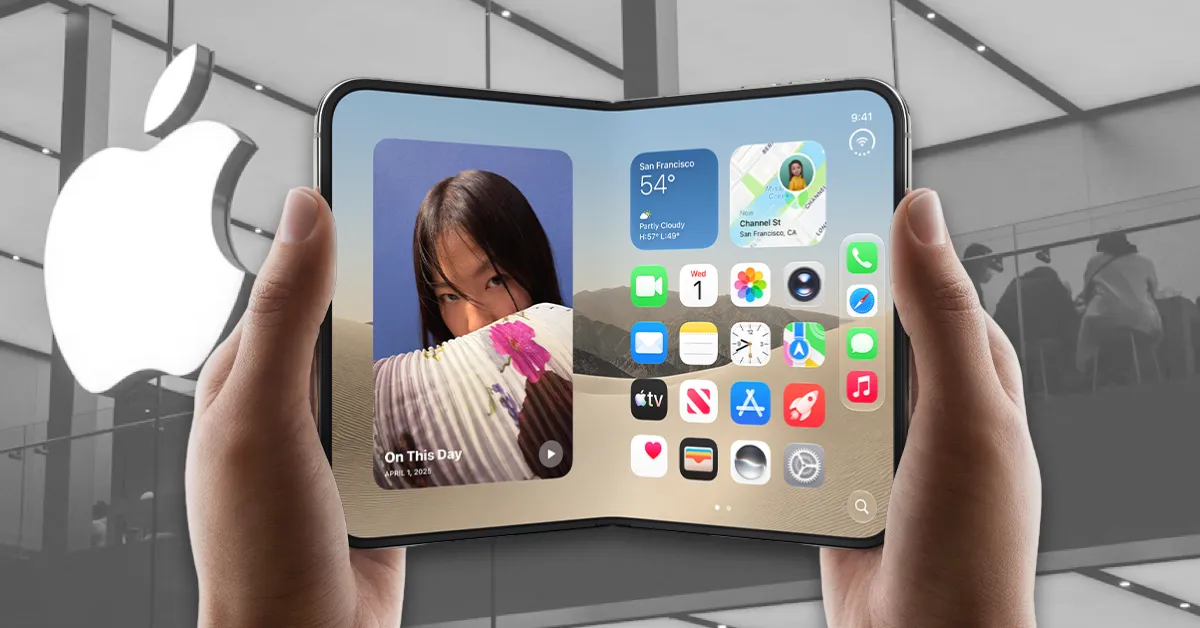
Within seconds of Apple unveiling its first folding iPhone on September 9, the joke was already written. Social media users didn’t wait for a review or a teardown — they went straight for the punchline that Apple had just discovered a category that Huawei shipped in 2019. One recurring reaction template showed a cartoon figure copying an exam answer, captioned to suggest Apple had simply looked over its neighbour’s shoulder. Another joke reframed the device’s own name — the iPhone Duo — as a reference to how many household incomes it would take to buy one.
The memes were funny because they were accurate. Apple priced the iPhone Duo at ₹2,99,900 for the base 256GB configuration in India, rising to ₹4,49,900 for the 2TB variant — making it the most expensive iPhone the company has ever sold in the country, and the first to cross the ₹3 lakh mark. In the United States, the same base model starts at $1,999, which converts to roughly ₹1,90,900 at current exchange rates. That leaves a gap of about ₹1.09 lakh between what an American buyer pays and what an Indian buyer pays for an identical device.
Seven years late, and pricing to match
Huawei launched the Mate X, the first mainstream folding smartphone, in late 2019. Samsung followed within months with the Galaxy Fold and has iterated on the format every year since. Apple, by contrast, spent the better part of a decade fielding reports of an imminent foldable that kept sliding — 2020, then 2021, then 2022, then 2024, then 2025 — before finally shipping one in 2026. Engineering leaks throughout that period pointed to a specific obstacle: Apple could not solve the visible crease down the centre of a foldable display to its own satisfaction, reportedly pursuing an elimination of the crease “regardless of cost.”
Even Apple’s own rivals in the smartphone business have said the delay reflects a broader pattern rather than a one-off. Duan Yongping, founder of Oppo and Vivo, said years before the Duo shipped that Apple’s engineering strengths coexist with a stubborn streak that costs it ground elsewhere, put simply: “They’re maybe too stubborn sometimes.“
That patience shows up in the final product. The iPhone Duo opens into a 7.6-inch interior display and folds down to a 5.4-inch cover screen, built around Apple’s new A20 Pro chip and a titanium frame. Early hands-on coverage has focused on the crease being close to invisible when unfolded — the exact problem that reportedly held the device back for years. In other words, Apple didn’t skip the early, unglamorous phase of foldable engineering that Samsung and Huawei worked through in public. It just made Indian buyers absorb the cost of skipping it privately.
Popular entrepreneur Ramesh Vats, founder of Something Something, posted on X,
“I planned to resist buying the iPhone Duo. But I think I have folded.”
Why the India price is a policy, not a coincidence
The ₹1.09 lakh gap between Apple’s US and India pricing isn’t unique to the iPhone Duo — Indian buyers have paid a premium over American ones on every iPhone generation, largely a function of import duty and GST stacking on top of the dollar sticker price. What’s different this time is the scale. On a $1,999 device, a proportional markup is one thing; on a device already positioned as Apple’s most expensive iPhone ever, the same policy produces a number large enough to dominate the national conversation the day the phone launched. Coverage of the launch noted that the base Duo price alone exceeds what most first-time buyers in India put down on a car, and comfortably beats the price of several two-wheelers on Indian roads.
The EMI page tells its own story
Apple’s own India financing page does offer credit and debit card EMI, with up to six months of “No Cost EMI” through most leading banks, plus instant cashback with eligible American Express, Axis Bank and ICICI Bank cards. That six-month, no-cost window is worth noting on its own: it’s the shortest interest-free EMI term Apple offers in any major market it sells the Duo in, which means the same phone produces a proportionally larger monthly payment in India than it does elsewhere. On the base 256GB Duo, that six-month plan works out to roughly ₹48,817 a month.
What the headline offer doesn’t say is what happens once a buyer needs longer than six months. Push the tenure to nine, 12 or 24 months and standard interest of 14 to 15 percent per annum kicks in — at which point, EMI breakdowns show, the advertised “savings” quietly become a flat cashback of roughly ₹7,000 rather than a genuine interest waiver. Stretch the loan to the full 24 months and the monthly instalment drops to a comfortable-looking ₹14,000, but the total paid over two years comes to around ₹3,40,842 — close to ₹41,000 more than the phone’s own sticker price. Apple’s storewide cashback ceiling of ₹15,000 sounds as if it applies here too, but that figure is a cap across the entire Apple Store India catalogue, not an offer specific to the Duo — a distinction the checkout page doesn’t spell out for a buyer doing the math in the moment.
The internet did the analysis first
Long before any spec sheet or financing breakdown circulated, the joke had already made the point. Comedian Atul Khatri quipped that the phone earned its “Duo” name because buying one would require selling a pair of organs rather than one.
“It’s called iPhone Duo because to buy it – you will have to sell both your kidney as well as liver” — said Khatri on X
A widely shared comparison by X user Qasim Husain stacked the ₹2,99,900 starting price against the annual salary of someone earning ₹3.5 lakh a year, calculating that the phone alone would eat up 86 percent of that income.
The cultural contrast wasn’t lost on people either. X user Prayag drew a side-by-side of the two markets’ reactions, imagining an American buyer casually weighing an upgrade while an Indian buyer’s first instinct was to check the Dubai price instead — a joke that doubled as a comment on how differently the same launch lands depending on where you’re standing.
Even brands got in on it. Duolingo’s official account, seeing its mascot’s name borrowed for Apple’s foldable, posted: “They named a phone after me and made it bend over.” Samsung Mobile US joined the exchange too, needling both Apple and Duolingo in the same breath, according to Reuters. A separate joke, spotted by Sunday Guardian Live, reframed the phone’s competition entirely: “iPhone Duo is priced at 3 lacs. Samsung is out of the picture.”
None of it was subtle, and none of it needed to be. The internet’s read on Apple’s foldable debut wasn’t really about the hinge or the crease — it was that a company famous for showing up polished tends to show up late in categories it didn’t invent, then charges Indian buyers the most to catch up.
What it means for Apple’s India play
None of this is likely to dent early demand. Apple’s India business has grown steadily on the back of buyers willing to pay a premium for the ecosystem, and pre-orders for the iPhone Duo open October 16 with deliveries from October 23 — well within the festive-season window that has historically driven Apple’s strongest India sales. The more durable question is reputational rather than financial: whether a company that positions itself as defining categories can keep absorbing “you’re late and you’re charging us for it” as the dominant public reaction to a flagship launch, quarter after quarter, category after category.