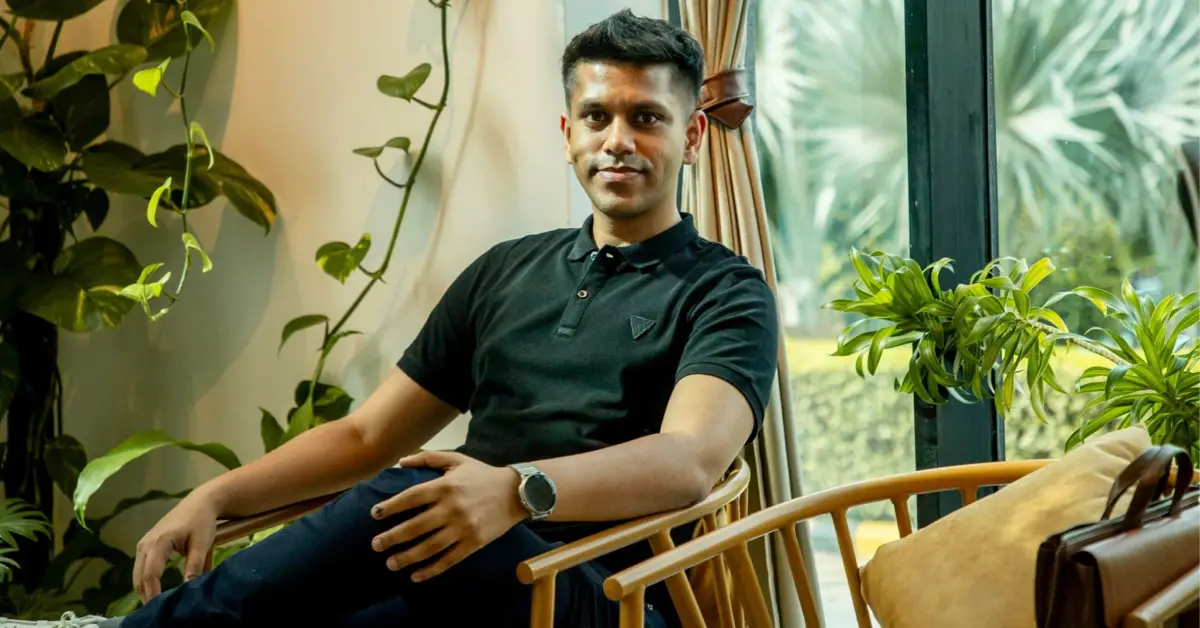
In June 2017, Varun Gupta listed a pair of earphones on Myntra. There was no seed round, no angel cheque, no incubator backing. Just a small amount of capital, a brother named Tarun, and a bet that India was about to stop buying wired earphones.
The bet paid off. By FY25, the brand they built — then called Boult Audio, now operating as GoBoult — clocked operating revenue of ₹762.9 crore, up 9.4% from ₹697.2 crore the previous year. Profit after tax surged nearly tenfold — from ₹2.5 crore in FY24 to ₹24.2 crore in FY25. All without a single external investor on the cap table. The company, incorporated as Exotic Mile Pvt. Ltd. and headquartered in Delhi, has not taken a single rupee of external funding since inception.
GoBoult’s primary rival, boAt, is backed by Warburg Pincus and has raised hundreds of crores. Noise counts Peak XV Partners among its investors. GoBoult competes with both — and turns a profit while doing it.
Also Read: Bollywood actor Ranveer Singh invests in lifestyle brand boAt, becomes Brand Ambassador
Catching the pulse before everyone else did
Varun Gupta had already launched three startups before Boult — in advertising, community-based reselling, and e-commerce consulting. Each one sharpened his understanding of how Indian consumers discover and buy products online. By 2017, he was watching a structural shift that most consumer electronics brands were too slow to act on.
Apple had just begun shipping iPhones without the 3.5mm headphone jack. Chinese smartphone brands were following. Millions of Indian consumers, who had never bought earphones separately before, suddenly needed to. The TWS category was about to explode — and at the time, it had almost no organised D2C players building for it at scale.
The Gupta brothers didn’t move fast by raising money. They moved fast by staying lean. Within two years, Boult had expanded from Myntra to Amazon and Flipkart. The model was simple: design everything in-house, price 10% above the mass-market segment to signal quality without alienating buyers, and let the product generate repeat purchases instead of burning cash on brand recall.
The product-first playbook
One of the more unusual aspects of GoBoult’s operation is that it runs its own design studio — the only consumer electronics brand in India to do so, according to Varun Gupta. Every product — the colour, material, finish, ergonomics — is conceptualised internally before going to manufacturing.
“We are the only firm that does 100% in-house product designing. I am an artist myself, and so I work with the design team. I work on the colour, material, finish, overall presentation of the product, and ergonomics, everything is done in-house,” — Varun Gupta told digit
This matters for one reason that the revenue numbers don’t immediately reveal: review scores. GoBoult has accumulated over two million ratings across e-commerce platforms and claims the highest repeat purchase rate in its category. In a market where most brands compete on the same Chinese-manufactured components and nearly identical feature sets, design differentiation and post-sale quality become the actual moat.
The brand’s manufacturing footprint is also domestic. Varun Gupta has stated that 99% of products sold in India are manufactured and assembled in India, with facilities in Delhi and Gurgaon — a Make in India story that predates the policy pressure to localise production.
The brand’s lean marketing philosophy extended to ambassador choices too. In October 2022, GoBoult — then Boult — signed actor Saif Ali Khan and cricketer Suryakumar Yadav as brand ambassadors, a move that gave the brand mainstream visibility without the heavy celebrity endorsement budgets its funded rivals were known for.
“We don’t have heavy pockets or deep investment money to splurge money into marketing because we’re a bootstrapped firm. For us, the product is the hero,” Varun Gupta told Business Standard
Why competitors raising funds was never a threat
The Indian D2C audio market saw heavy venture capital deployment in the early 2020s. boAt raised funds from institutional investors. Noise raised a ₹335 crore Series B. Fire-Boltt came in with aggressive pricing. The category was awash with funded marketing budgets, Bollywood endorsements, and IPL sponsorships.

Varun Gupta’s response to this was counterintuitive. When asked about the fear of being outspent by funded rivals, he described competitor fundraising as a net positive for Boult.
“When a competitor raises 10 to 100 million dollars, they will invest a lot of media, a lot of energy, and a lot of funds into building awareness for that category. It increases the entire market size. It is not a zero-sum game.” — Varun Gupta said in a podcast with Think School
While boAt and Noise built broad market awareness for wireless audio, GoBoult — then Boult — absorbed the demand without spending on category creation. It stayed disciplined on pricing, avoided a race to the bottom during the 2022–2024 industry stagnation period, and came out with higher margins than competitors who had discounted themselves into thin unit economics.
“From 2022–24, the industry faced stagnation, with most competitors bleeding money. While we remained barely profitable, we resisted the temptation to drop prices, unlike others. This decision now allows us to command a premium, as we avoided a pricing spiral that eroded brand perception.” — Varun Gupta, in an interview with Impact
The channel strategy: online first, offline patient
GoBoult built its revenue base entirely online before making a calculated move to offline retail. The brand expanded to physical stores only around October 2023, entering Croma and Reliance Digital while simultaneously pushing into general trade. By the time it rebranded in August 2025, it had presence in 3,000 offline stores across India.
The next phase is a 10x expansion: GoBoult has announced plans to grow its offline footprint to over 30,000 stores — covering general trade, modern retail, and experiential formats — over the next 18 months.
Varun Gupta has been candid about why offline took this long.
Varun Gupta has acknowledged that offline remains skewed heavily toward the category leader, describing it as a slower, more patient channel to penetrate. According to IDC’s India Wearable Device Tracker, the offline channel expanded its share from 37.8% to 40.7% in 2025 — a signal that physical retail is becoming more decisive in the category even as online volumes soften.
The sequencing reflects a deliberate logic. Build product quality and review scores online where discovery is search-driven and rating-dependent. Once brand credibility is established in the digital channel, use offline presence to add a layer of consumer trust that e-commerce alone cannot replicate. The result: GoBoult entered physical retail from a position of strength rather than desperation.
Market position in a contracting category
The Indian wearables market is not growing. IDC data shows the market fell 4% year-on-year in 2025 to 114.2 million units, with smartwatch shipments declining 17.6%. The overall earwear category grew only 1.4%.
GoBoult is growing inside a shrinking market. In the over-the-ear headphones segment — the fastest-growing sub-category in earwear at 65.4% YoY growth — GoBoult posted an exceptional 698.3% year-on-year growth in 2025, per IDC. In smartwatches, despite the category-wide decline, it maintained growth of 29.8% YoY. In the TWS segment, it held a 14.9% market share as recently as Q2 2025, second only to boAt’s 31.9%.
The strategic reason: GoBoult stayed in its categories. Unlike boAt, which recently entered dashcams, GoBoult has not chased diversification.
The rebrand — and the legal reality behind it
GoBoult’s August 2025 rebrand from Boult Audio was publicly framed as a strategic pivot toward premiumisation and global expansion. The reality, as revealed through Delhi High Court documents reviewed by legal observers, is more complex.
boAt had filed a trademark infringement case against Boult as far back as 2019, arguing that the two names were phonetically and visually similar enough to mislead consumers. In January 2020, the Delhi HC issued an interim injunction restraining Boult from using certain marks. By September 2025, a two-judge bench upheld the injunction and ruled that “Boult” and “boAt” were deceptively similar — effectively barring the company from returning to its original identity.
The GoBoult name, however, was not part of the original petition and was not restrained by the Delhi HC order. A separate challenge from another brand, GoBold — filed in a Bengaluru commercial court — further complicated the rebrand, but as of the last publicly available proceedings, GoBoult continued to operate under the new name. The company’s own legal entity, incorporated as Exotic Mile, remains unchanged.
The legal headwinds have not materially affected the business. Revenue continued to grow through the dispute period, and the rebranding — whatever its origins — gave GoBoult an opportunity to move upmarket in both pricing and brand identity.
Also Read: Aman Gupta’s OffBeat Studios raises ₹100 crore in seed funding led by Bessemer Venture Partners
The road to listing: three milestones, one IPO
GoBoult’s IPO plans are structured around self-imposed thresholds rather than investor timelines — which, in itself, is a product of being bootstrapped. Varun Gupta had publicly set ₹1,000 crore in annual revenue as the internal benchmark for going public. The company is on track to hit that in FY26, targeting ₹1,000 crore this year after crossing ₹762.9 crore in FY25.
As of February 2026, GoBoult plans to file its DRHP with SEBI by October or November 2026, with a public listing targeted for mid-2027. The company has also outlined a longer-term revenue ambition of ₹3,000 crore by FY30 — implying roughly 30% annual growth from here.
To support premiumisation ahead of the IPO, GoBoult has partnered with Mustang (the Ford brand) and Dolby — collaborations that have already pushed average selling prices above ₹1,100. The two-year ASP target is ₹1,500, up from a mass-market average that once sat well below ₹1,000.
Tarun Gupta framed the direction plainly.
“Our expanded retail presence, robust product pipeline, and global expansion strategy position GOBOULT for its next growth chapter as we build toward our ₹2,000 crore vision by 2030.” — Tarun said in a statement to Financial Express
What the GoBoult model actually teaches
The standard narrative around Indian consumer electronics startups assumes that distribution at scale requires venture capital — that you need funded marketing budgets to build awareness, funded inventory to fill offline shelves, and funded losses to survive the pricing wars. GoBoult is a direct challenge to that assumption.
The Gupta brothers built to ₹762 crore not by outspending rivals but by out-designing them, out-reviewing them on the platforms where Indian consumers actually make buying decisions, and staying disciplined on pricing when the rest of the market discounted its way to single-digit margins. They treated competitor fundraising as category validation rather than a competitive threat. They sequenced offline entry for when they could enter from a position of strength.
The model is not replicable in every category — consumer electronics at this price point has specific structural advantages for a bootstrapped approach that a logistics or fintech startup would not enjoy. But as a case study in capital efficiency and brand-building without venture dependency, GoBoult sits in a category of its own.