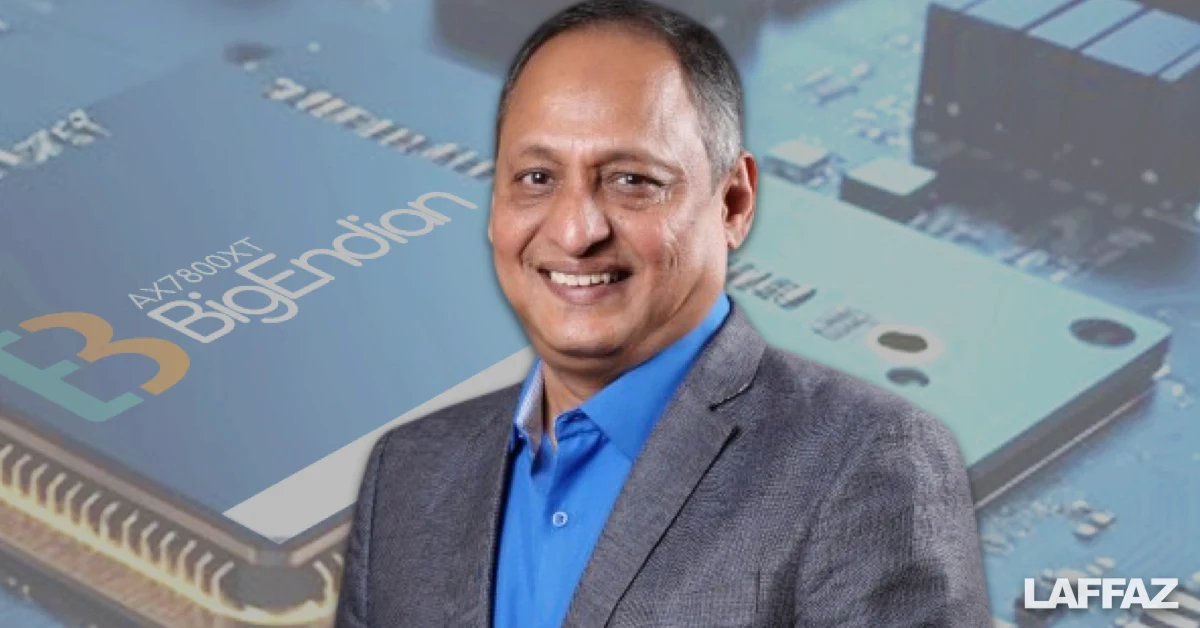
India’s semiconductor ambitions have long been measured in policy announcements and factory groundbreakings. What has been harder to show is Indian companies actually designing original silicon — from architecture to tape-out — without replicating foreign blueprints. BigEndian Semiconductors is trying to change that, and this week it closed a $6 million pre-Series A round to prove it can go further. The round was led by IAN Alpha Fund, with participation from existing investors Vertex Ventures SEA & India and IvyCap Ventures, along with strategic angel investors.
The Bengaluru-based startup, co-founded in March 2024 by a five-member founding team — Sunil Kumar, Renuka Prasad, Dinesh Annayya, Kanagaraju Ponnusamy, and Jansen Cheng — brings backgrounds spanning chip design at Arm, Intel, and Broadcom. BigEndian is building high-performance, security-focused system-on-chips (SoCs) designed for surveillance, telecom, IoT, and enterprise systems. Crucially, the company has already completed tape-out of its first commercial chip — the point in the design cycle where a finished schematic is handed to a foundry for fabrication, a costly and technically demanding milestone that many Indian chip startups have yet to reach.
The timing is deliberate. The Union Budget 2026-27 announced the India Semiconductor Mission 2.0 with a ₹1,000 crore annual provision, while the government has separately mandated that surveillance equipment deployed in sensitive infrastructure comply with Standardisation Testing and Quality Certification norms — a move widely seen as restricting certain Chinese-made chipsets from key installations. That policy shift creates direct market demand for the kind of domestically designed, security-by-design silicon that BigEndian is building. The startup’s first SoC targets enterprise and consumer surveillance cameras, positioning it squarely in the edge AI and video processing market where companies like Ambarella currently dominate.
Also Read: KRAFTON and Naver Launch ₹6,000 Crore India Fund — The Largest from Asia for Indian Startups
“Raising capital in semiconductors is never about the money alone. It’s about earning trust in your ability to execute. This funding validates not just our technology, but our approach to building silicon the hard way: from architecture to tape-out, with a long-term roadmap in mind.” said Sunil Kumar, Co-founder & CEO, BigEndian Semiconductors
Fresh capital will go toward commercialising that first SoC, scaling the product engineering team, and deepening partnerships with foundries, IP ecosystems, and OEMs. The round remains open — BigEndian has indicated it may raise an additional $4 million if needed, which would take the total pre-Series A to $10 million. Vertex Ventures’ Ben Mathias noted that the company had achieved tape-out “in record time” since the seed investment eighteen months ago, and signalled the next phase would involve transitioning from test silicon to production-ready SoCs, alongside developing next-generation Vision Edge AI architectures. IAN Alpha Fund’s Rajnish Kapur framed the investment around India’s broader shift from large-scale chip manufacturing toward specialised, secure, domain-specific design — a segment where BigEndian is competing alongside peers such as Netrasemi, Mindgrove, and Vervesemi, the last of which raised $10 million in a Series A earlier this year.
India’s Design Linked Incentive scheme currently backs 24 semiconductor design startups — a thin but growing cohort trying to convert the country’s engineering talent surplus into original silicon IP. BigEndian’s fundraise, coming on the back of an actual tape-out, is the kind of execution milestone that separates credible chip startups from ones still stuck at the whiteboard stage.
Also Read: HrdWyr Raises $13 Mn to Build AI-Native Chips for India and the World