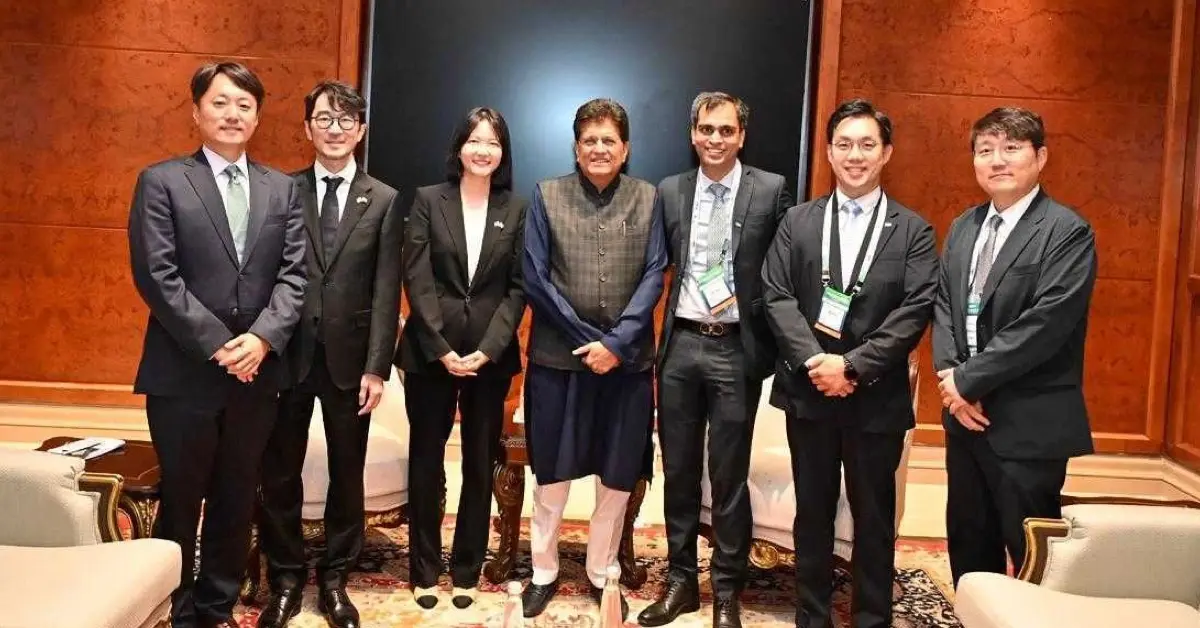
South Korean technology giants KRAFTON Inc. and Naver Corporation have formally launched the Unicorn Growth Fund, a ₹6,000 crore vehicle focused exclusively on Indian technology companies. The fund will be managed and advised by Mirae Asset Venture Investments (MAVI), the private investment platform of the Mirae Asset Group. The announcement was made on April 21, 2026 in New Delhi at a high-level meeting attended by Union Commerce Minister Piyush Goyal and South Korea’s Minister of Trade, Industry and Resources Dr Jung-Kwan Kim — on the sidelines of South Korean President Lee Jae Myung‘s official state visit to India.
The Unicorn Growth Fund is described by the partners as the largest India-focused capital pool ever raised by an Asian technology-led platform. It will invest primarily in growth-stage Indian startups across four themes: technology platforms covering consumer internet, digital marketplaces, and next-generation infrastructure; consumer discretionary including digitally native brands and new-age consumer businesses; AI and software spanning generative AI, enterprise SaaS, and developer tooling; and deep tech covering semiconductors, space-tech, robotics, advanced materials, and frontier science.
Not Just Capital — Strategic Access
What distinguishes this fund from a conventional venture vehicle is what comes alongside the capital. Portfolio companies will get access to product, AI, gaming, and platform expertise from KRAFTON and Naver directly — along with a structured route into Korean and broader Asian markets. For Indian startups looking to expand globally without defaulting to a US pivot, Asia-market access is a tangible differentiator. KRAFTON has previously invested over $200 million in India’s digital entertainment ecosystem, backing companies including Nodwin Gaming, Loco, Kuku FM, and Pratilipi — giving it real operating knowledge of what Indian growth-stage companies need beyond a cheque
Naver, South Korea’s dominant internet platform — comparable in its home market to what Google is in much of the world — brings a different kind of leverage: deep content, search, and commerce infrastructure experience that maps well onto India’s own platform economy ambitions. Together, the two companies are not passive LPs. The fund structure appears designed for founders who want operational partners with domain depth in Asia, not just capital allocators with a mandate.
The Diplomatic Dimension
The timing of the fund announcement is not incidental. It was made on the sidelines of a state visit — the South Korean President’s official engagement with Prime Minister Narendra Modi and senior Indian ministers — and was framed as part of broader bilateral discussions on technology and trade cooperation. Commerce Minister Goyal’s presence at the announcement elevates it from a private sector deal to a signal of government-backed economic alignment between India and South Korea.
India and South Korea have been deepening economic ties across semiconductors, defence manufacturing, and technology. This fund fits into a pattern of Korean capital seeking structured, long-term exposure to India’s technology economy at a moment when Indian founders are building companies of genuine global ambition. Puneet Kumar, CEO of Mirae Asset Venture Investments India, framed it directly: India is at an inflection point, and this fund is positioned to back the generation of companies that will define what Indian technology looks like on the world stage over the next decade.
What It Means for Indian Founders
For growth-stage Indian startups in AI, deeptech, and consumer internet, the Unicorn Growth Fund represents a meaningful new capital source — one that comes without the US-market-first assumptions often baked into Silicon Valley funds, and with strategic assets that are genuinely relevant to Asian expansion. India’s startup ecosystem has matured to the point where founders are increasingly thoughtful about not just the size of a cheque but what the investor brings beyond it. A fund backed by the makers of BGMI, the operator of Korea’s dominant internet ecosystem, and one of Asia’s largest investment platforms, is a combination that Indian growth-stage founders would find difficult to ignore.
The fund’s focus on deep tech — semiconductors, space, robotics — also aligns with where Indian government policy and private capital are converging in 2026, making it well-positioned to catch the next cohort of companies that move from lab to market in those sectors.