Cradlewise has raised $12 million in a Series A led by 3one4 Capital and Prudent Investment Management, bringing total funding to $26 million alongside earlier backers Sean O’Sullivan Ventures, Footwork VC, and Charles River Ventures. The company’s previous round, a $7 million raise, closed in November 2021 — nearly five years before this one.
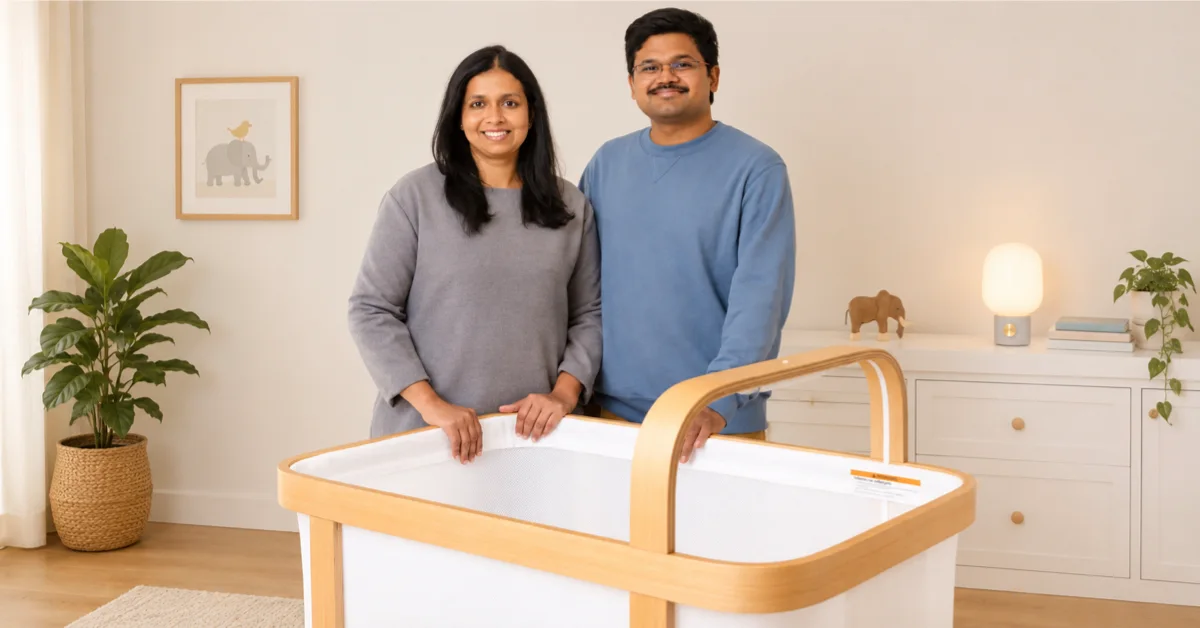
Radhika Patil and Bharath Patil, a husband-and-wife team with master’s degrees in electronics from the Indian Institute of Science, founded the company in 2019. Radhika, chief executive, previously worked on power management systems for Qualcomm’s Snapdragon processors; both have engineering backgrounds spanning Qualcomm and Texas Instruments. Their product is a convertible smart crib: sensors track a baby’s movement, sound, and sleep state, and the system predicts an impending wake-up and begins rocking pre-emptively to resettle the child before they fully wake. A contactless, night-vision monitor is built in, removing the need for a separate camera. The crib converts from a bassinet to a full crib and is designed to last until a child is about two, retails at roughly $1,799, and won a TIME Best Inventions award in 2020. Cradlewise says its prediction models are trained on more than 75 million hours of sleep data and that the product saves parents up to two hours of effort a day.
Where most smart sleep hardware simply responds to crying, Cradlewise is trying to intervene before a baby is fully awake — a harder sensing problem, and the reason the company’s training-data claim matters more than it might elsewhere. The convertibility is the sharper commercial argument, though. Rival Happiest Baby’s SNOO is a bassinet covering roughly the first six months, after which families buy a separate crib. Cradlewise, at a comparable $1,799 against SNOO’s $1,695, covers around two years on a single purchase — a useful life four times longer for a near-identical price, in a category where the standing objection is that this is a lot of money for nursery furniture.
Also read: Mokobara Raises ₹170 Crore, but Filings Show Just ₹91 Crore of New Shares
Manufacturing runs out of an integrated facility in Pune capable of producing, testing and packing thousands of cribs a month, with the company operating from California and Bengaluru and selling almost entirely into the United States since 2021. Owning that line, rather than contracting to China as most consumer hardware companies do at this scale, gives Cradlewise the ability to iterate on the product without renegotiating with a factory — a capability that takes years to build and that a Series A alone could not buy.
It also leaves the company exposed on two fronts the funding announcement does not address. SNOO holds FDA authorisation as a medical device for keeping infants safely positioned during sleep; Cradlewise has no equivalent clearance, which matters in a category where the underlying buyer anxiety is safety rather than convenience. And a Pune-manufactured, America-sold $1,799 device has limited room to absorb import duty before either margin or price has to move — an arrangement that made sense when Indian goods entered the US cheaply, and carries different risk now. Neither issue is named among the round’s four stated uses: growth, channel expansion, product research and geographic expansion.
The nearly five-year gap since Cradlewise’s last raise, and the Series A label attached to a round that follows $14 million already invested, suggests the company grew carefully through a market that stayed closed to it for a long stretch — a modest total of $26 million for a seven-year-old hardware company selling a premium product in America.