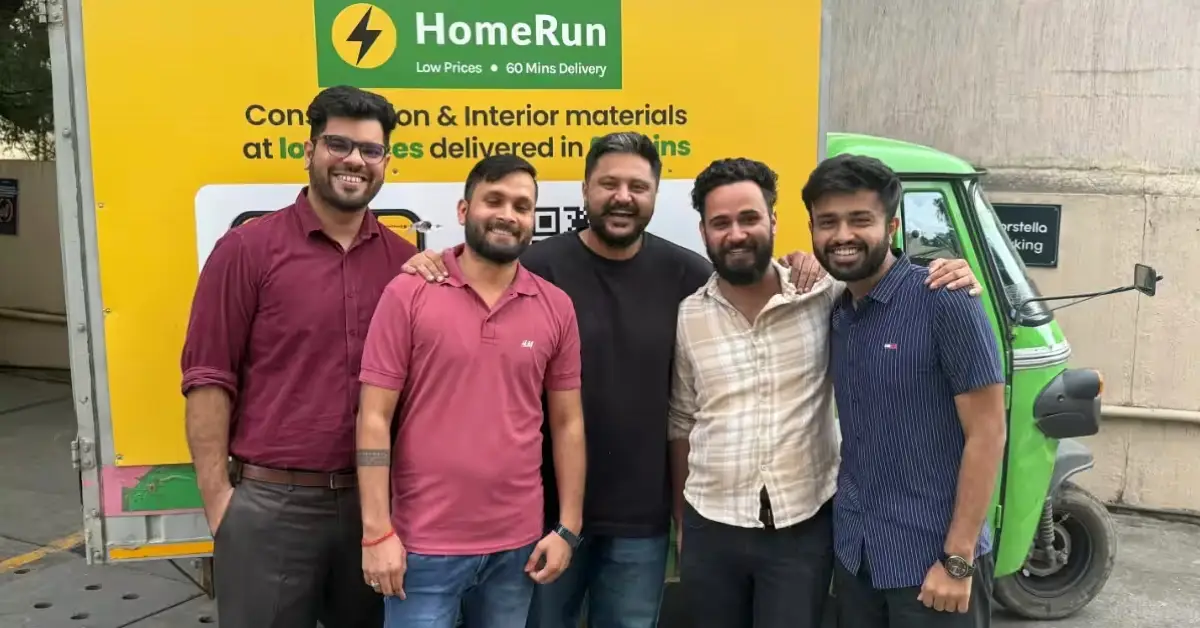
HomeRun, the Bengaluru-based quick commerce startup for construction and interior materials, has raised $12 million in a Series A+ round led by Nexus Venture Partners, with existing backers Sorin Investments, Titan Capital, Sparrow Capital and Consumer Collective by Atrium also participating. The company has not disclosed its post-money valuation or the dilution the round represents.
The pace of HomeRun’s fundraising says almost as much as the round itself. This is the company’s third priced round in roughly nine months — a ₹9 crore seed in November 2025, a ₹60 crore ($6.6 million) Series A led by Sorin Investments in February 2026, and now this Series A+ — taking its total disclosed capital to around $19.6 million against an operating footprint that, as of its last public snapshot, was still confined to five dark stores in a single city. That capital-to-footprint gap is the central bet Nexus is underwriting: that construction materials, a category still dominated by fragmented neighbourhood hardware stores and cement-brand exclusive dealers, can be pulled onto a hyperlocal delivery model the way groceries and pharmacy already have been, and that HomeRun can prove that quickly enough to justify raising this far ahead of its city count.
Founded by Pukhraj Singh Grewal, who previously ran construction-labour marketplace Project Hero before winding it down and pivoting into materials delivery in December 2024, HomeRun promises 60-90 minute delivery of cement, tiles, plywood, wires and paints across roughly 105 pincodes in Bengaluru, sourced through authorised dealers with an all-electric delivery fleet. The company has reported an average order value of around ₹7,000 and more than 100,000 fulfilled orders to date, alongside a claimed 8X growth over the past year — though it has not specified whether that growth figure refers to orders, gross merchandise value or revenue.
Unlike grocery quick commerce, where a single delivery might weigh a few kilograms, HomeRun’s per-order logistics carry cement bags, plywood boards and bulk wire spools — cargo that is structurally heavier and costlier to move, which means the reported average order value alone doesn’t confirm the unit economics are contribution-positive once dark-store rent and inventory holding are factored in. The fresh capital is earmarked for entering new cities beyond Bengaluru, deepening the supply chain, and expanding the product catalogue, with Hyderabad and Pune flagged as likely next markets. The category is filling in fast: rival Fixxly closed a $5.5 million seed from Accel, Fireside Ventures and Lightspeed India Partners in late July with a September launch planned, while established B2B platforms Infra.Market and JSW One MSME already hold considerably deeper balance sheets in adjacent segments.