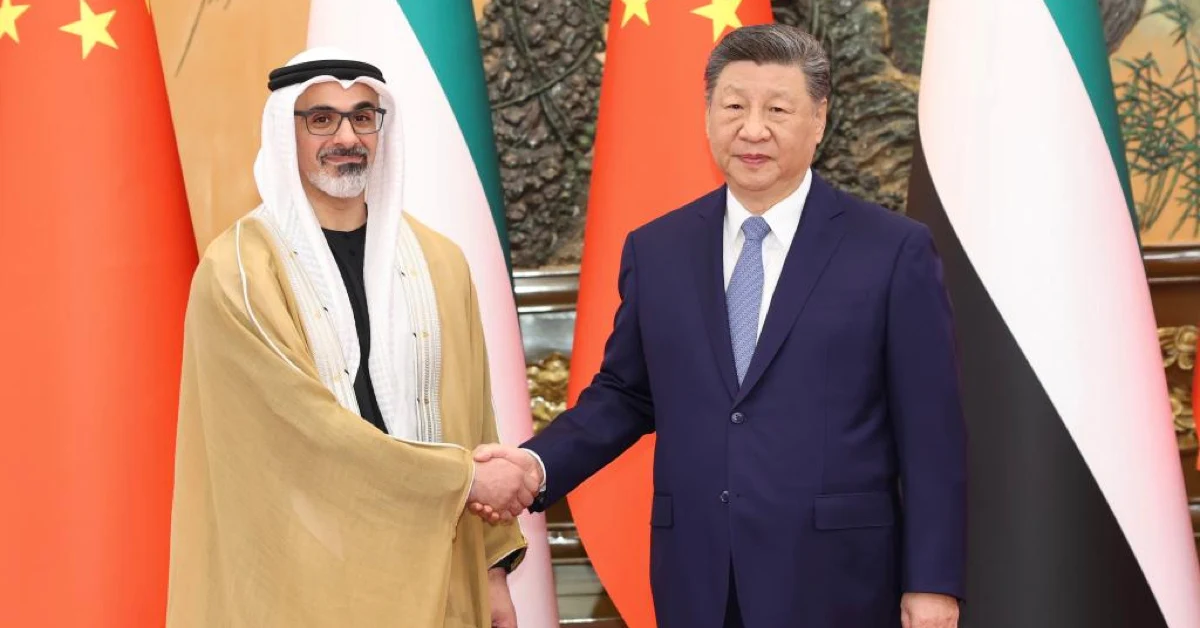
When Sheikh Khaled bin Mohamed bin Zayed Al Nahyan, the Crown Prince of Abu Dhabi, landed in Beijing earlier this week, the optics were carefully managed. High-level diplomatic visit. Handshakes, panel sessions, a theme — “From Vision to Value” — that sounded like a corporate rebranding exercise. But what actually happened at the UAE-China Business Promotion Conference on April 13 was something more concrete: 24 Memorandums of Understanding signed in a single afternoon, with ministers from both sides on stage, and a data point that stopped the room.
UAE-China non-oil trade hit $111.5 billion in 2025 — a record, achieved at a growth rate of 24.5% in a single year, according to UAE Minister of Foreign Trade Dr. Thani bin Ahmed Al Zeyoudi. That figure didn’t arrive quietly. It arrived with the Crown Prince in the room, with Chinese ministers watching, and with a crowd of Emirati business executives who, by multiple accounts, started their speeches with “Ni Hao.”
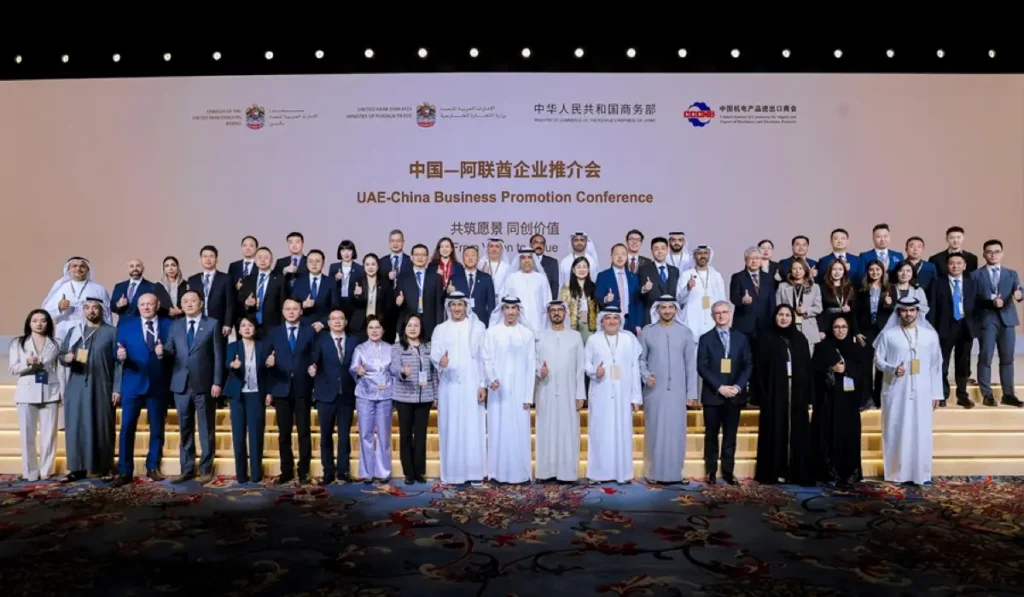
The symbolism wasn’t accidental. Neither was the timing.
A Partnership That Has Outgrown the Word ‘Partnership’
The UAE and China have been talking about deepening ties for years. What’s changed in 2025 and early 2026 is that the relationship has moved from aspirational language to actual architecture. China is now the UAE’s largest trading partner, accounting for roughly 11% of the country’s total non-oil trade. The UAE, in turn, is China’s top trading partner across the Middle East and Africa — and accounts for more than 20% of China’s non-oil trade with the entire region.
There are approximately 17,000 trade licenses linked to Chinese nationals currently active in the UAE. China ranks as the third-largest source of foreign direct investment into the country. In Dubai’s free zones alone, more than 1,000 Chinese firms are registered — a share that has been growing by as much as a quarter annually for three consecutive years, according to reporting by The Economist.
The sectors driving this aren’t just oil and construction anymore. At the Beijing conference, you had Etihad Airways talking about logistics corridors. Elite Agro Holding, a UAE-based agricultural company, sitting across a table from Wuhan Plant Ark Intelligent Technology to discuss importing Chinese AI models for plant-growth management. Dreame, a Chinese robotics brand, quietly claiming close to half of the UAE’s robotic vacuum cleaner market after just a few years of focus.
The word Mamoon Sbeih, Chief International Business Development Officer at advisory firm Apco, used at the conference was “stability.” China, he said, offers “clear stability” in a world that no longer does. That framing — China as the predictable bet in unpredictable times — is one you hear more frequently in Gulf business circles now, and it reflects something real. The US tariff policy has made American market access feel volatile. European demand is sluggish. The Gulf is looking east, and it’s not bothering to be subtle about it.
Where This Leaves India
Here is where the story gets complicated for New Delhi.
The UAE is not a peripheral relationship for India. It is India’s third-largest trading partner globally, behind only the US and China. Bilateral trade crossed $100 billion in FY 2024-25, under the terms of the Comprehensive Economic Partnership Agreement signed in 2022. More than 3.5 million Indians live in the UAE — roughly 30% of the Emirates’ total population, the largest single expatriate community in the country. India’s exports to the UAE include everything from engineering goods and gems to petroleum products and electronics.
In January 2026, UAE President Sheikh Mohamed bin Zayed Al Nahyan visited India, and the two countries signed a $3 billion LNG supply deal, with a stated ambition to double bilateral trade to $200 billion by 2032. The relationship, at least on paper, looks healthy.
But the geometry of the situation is worth examining carefully. India’s trade relationship with China tells a different story. Bilateral trade between India and China reached approximately $127.7 billion in FY 2024-25 — but India’s trade deficit with Beijing expanded to nearly $99.2 billion in the same year. The imports are dominated by Chinese electronics, machinery, and chemicals. Indian exports to China, at roughly $14.25 billion, are a fraction of the flow going the other way. The Line of Actual Control dispute, despite partial disengagement at Depsang and Demchok in late 2024, continues to simmer. The reset is real, but fragile.
So India’s position in 2026 looks like this: its most important Gulf partner is sprinting toward deeper integration with a country India views with strategic caution. The UAE is not choosing sides — it has been consistent about that posture. But it is making economic choices that will reshape the Gulf’s trade infrastructure in ways that India will have to navigate.
“Anybody who understands economics will want to build relationship with China.” — Mamoon Sbeih, Apco, at the UAE-China Business Promotion Conference, Beijing, April 14, 2026
That line landed well in a Beijing conference room. In New Delhi, it reads differently.
The Hub Problem
The UAE’s strategic value to China isn’t just as a trading partner — it’s as a logistics gateway. Dubai sits between Chinese manufacturing and African and European consumer markets. It handles the re-export of Chinese goods across MENA. It houses the five largest Chinese banks in the DIFC. Chinese issuers have listed more than $22 billion in debt instruments on Nasdaq Dubai. The financial plumbing between Beijing and the Gulf increasingly runs through the UAE.
India has its own ambitions for this lane. The India-Middle East-Europe Economic Corridor, or IMEEC, announced at the G20 Summit in 2023, was explicitly designed to create an India-anchored trade route through the Gulf to Europe — a structural alternative to China’s Belt and Road Initiative. The UAE is a core node in that corridor. So is Saudi Arabia.
The problem is that IMEEC remains largely a paper ambition, slowed by financing gaps and political complexity. Meanwhile, China’s physical presence in UAE ports, free zones, and financial institutions is already built. When Etihad’s cargo chief says he’s strengthening logistical ties with China to find “certainty” in global trade, he’s describing a network that India’s corridor was supposed to eventually compete with.
This isn’t a crisis for India’s Gulf strategy. But it is a pressure point. The UAE will not sacrifice its relationship with New Delhi — the Indian diaspora, remittances, and bilateral trade are too central to its own economic model. But the UAE is also a pragmatic actor, and it has decided that deepening the China relationship is worth pursuing aggressively, regardless of how that lands in New Delhi’s strategic calculations.
What Indian Businesses Should Actually Watch
The immediate read for Indian companies operating in or through the UAE is one of competitive intensity, not crisis. Chinese brands are no longer using the UAE purely as a transit hub. They are building consumer market share there. Dreame’s near-50% share of the UAE’s robotic vacuum category is one data point, but the pattern repeats across consumer electronics, construction materials, and increasingly, software and AI services.
Indian IT and technology companies have long used the UAE as their MENA beachhead. That advantage holds, but the competition for mindshare — with UAE businesses, with UAE government entities, with UAE sovereign funds — is intensifying as Chinese firms become more locally embedded and more locally trusted.
The 24 MOUs signed in Beijing this week cover sectors that Indian companies care about: logistics, technology, agriculture, and financial services. The details of those agreements aren’t yet fully public. But each one represents a piece of the UAE’s economic roadmap that a Chinese partner just claimed.
India’s answer to this — if it has one — is the CEPA, the IMEEC, and the soft power of its diaspora. Those are real assets. But in a week where the UAE’s Crown Prince flew to Beijing, signed 24 deals, and stood next to a minister confirming $111.5 billion in trade, the asymmetry of momentum is hard to ignore.
The new Silk Road isn’t a metaphor. It’s a conference room in Beijing, a pile of signed MOUs, and a Dreame vacuum cleaner in a Dubai apartment.