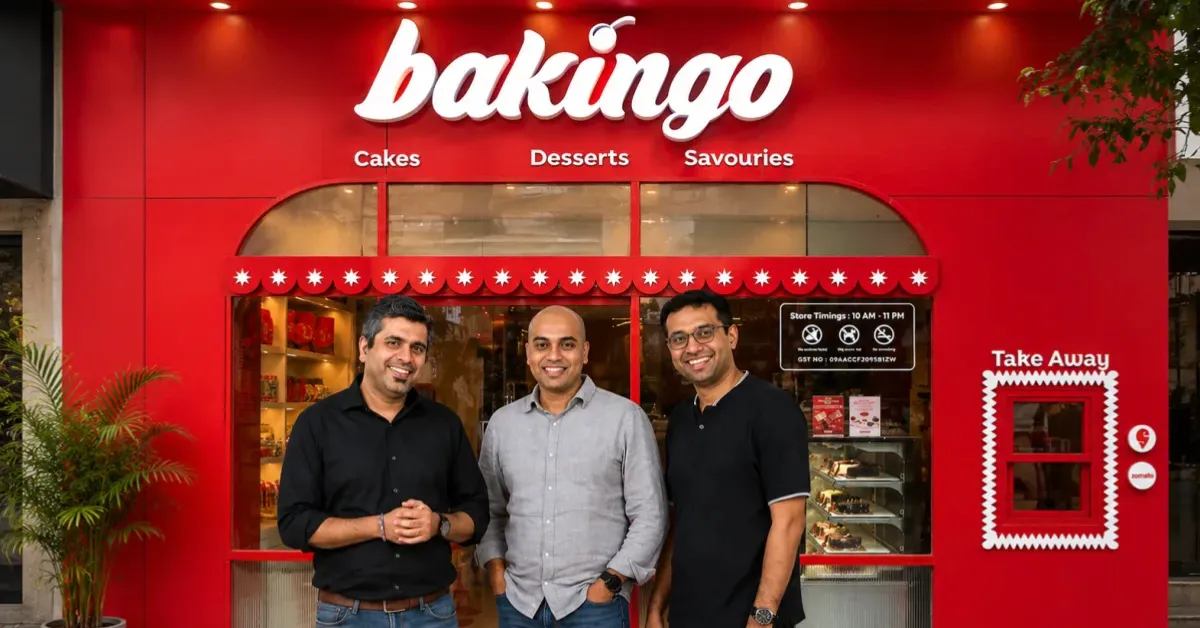
Gurugram-based online bakery brand Bakingo has raised ₹100 crore (~$10.5 million) in a Series B round from its existing investor, private equity firm Faering Capital, at a valuation reported to be 2.6 times higher than its previous round.
Bakingo was founded in 2016 by Suman Patra, Shrey Sehgal and Himanshu Chawla, growing out of FlowerAura, the gifting e-commerce company the same founders built first — a lineage central to how the bakery still operates. Gifting gave Bakingo a ready demand channel and an understanding of occasion-led buying, where customers order ahead and value reliability over the lowest price.
The raise lands as branded, vertically integrated bakery brands try to hold ground on two fronts at once. Theobroma, Monginis and a field of regional chains compete on brand and freshness, while Blinkit, Swiggy and Zomato have pushed hard into instant cake delivery, turning speed into the axis of competition and pressuring any model built around a scheduled order. Bakingo runs its own network of more than 100 kitchens across over 30 cities, producing over 400 cake designs sold through its website, its sister gifting platform FlowerAura, and quick-commerce channels — a dark-kitchen footprint that is an asset against the first group of rivals and a potential liability against the second if consumers shift decisively toward instant delivery.
Also Read: Discovered Materials Raises $9M Seed Led by Lightspeed India
Following the allotment, Faering holds a 26.31 percent stake in Bakingo. By Entrackr’s analysis of the RoC filing, the round values the company at ₹1,643 crore ($173 million), about 2.6 times the ₹627 crore at which it raised its previous round — a $16 million investment also from Faering in November 2023, which was Bakingo’s first external funding after seven years of bootstrapped operation and was reported then at a valuation of around ₹571 crore. Bakingo has not disclosed the equity dilution details, the primary-secondary split, or a specific use for the fresh capital beyond general business requirements and expansion. In FY25, the company reported standalone revenue of ₹300 crore against a net loss of ₹16.5 crore; revenue has climbed steadily from ₹94.6 crore in FY23, but the loss has widened from ₹0.8 crore over the same span as the kitchen network expanded, and FY26 accounts have not yet been filed.
A round funded entirely by the incumbent investor, with no new institutional name attached, can read as efficient continuity or as limited outside appetite at this valuation — the filing does not say which. Bakingo’s edge is that gifting demand from FlowerAura arrives without paid acquisition, and owning its kitchens captures margin an aggregator cannot, in a category where brand trust and reliable delivery matter more than price. What the fresh ₹100 crore has to prove is whether that structure can turn into profitability at scale, or whether it simply funds another leg of expansion that widens the loss before it narrows it.