Every year, somewhere in a Mumbai conference room, a brand manager presents a slide with two options: a Bollywood actor’s face on the left, an Instagram grid on the right. The debate that follows — celebrity or influencer? — consumes hours, budgets, and, sometimes, entire marketing cycles.
Minimalist never had that meeting. When brothers Mohit Yadav and Rahul Yadav launched their skincare brand in October 2020, they did it with a single Instagram post, an account with barely 200 followers, and 1,000 bottles of product. No celebrity. No launch campaign. No paid media push. Within two days, those 1,000 bottles had sold out, and the account had crossed 10,000 followers. Within eight months, the brand hit ₹100 crore in annual revenue — profitably.
In January 2025, Hindustan Unilever Limited (HUL) acquired a 90.5% stake in Minimalist for ₹2,955 crore, in what became the largest acquisition in Indian D2C beauty history. The brand had reached ₹360 crore in revenue by then, with a 4.7-star average rating across platforms and distribution across 7 international markets.
No Bollywood face was anywhere near the cap table.
The Market They Walked Into
When Minimalist launched, India’s skincare market was running on a familiar playbook. Legacy brands manufactured broad-claim products — “fairness,” “glow,” “natural” — and signed film stars to sell them. The consumer was treated as a passive buyer, moved by aspiration rather than information. A Sara Ali Khan or a Shilpa Shetty Kundra on a bottle was considered the shortcut to recall.
Mohit, a chartered accountant who had previously worked at Credit Suisse and CarDekho, and Rahul, a chemical engineer from IIT Roorkee, saw a different consumer emerging. A younger, more informed cohort — call them skintellectuals — who read ingredient lists, debated niacinamide concentrations on Reddit, and cross-referenced products before purchasing. This consumer did not need a celebrity to tell them what to put on their face. They needed a brand willing to tell them exactly what was inside the bottle and why it worked.
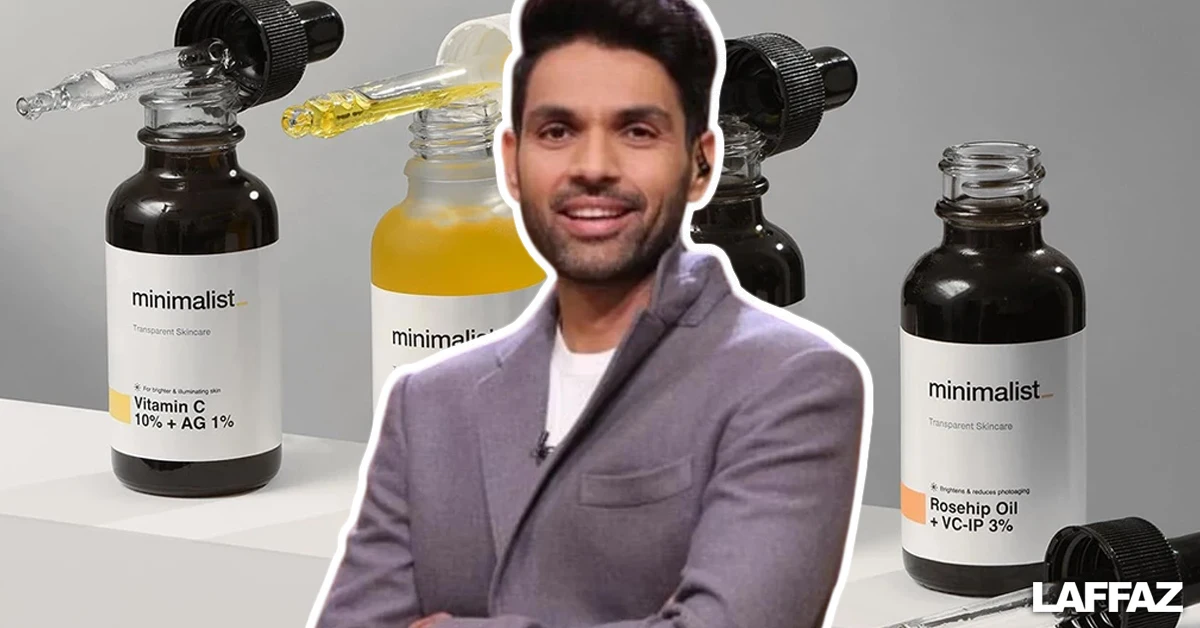
Minimalist called it the #HideNothing philosophy. Active ingredient names and concentrations were printed on the front of every product. Clinical data backed every claim. The Instagram feed looked more like a chemistry class than a beauty campaign.
“Instead of chasing trends or relying on flashy ads, our marketing initiatives are rooted in science-backed information, transparency, and real consumer experiences.” said Mohit Yadav in a conversation with Storyboard about Minimalist’s marketing approach
“Instead of bringing trending products, shouldn’t it be the other way round? Shouldn’t we understand what the consumer wants and then develop products?” Yadav told YourStory
How the Influencer Strategy Actually Worked
Minimalist did use influencers. But the selection logic was fundamentally different from what most Indian brands were doing.
The brand worked with niche skincare creators — Shreya Jain, Shweta Vijay, Tarini Peshawaria, and Jovita George, among them — who had built credibility with audiences specifically interested in skincare science. These were not macro-influencers chasing broad reach. They were trusted voices within a defined, high-intent community. Their followers were already looking for products like Minimalist before the collaboration began.
The distinction matters. A celebrity endorsement buys visibility across a diffuse audience, most of whom have no immediate purchase intent. A niche skincare influencer brings the brand directly into a pre-qualified conversation. The conversion economics are structurally different.
Minimalist also worked with dermatologists and skincare experts who added a layer of clinical credibility to the brand’s positioning. This wasn’t influencer marketing as reach play — it was influencer marketing as trust infrastructure.
The Portfolio, Not the Bet
The broader logic maps cleanly onto what marketing professionals have been arguing for years but Indian brand managers have been slow to act on. A single celebrity campaign is a concentrated risk — one face, one narrative, one shot at resonance. A portfolio of niche creators spreads that risk across multiple audiences, allows for real-time testing, and compounds trust over time rather than spending it in a single campaign burst.
Minimalist’s approach demonstrated this at scale. By keeping marketing spend disciplined — approximately 10% of topline — and routing it toward creator-led education rather than billboard-style endorsement, the brand kept customer acquisition costs low while building the kind of loyalty that sustained a 4.7-star rating across thousands of reviews.
The numbers in the broader market support the logic. Micro and nano-influencers in India consistently deliver engagement rates of 3–6%, compared to 1–2% for celebrity and macro-influencer campaigns, according to industry data. For a category like skincare, where purchase decisions are research-driven and trust-dependent, that engagement differential translates directly into conversion.
Also Read: Minimalist Won’t Survive Under HUL, Predicts Bombay Shaving Company CEO Shantanu Deshpande
What HUL Was Actually Buying
The ₹2,955 crore acquisition was not simply a bet on a product portfolio. Hindustan Unilever was buying a brand architecture that its own legacy stable could not replicate quickly — a brand trusted by the exact consumer cohort it had been struggling to reach: urban, 22–35, digitally native, and deeply sceptical of traditional advertising.
Minimalist had built that trust without a single Bollywood face. It had done so by treating the consumer as an intelligent adult, by letting creators who shared that consumer’s language carry the message, and by ensuring that every product claim could withstand scrutiny.
That is an asset that cannot be manufactured through a celebrity contract. It has to be earned, creator by creator, honest review by honest review, over years of showing up in the right conversations.
The Indian D2C beauty market is projected to grow at a 36.4% CAGR through 2032. As that market matures, the brands that will be acquisition targets — the ones that command the kind of multiples Minimalist commanded — will be the ones that built genuine trust architectures, not the ones that paid the biggest faces to smile on their packaging.
Two brothers from Rajasthan, working without a single celebrity, built the proof of concept. The exit speaks for itself.